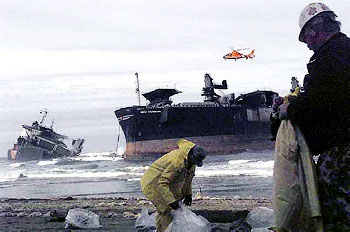
 An On-Scene Coordinator (OSC) acts as the leader for response activities. In the coastal areas of the United States, USCG serves as the OSC for oil spill responses. In inland areas, including rivers and other inland waters, EPA generally takes the lead.
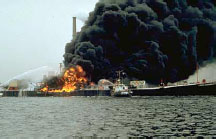 Volunteers frequently participate in marine oil spill response, but Federal OSHA standards do not cover uncompensated workers. In states approved to manage their own occupational health and safety program (called OSHA state plan states), volunteers are often covered under state plan HAZWOPER requirements. In states administered by Federal OSHA, volunteers are covered by the EPA HAZWOPER standard (40 CFR 311). EPA's HAZWOPER standard has identical requirements, but the coverage is different from Federal OSHA standard coverage. The EPA standard covers local and state government employees, both compensated and volunteers.
| Hazardous Chemicals | Adverse Health Effects |
| Benzene (crude oils high in BTEX, benzene, toluene, ethylbenzene, and xylene) | Irritation to eyes, skin, and respiratory system; dizziness; rapid heart rate; headaches; tremors; confusion; unconsciousness; anemia; cancer |
| Benzo(a)pyrene (a polycyclic aromatic hydrocarbon reproductive [see below], formed when oil or gasoline burns) | Irritation to eyes and skin, cancer, possible effects |
| Carbon dioxide (inerting atmosphere, byproduct of combustion) | Dizziness, headaches, elevated blood pressure, rapid heart rate, loss of consciousness asphyxiation, coma |
| Carbon monoxide (byproduct of combustion) Irritation to eyes, skin, and respiratory | Dizziness, confusion, headaches, nausea, weakness, loss of consciousness, asphyxiation, coma |
| Ethyl benzene (high in gasoline) | Irritation to eyes, skin, and respiratory system; loss of consciousness; asphyxiation; nervous system effects |
| Hydrogen sulfide (oils high in sulfur, decaying plants and animals) | Irritation to eyes, skin, and respiratory system; dizziness; drowsiness; cough; headaches; nervous system effects |
| Methyl tert-butyl ether (MTBE) (octane booster and clean air additive for gasoline, or pure MTBE) | Irritation to eyes, skin, and respiratory system; headaches; nausea; dizziness; confusion; fatigue; weakness; nervous system, liver, and kidney |
| Polycyclic aromatic hydrocarbons (PAHs) (occur in crude oil, and formed during burning of oil) | Irritation to eyes and skin, cancer, possible reproductive effects, immune system effects |
| Sulfuric acid (byproduct of combustion of sour petroleum product) | Irritation to eyes, skin, teeth, and upper respiratory system; severe tissue burns; cancer |
| Toluene (high BTEX crude oils) | Irritation to eyes, skin, respiratory system; fatigue; confusion; dizziness; headaches; memory loss; nausea; nervous system, liver, and kidney effects |
| Xylenes (high BTEX crude oils) | Irritation to eyes, skin, respiratory system; dizziness; confusion; change in sense of balance; nervous system gastrointestinal system, liver, kidney, and blood effects |
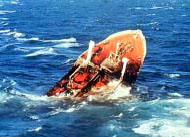 Because workers need to be trained before they respond, you should train your emergency response workers to the highest level of responsibility they might need to assume. You should train your cleanup workers to the highest exposure conditions they may encounter. You must never expect or allow your workers to perform an emergency response or cleanup operation without proper training and certification.
| What action will the worker be assigned in the emergency response? | |||||
| Incident Commander On-Scene Coordinators Supervisors | Active Response: Taking action at the source Stopping the release | Defensive Response: Containing at a distance people, property, and environment at a safe distance | Initiate Response Only: Notifying Authorities | Skilled Support: Usually not a response team employee Immediate, short-term, intervention only. | Specialist Employee: Providing echnical assistance to individual in charge |
| Incident Commander 1910.120(q)(6)(v) ______________ 24 hours + Demonstrated Competencies + Annual Refresher Table 2: Incident Commander |
Hazardous Materials Technician or Specialist 1910.120(q)(6)(iii) or (v) ______________ 24 hours + Demonstrated Competencies + Annual Refresher Table 2: Active Response |
First-Responder Operations Level 1910.120(q)(6)(ii) ______________ 8 hours + Demonstrated Competencies + Annual Refresher Table 2: Defensive Response |
First-Responder Awareness Level 1910.120(q)(6)(i) ______________ Hours Sufficient to Demonstrated Competencies + Annual Refresher Table 2: Initiate Response |
Skilled Support Personnel 1910.120(q)(4) ______________ Spill Site Briefing Only Table 2: Skilled Support |
Specialist Employee 1910.120(q)(5) ______________ Demonstrate Competencies in Specialization Annually Table 2: Specialist Employee |
| Will the worker participate in post-emergency response cleanup? | No --> | No futher training required | |||
| Yes | |||||
| Will the worker be exposed to oil or other hazardous substances? Yes |
No --> | Spill site briefing. Training under other OSHA standards may be required (see Appendix A) | ||||
| Is the worker's experience and/or training equivalent to the appropriate training below?* No |
Yes --> | No futher training required; employer must document equivalency per 1910.120 (e)(9) Site-specific traing is required | ||||
| Will the worker face ANY of the following: Exposures above Permissible/ Published Limits? Repirators Needed? Potential for Emergency to Develop? | ||||||
| Yes | No | |||||
| No | Manager? | Yes | No | Manager? | Yes | |
General Spill Site Worker 1910.120(e)(3)(i) ______________ • 40 hours initial
Table 3:• 24 hours field • 8 hours annual refresher Moderate-High Exposure |
Managers/ Supervisors 1910.120(e)(4) ______________ 40 hours initial
Table 3:24 hours field 8 hours manager 8 hours annual refresher Moderate-High Exposure |
Workers Unlikely to Be Exposed Above Limits** 1910.120(e)(3)(ii), (e)(3)(iii) ______________ • 24 hours initial**
Table 3:• 8 hours field • 8 hours annual refresher Low Exposure |
Managers/ Supervisors of Workers Unlikely to Be Exposed Above Limits 1910.120(e)(4) ______________ • 24 hours initial
Table 3:• 8 hours field • 8 hours manager • 8 hours annual refresher Low Exposure |
|||
| Job Function Examples | Minimum Training & Experience | |
| Incident Commander | - On-Scene Coordinators - On-Scene Coordinator Representatives - On-Scene Industry Representatives - ICS Operations Section Chief - ICS Site Safety Enforcement Personnel - Supervisors/Managers - ICS Safety Officer - ICS Group Supervisors |
As shown on Figure 1 24 hours initial emergency response training covering areas 25-36 AND competency in areas 1-6 Annual refresher training or annual demonstration of competency, ensuring competencies in areas 25-36 and 1-6 |
| Active Response | - Work close to flammable/combustible liquids such as in a pumping operation - Work in confined or enclosed spaces containing volatile oil - Underwater free-floating oil removal - Soil/sand subsurface oil assessment - Plugging holes/emergency repairs to source - Diving operations close to source - Work adjacent to volatile fuel during initial spill hours (boat operations, etc.) - Site characterization of chemical exposures, air monitoring/sampling - Soil investigation/sampling - Dispersant application and monitoring operations - In-situ burn and monitoring operations - Application of herding agents/emulsion breakers - Marine chemist activities - Salvage response - Booming operations at source - Vessel damage assessment - Accident investigation - Firefighting response |
As shown on Figure 1 Technician Level [(q)(6)(iii)]: • 24 hours initial emergency response training covering areas 25-36 AND competency in areas 7-15 • Annual refresher training or annual demonstration of competency, ensuring competencies in areas 25-36 and 7-15 OR Specialist Level [(q)(6)(iv)]: • 24 hours initial emergency response training covering areas 7-15 and 25-36 AND competency in areas 16-24 • Annual refresher training or annual demonstration of competency, ensuring competencies in areas 7-36 |
| Defensive Response | - Booming operations at a safe distance* - Surface level shoreline impact assessment - Manual pickup and removal of irritant oil and oily debris for oils that could be re-released into environment - Damming/diking at a safe distance - Loading of oil into receptacles at a safe distance - Emergency medical personnel (if working in contaminated areas) - Staging area managers - Vacuum truck operations at a safe distance - Security operations - Safety zone enforcement - Skimmer/boat operations at a safe distance |
As shown on Figure 1 • 8 hours initial emergency response training covering areas 31-36 AND competency in areas 25-30 • Annual refresher training or annual demonstration of competency, ensuring competencies in areas 25-36 |
| Initiate Response | - Crew members who discover a release and alert the proper emergency response personnel - Industry and government watchstanders |
As shown on Figure 1 • Sufficient hours to demonstrate competency in areas 31-36 • Annual refresher training including demonstation of competency in areas 31-36 • Additional training required for post-emergency cleanup activities unless there is no exposure to hazardous substances. See Figure 1 for guidance. |
| Skilled Support | - Immediate, short-term intervention of a specialized nature that cannot be performed by other workers - On-scene resource documentation - Operation of certain equipment such as mechanized digging equipment, cranes, and other hoisting equipment - Aerial assessment - Remote sensing aerial platforms - Photo-documentation - Administrative/finance support |
As shown on Figure 1 • Spill site briefing in areas 55-59 |
| Specialist Employer | - Dispersion modeling personnel - Meteorologist - Analytical chemical/oil specialist - Professional engineer/spill recovery system or shipbuilding specialist |
As shown on Figure 1 • Briefing covering areas 55-59 • Training or demonstrated competency in area of specialization annually |
| Job/Site Characterization | Job Function Examples | Minimum Training & Experience | |
| Moderate-High (At/Above Exposure Limits) | • Unknown oil or unknown hazardous substance mixed with oil • Exposures equal or exceed exposure limits or other published limits • Respiratory protection required • Concentrations at or above 10 percent of the Lower Explosive Limit (LEL) • Oxygen levels ³ 19.5 <22 percent) • Carcinogen: known or suspected • Situations in which oil is known but parameters above cannot be reasonabily assessed |
- Manual cleanup of stranded oil with potential skin carcinogens (e.g., benzo (a) pyrene) - Cleanup of stranded oil when toxic chemicals are persistent and above exposure limits - Wildlife capture and treatment depending on explosives - Load and transfer piled oil-saturated decaying plants and animals that provide a hydrogen sulfide risk - Cleanup of stranded oil in confined spaces - On land marsh burning operations |
• 40 hours of initial training in areas 37-43 and 3 days supervised field experience, or equivalent training certification • At least 8 hours of annual refresher training • Supervisory/management personnel must also receive 8 hours of additional initial training covering at a minimum areas 51-54 |
| Low (Below Exposure Limits) | Routine spill cleanup workers [(e)(3)(iii)]: • Oil and other hazards of spill constituents known • Exposures may cause irritation (skin, eye, respiratory) but are below permissible published limits • Oxygen levels ³ 19.5 <22 percent) • Concentrations less than 10 percent, but more than the LEL • Other significant hazards may be present: Physical, safety, ergonomic, thermal. [(e)(3)(ii)]: • Oil and other hazards of spill constituents known • Exposures below permissible/published limits |
- Pressure washing operations of stranded weathered oil - Cutting of contaminated live vegetation - Natural resource damage assissment - Bioremediation operations - Shoreline cleanup assessment - Vessel/equipment decontamination - Underwater stranded oil removal operations - Soil/sand substance oil removal - Containerized/packaged waste handling and disposal for transport operations |
As shown in Figure 1 • 24 hours of initial training in areas 44-50 and 1 day supervised field experience, or equivalent training • At least 8 hours of annual refresher training • Supervisory management personnel must also receive 8 hours of additional initial training covering at a minimum areas 51-54 |
| Non-Recurring/Minimal Exposure | • Oil and other spill constituents known • Exposures below permission/published limits • Respirators not required • Oxygen levels ³ 19.5 <22 percent) • No potential for chemical emergency, explosion, or fire • Minimal irritants to respiratory system, eyes, or skin • No significant physical, safety, ergonomic, and thermal hazards |
- Workers who do not participate in marine oil spill responses on a frequent recurring basis and who will have minimal exposure - Tarball shoreline cleanup - On scene cost documentation - Operators of large construction vehicles during stranded oil removal |
As footnoted in Figure 1 • If conditions described in CPL 02-02-051 are met, reduced initial training or equivalent training certification covering items 44-50 • Up-to-date training consistent with 1910.38(a) and 1910.1200, and health and safety training associated with assigned tasks Supervisory/management personnel must receive: • At least 24 hours of initial training in areas 44-50 and 1 day of supervised field experience; • 8 hours of additional initial training covering at a minimum areas 51-54; and • 8 hours annual refresher training |
| No Exposure | • Area characterized and stable with: • No potential for exposure to hazardous waste or substances by any route (i.e., inhalation, skin absorption, ingestion No safety hazards associated with hazardous waste or hazardous substances |
- Aerial photo documentation - Command Post support - Food service personel - Legal representation - Over-flight assessment (if no potential for exposure) - Resource tracking (if no potential for exposure) - Financial services personnel - Historians - Press |
As shown in Figure 1 • Briefing covering areas 55-59 |
|
|
|
||||||||||||||||||||||||
|
|
|
||||||||||||||||||||||||
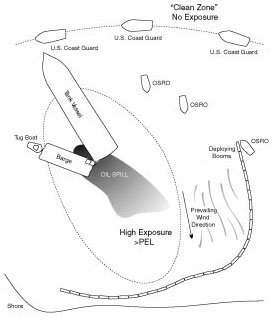 The owner of the barge is located across the country. According to the company's emergency response plan, the owner calls an Oil Spill Removal Organization (OSRO) to clean up the spill. The tug captain is designated by the owner to be the company's representative. Because the owner is not on-scene and does not participate in spill response activities, he is not required to have HAZWOPER training. The tug captain is on-scene making decisions in the response. Therefore, the tug captain must have Incident Commander training for emergency response (Figure 1: Incident Commander).
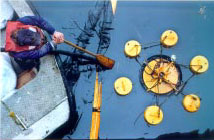 Oil recovery skimmers arrive to skim free-floating oil. Containment boom and skimmer operators work from a boat. These operators wear goggles and protective clothing because the oil could irritate their skin and eyes. Because air concentrations are below permissible limits, operators are not required to wear respirators (Figure 1: First-Responder Operations Level).
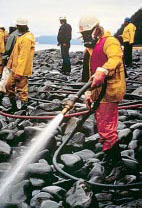 A skimming team recovers oil trapped between the vessels. Vessel personnel in SCBAs measure chemical and oxygen concentrations and the percentage of the lower explosive limit (LEL) for the space between the vessels (Figure 1: Hazardous Materials Technician/Specialist, or Specialist Employee, depending on job duties). Results of the monitoring indicate that workers conducting skimming operations must also be in SCBA. The workers decide to wait until exposure levels register below permissible limits before removing the oil.
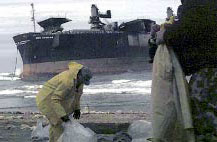 The company's site safety and health plan does not cover the disposal of waste containers. Because of this oversight, oiled debris and waste decay in the containers, releasing hydrogen sulfide. A hazardous materials response team removes the contaminated waste from the containers (Figure 1: General Spill Site Worker). A week has passed. To speed removal of remaining debris on shore, training is offered to a team of local volunteers (Figure 2: Workers unlikely to be exposed above limits, and associated footnote). Trained supervisors (Figure 2: Managers/Supervisors of workers unlikely to be exposed above limits, with training level dependent on anticipated exposures) oversee the volunteers. As shoreline cleanup progresses, shoreline clean-up assessment teams begin to verify that shorelines are clean (Figure 2: Workers unlikely to be exposed above limits).