Good maintenance and repair procedures contribute significantly to the safety of the maintenance crew as well as that of machine operators. The variety and complexity of machines to be serviced, the hazards associated with their power sources, the special dangers that may be present during machine breakdown, and the severe time constraints often placed on maintenance personnel all make safe maintenance and repair work difficult.
Training and aptitude of people assigned to these jobs should make them alert for the intermittent electrical failure, the worn part, the inappropriate noise, the cracks or other signs that warn of impending breakage or that a safeguard has been damaged, altered, or removed. By observing machine operators at their tasks and listening to their comments, maintenance personnel may learn where potential trouble spots are and give them early attention before they develop into sources of accidents and injury. Sometimes all that is needed to keep things running smoothly and safely is machine lubrication or adjustment. Any damage observed or suspected should be reported to the supervisor; if the condition impairs safe operation, the machine should be out of service for repair. Safeguards that are missing, altered, or damaged also should be reported so appropriate action can be taken to insure against worker injury.
If possible, machine design should permit routine lubrication and adjustment without removal of safeguards. But when safeguards must be removed, and the machine serviced, the lockout procedure of 29 CFR 1910.147 must be adhered to. The maintenance and repair crew must never fail to replace the guards before the job is considered finished and the machine released from lockout..
Is it necessary to oil machine parts while a machine is running? If so, special safeguarding equipment may be needed solely to protect the oiler from exposure to hazardous moving parts. Maintenance personnel must know which machines can be serviced while running and which cannot. "If in doubt, lock it out." Obviously, the danger of accident or injury is reduced by shutting off and locking out all sources of energy.
In situations where the maintenance or repair worker would necessarily be exposed to electrical elements or hazardous moving machine parts in the performance of the job, there is no question that all power sources must be shut off and locked out before work begins. Warning signs or tags are inadequate insurance against the untimely energizing of mechanical equipment.
Thus, one of the first procedures for the maintenance person is to disconnect and lock out the machine from all of its power sources, whether the source is electrical, mechanical, pneumatic, hydraulic, or a combination of these. Energy accumulation devices must be "bled down."
Electrical: Unexpected energizing of any electrical equipment that can be started by automatic or manual remote control may cause electric shock or other serious injuries to the machine operator, the maintenance worker, or others operating adjacent machines controlled by the same circuit. For this reason, when maintenance personnel must repair electrically powered equipment, they should open the circuit at the switch box and padlock the switch (lock it out) in the "off" position. This switch should be tagged with a description of the work being done, the name of the maintenance person, and the department involved. When more than one worker is to be engaged in the servicing/maintenance function a typical lockout hasp to which each may affix a personal lock is shown in Figure 69.
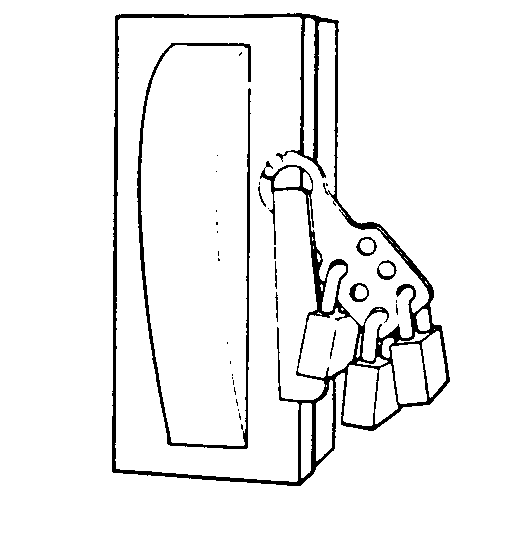
Figure 69. Lockout hasp
Mechanical: Figure 70 shows safety blocks being used as an additional safeguard on a mechanical power press, even though the machine has been locked out. The safety blocks prevent the ram from coming down under its own weight.
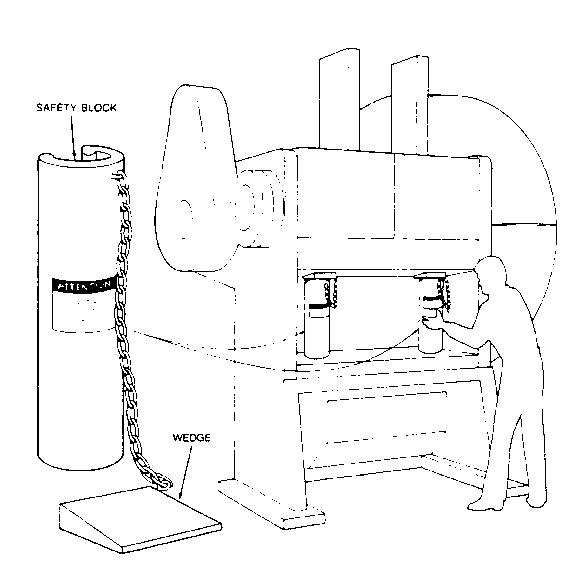
Figure 70. Safety blocks installed on power press
Pneumatic and hydraulic: Figure 71 shows a lockout valve. The lever-operated air valve used during repair or shutdown to keep a pneumatic-powered machine or its components from operating can be locked open or shut. Before the valve can be opened, everyone working on the machine must use his or her own key to release the lockout. A sliding-sleeve valve exhausts line pressure at the same time it cuts off the air supply. Valves used to lock out pneumatic or hydraulic-powered machines should be designed to accept locks or lockout adapters and should be capable of "bleeding off" pressure residues that could cause any part of the machine to move.
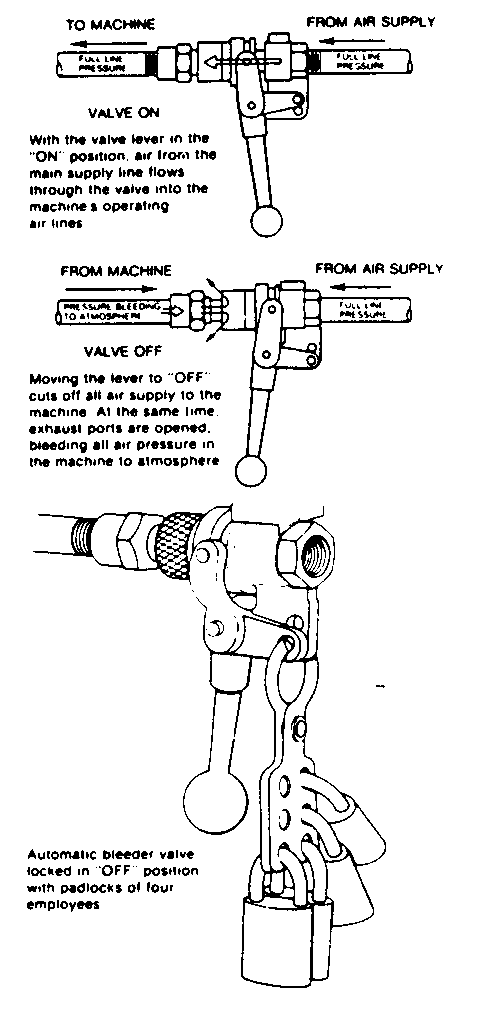
Figure 71. Lockout valve
In shops where several maintenance persons might be working on the same machine, multiple lockout devices accommodating several padlocks are used. The machine cannot be reactivated until each person removes his or her lock. As a matter of general policy, lockout control is gained by the procedure of issuing personal padlocks to each maintenance or repair person; no one but that person can remove the padlock, thereby each worker controls the power systems.
Whenever machines or equipment are serviced, there are hazards encountered by the employees performing the servicing or maintenance which are unique to the repair or maintenance procedures being conducted. These hazards may exist due to the failure of the employees doing the servicing or maintenance to stop the machine being worked on. Even if the machine has been stopped, the machine can still be hazardous due to the possibility of the machine becoming reenergized or restarting.
In order to prevent these hazards, each machine or piece of equipment should be safeguarded during the conduct of servicing or maintenance by: (1) notifying all affected employees (usually machine or equipment operators or users) that the machine or equipment must be shut down to perform some maintenance or servicing; (2) stopping the machine; (3) isolating the machine or piece of equipment from its energy source; (4) locking out or tagging out the energy source; (5) relieving any stored or residual energy; and (6) verifying that the machine or equipment is isolated from the energy source. Although this is the general rule, there are exceptions when the servicing or maintenance is not hazardous for an employee, when the servicing which is conducted is minor in nature, done as an integral part of production, and the employer utilizes alternative safeguards which provide effective protection as is required by 29 CFR 1910.212 or other specific OSHA standards.
When the servicing or maintenance is completed, there are specific steps which must be taken to return the machine or piece of equipment to service. These steps include (1) inspection of the machine or equipment to ensure that all guards and other safety devices are in place and functional, (2) checking the area to ensure that energization and start up of the machine or equipment will not endanger employees, (3) removal of the lockout devices, (4) reenergization of the machine or equipment, and (5) notification of affected employees that the machine or equipment may be returned to service.
The steps to lockout described above are only a part of the total energy control program which must exist in the workplace. In addition, the employee should have written procedures for all machines and equipment, employees must be trained in their duties and responsibilities under the energy control program and periodic inspections must be conducted to maintain the effectiveness of the program.
Figure 72 provides a functional flow diagram of the functions necessary during the conduct of a viable servicing/maintenance operation during which the equipment must be isolated and locked out.
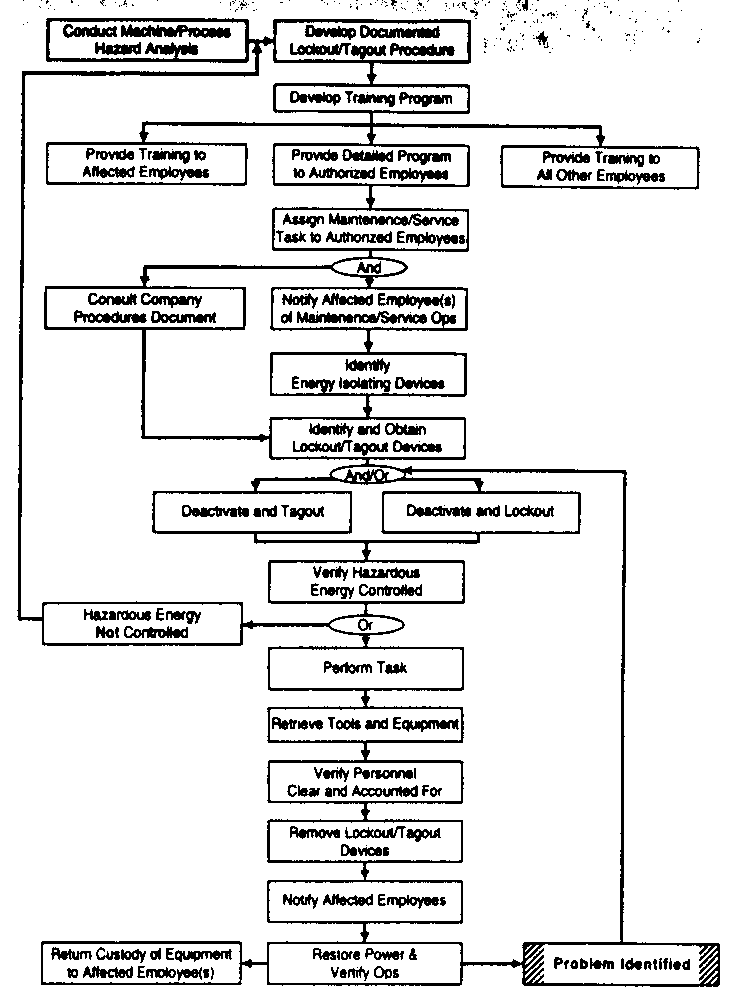
Figure 72. Functional flow diagram for implementation of lockout/tagout requirements
The maintenance and repair facility in the plant deserves consideration here. Are all the right tools on hand and in good repair? Are lubricating oils and other common supplies readily available and safely stored? Are commonly used machine parts and hardware kept in stock so that the crews are not encouraged (even obliged) to improvise, at the risk of doing an unsafe repair, or to postpone a repair job? And don't overlook the possibility that maintenance equipment itself may need guarding of some sort. The same precaution applies to tools and machines used in the repair shop. Certainly, the maintenance and repair crew are entitled to the same protection that their service provides to the machine operators in the plant.
 Chapter 5