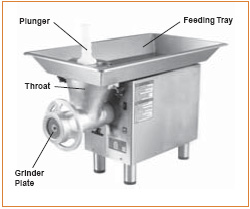
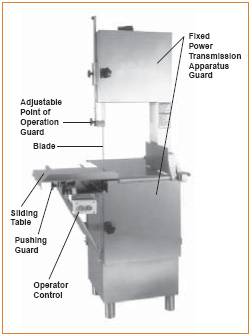
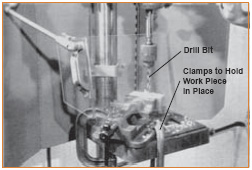
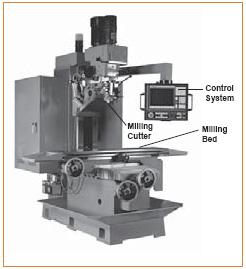
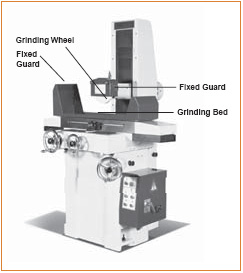
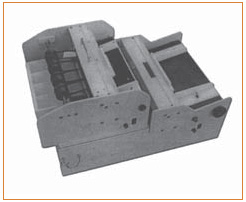
| Types of Machine Guards |
| Type |
Safeguarding Action |
Advantages |
Limitations |
| Fixed |
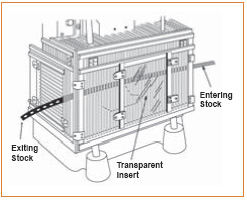
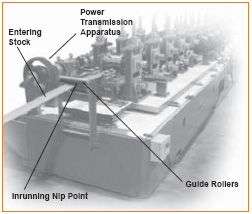
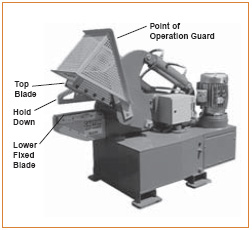
Barrier that allows for stock feeding but does not permit operator to reach the danger area. |
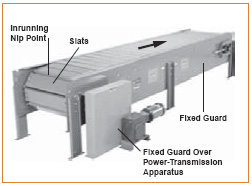
* Can be constructed to suit many applications.
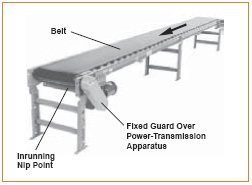
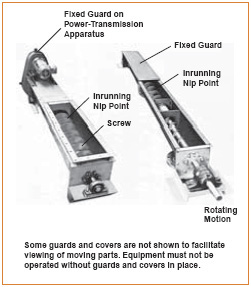
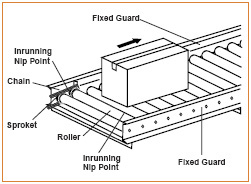
* Permanently encloses the point of operation or hazard area.
* Provides protection against machine repeat.
* Allows simple, in-plant construction, with minimal maintenance. |
* Sometimes not practical for changing production runs involving different size stock or feeding methods
* Machine adjustment and repair often require guard removal.
* Other means of protecting maintenance personnel often required (lockout/ tagout). |
| Adjustable |
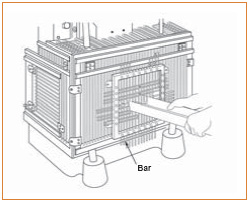
Barrier that adjusts for a variety of production operations. |
* Can be constructed to suit many applications.
* Can be adjusted to admit varying stock sizes. |
* May require frequent maintenance or adjustment.
* Operator may make guard ineffective. |
| Self-Adjusting |
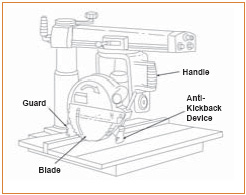
Barrier that moves according to the size of the stock entering point of operation. Guard is in place when machine is at rest and pushes away when stock enters the point of operation. |
* Off-the-shelf guards are often commercially available. |
* Does not provide maximum protection.
* May require frequent maintenance and adjustment. |
| Interlocking |
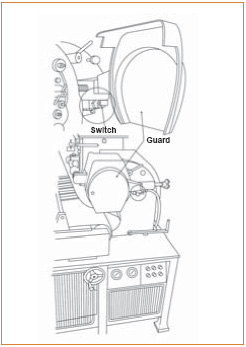
Shuts off or disengages power and prevents machine start-up when guard is open. Should allow for inching of machine. Replacing the guard should not automatically restart the machine. |
* Allows access for machine set-up, adjustment, or jam removal without time-consuming removal of fixed guards when used with hand tools or safety blocks. |
* May require periodic maintenance or adjustment.
* Movable sections cannot be used for manual feeding.
* Some designs may be easy to defeat. |
| Types of Machine Devices
|
| Type |
Method of Safeguarding |
Advantages |
Limitations |
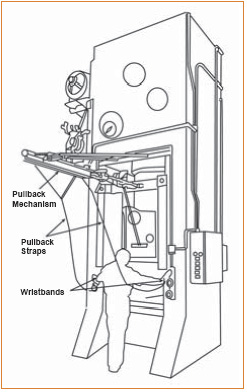
| Pullback Devices |
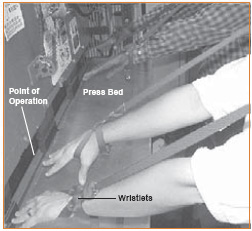
Cords connected to operator's wrists and linked mechanically to the machine automatically withdraw the hands from the point of operation during the machine cycle. |
* Allows the hands to enter the point of operation for feeding and removal.
* Provides protection even in the event of mechanical repeat. |
* Close supervision ensures proper use and adjustment. Must be inspected prior to each operator change or machine set-up.
* Limits operator's movement and may obstruct their work space.
* Operator may easily make device ineffective by not adjusting the device properly. |
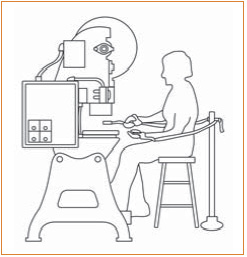
| Restraint Devices |
Wrists are connected by cords and secured to a fixed anchor point which limit operator's hands from reaching the point of operation at any time. |
* Simple, few moving parts; requires little maintenance.
* Operator cannot reach into the danger area.
* Little risk of mechanical failure; provides protection even in the event of mechanical repeat. |
Close supervision required to ensure proper use and adjustment. Must be inspected prior to each operator change or machine set-up.
* Operator must use hand tools to enter the point of operation.
* Limits the movement of the operator; may obstruct work space around operator.
* Operator may easily make device ineffective by disconnecting the device. |
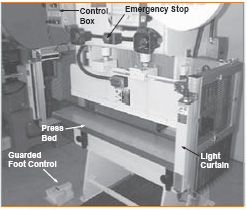
| Presence-Sensing Devices |
Interlock into the machine's control system to stop operation when the sensing field (photoelectric, radio frequency, or electromagnetic) is disturbed. |
* Adjusts to fit different stock sizes. * Allows access to load and unload the machine. * Allows access to the guarded area for maintenance and set-up activities. |
* Restricted to machines that stop operating cycle before operator can reach into danger area (e.g., machines with partial revolution clutches or hydraulic machines). * Must be carefully maintained and adjusted. * Does not protect operator in the event of a mechanical failure. * Operator may make device ineffective. |
| Presence-Sensing Mats |
Interlock into machine's control system to stop operation when a predetermined weight is applied to the mat. A manual reset switch must be located outside the protected zone. |
* Full visibility and access to the work area. * Install as a perimeter guard or over an entire area. * Configure for many applications. |
* Restricted to machines that stop operating cycle before operator can reach into danger area (e.g., machines with part-revolution clutches or hydraulic machines). * Some chemicals can degrade the mats. * Does not protect operator during mechanical failures. |
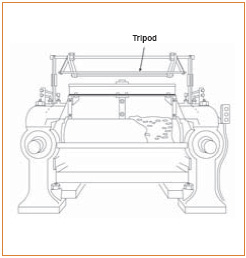
| Safety Trip Controls (pressure-sensitive body bar, safety triprod, safety tripwire) |
Stops machine when tripped. |
* Simple to use. |
* Must be manually activated.
* May be difficult to activate due to location.
* Protects operator only.
* May require a machine brake. |
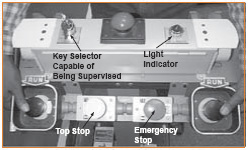
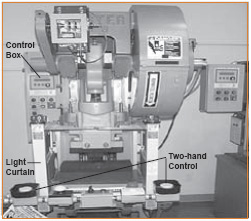
| Two-Hand Control |
Requires concurrent and continued use of both hands, preventing them from entering the danger area. |
* Operator's hands are at a predetermined location.
* Operator's hands are free to pick up new parts after completion of first part of cycle. |
* Requires a partial cycle machine with a brake and anti-repeat feature.
* Operator may make devices without anti-tiedown ineffective.
* Protects the operator only. |
| Two-Hand Trip |
Requires concurrent use of both hands, prevents them from being in danger area when machine cycle starts. |
* Operator's hands are at a predetermined location.
* Can be adapted to multiple operations.
* No obstruction to hand feeding. |
* Operator may make devices without antitiedown ineffective.
* Protects the operator only.
* Sometimes impractical because distance requirements may reduce production below acceptable level.
* May require adjustment if tooling changes.
* Requires anti-repeat feature. |
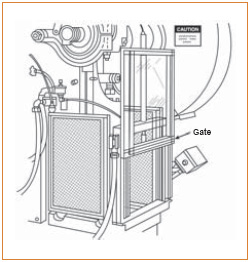
| Type "A" Gate (moveable barrier) |
Applicable to mechanical power presses. Provides barrier between danger area and operator (or other workers) until completion of machine cycle. |
* Prevents operator from reaching into danger area during machine cycle.
* Provides protection from machine repeat. |
* May require frequent inspection and regular maintenance.
* May interfere with operator's ability to see work. |
| Type "B" Gate (moveable barrier) |
Applicable to mechanical power presses and press brakes. Provides a barrier between danger area and operator (or other workers) during the downstroke. |
* May increase production by allowing the operator to remove and feed the press on the upstroke. |
* Can only be used on machines with a part-revolution clutch or hydraulic machines.
* May require frequent inspection and regular maintenance.
* May interfere with the operator's ability to see work. |