This informational booklet provides a general overview of a particular topic related to OSHA standards. It does not alter or determine compliance responsibilities in OSHA standards or the Occupational Safety and Health Act of 1970. Because interpretations and enforcement policy may change over time, you should consult current OSHA administrative interpretations and decisions by the Occupational Safety and Health Review Commission and the Courts for additional guidance on OSHA compliance requirements.
This publication is in the public domain and may be reproduced, fully or partially, without permission. Source credit is requested but not required.
This information is available to sensory impaired individuals upon request.
Voice phone: (202) 693-1999; teletypewriter (TTY) number: (877) 889-5627.Contents
Introduction
General Requirements
Rules for Ladders
All Ladders
Specific Types of Ladders
Stepladders
Portable Ladders
Fixed Ladders
Cages for Fixed Ladders
Wells for Fixed Ladders
Ladder Safety Devices and Related Support Systems for Fixed Ladders
Requirements for Mounting Ladder Safety Devices for Fixed Ladders
Defective Ladders
Rules for Stairways
Stairways Used During Construction
Temporary Stairs
Stair Rails
Handrails
Midrails
Training Requirements
Glossary
OSHA Assistance
Safety and Health Program Management Guidelines
State Programs
Consultation Services
Voluntary Protection Programs (VPP)
Strategic Partnership Program
Alliance Program
Training and Education
Electronic Information
OSHA Publications
Emergencies, Complaints or Further Assistance
OSHA Regional OfficesIntroduction
Working on and around stairways and ladders is hazardous. Stairways and ladders are major sources of injuries and fatalities among construction workers for example, and many of the injuries are serious enough to require time off the job. OSHA rules apply to all stairways and ladders used in construction, alteration, repair, painting, decorating and demolition of worksites covered by OSHA's construction safety and health standards.General Requirements
These rules specify when employers must provide stairways and ladders. In general, the standards require the following:
When there is a break in elevation of 19 inches (48 cm) or more and no ramp, runway, embankment or personnel hoist is available, employers must provide a stairway or ladder at all worker points of access.
When there is only one point of access between levels, employers must keep it clear of obstacles to permit free passage by workers. If free passage becomes restricted, employers must provide a second point of access and ensure that workers use it.
When there are more than two points of access between levels, employers must ensure that at least one point of access remains clear.
In addition, employers must install all stairway and ladder fall protection systems required by these rules and ensure that their worksite meets all requirements of the stairway and ladder rules before employees use stairways or ladders. See 29 CFR 1926.1050-1060 for the details of the standard.
Note: The standard does not apply to ladders specifically manufactured for scaffold access and egress, but does apply to job-made and manufactured portable ladders intended for general purpose use. Rules for ladders used on or with scaffolds are addressed in 29 CFR 1926.451 Subpart L.Rules for Ladders
All Ladders
The following rules apply to all ladders:
Maintain ladders free of oil, grease and other slipping hazards.
Do not load ladders beyond their maximum intended load nor beyond their manufacturer's rated capacity.
Use ladders only for their designed purpose.
Use ladders only on stable and level surfaces unless secured to prevent accidental movement.
Do not use ladders on slippery surfaces unless secured or provided with slip-resistant feet to prevent accidental movement. Do not use slipresistant feet as a substitute for exercising care when placing, lashing or holding a ladder upon slippery surfaces.
Secure ladders placed in areas such as passageways, doorways or driveways, or where they can be displaced by workplace activities or traffic to prevent accidental movement. Or use a barricade to keep traffic or activity away from the ladder.
Keep areas clear around the top and bottom of ladders.
Do not move, shift or extend ladders while in use.
Use ladders equipped with nonconductive side rails if the worker or the ladder could contact exposed energized electrical equipment.
Face the ladder when moving up or down.
Use at least one hand to grasp the ladder when climbing.
Do not carry objects or loads that could cause loss of balance and falling.
In addition, the following general requirements apply to all ladders, including ladders built at the jobsite:
Double-cleated ladders or two or more ladders must be provided when ladders are the only way to enter or exit a work area where 25 or more employees work or when a ladder serves simultaneous two-way traffic.
Ladder rungs, cleats and steps must be parallel, level and uniformly spaced when the ladder is in position for use.
Rungs, cleats and steps of portable and fixed ladders (except as provided below) must not be spaced less than 10 inches (25 cm) apart, nor more than 14 inches (36 cm) apart, along the ladder's side rails.
Rungs, cleats and steps of step stools must not be less than 8 inches (20 cm) apart, nor more than 12 inches (31 cm) apart, between center lines of the rungs, cleats and steps.
Rungs, cleats and steps at the base section of extension trestle ladders must not be less than 8 inches (20 cm) nor more than 18 inches (46 cm) apart, between center lines of the rungs, cleats and steps. The rung spacing on the extension section must not be less than 6 inches (15 cm) nor more than 12 inches (31 cm).
Ladders must not be tied or fastened together to create longer sections unless they are specifically designed for such use.
When splicing side rails, the resulting side rail must be equivalent in strength to a one-piece side rail made of the same material.
Two or more separate ladders used to reach an elevated work area must be offset with a platform or landing between the ladders, except when portable ladders are used to gain access to fixed ladders.
Ladder components must be surfaced to prevent snagging of clothing and injury from punctures or lacerations.
Wood ladders must not be coated with any opaque covering except for identification or warning labels, which may be placed only on one face of a side rail.
Note: A competent person must inspect ladders for visible defects periodically and after any incident that could affect their safe use.
Specific Types of Ladders
Do not use single-rail ladders.
Use non-self-supporting ladders at an angle where the horizontal distance from the top support to the foot of the ladder is approximately one-quarter of the working length of the ladder.
Use wooden ladders built at the jobsite with spliced side rails at an angle where the horizontal distance is one-eighth of the working length of the ladder.
In addition, the top of a non-self-supporting ladder must be placed with two rails supported equally unless it is equipped with a single support attachment.
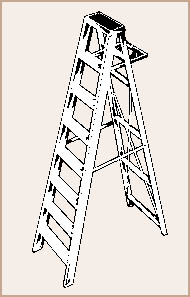
Stepladders
Do not use the top or top step of a stepladder as a step.
Do not use cross bracing on the rear section of stepladders for climbing unless the ladders are designed and provided with steps for climbing on both front and rear sections.
Metal spreader or locking devices must be provided on stepladders to hold the front and back sections in an open position when ladders are being used.
Portable Ladders
The minimum clear distance between side rails for all portable ladders must be 11.5 inches (29 cm).
In addition, the rungs and steps of portable metal ladders must be corrugated, knurled, dimpled, coated with skid-resistant material or treated to minimize slipping.
Non-self-supporting and self-supporting portable ladders must support at least four times the maximum intended load; extra heavy-duty type 1A metal or plastic ladders must sustain 3.3 times the maximum intended load. To determine whether a self-supporting ladder can sustain a certain load, apply the load to the ladder in a downward vertical direction with the ladder placed at a horizontal angle of 75.5 degrees.
When portable ladders are used for access to an upper landing surface, the side rails must extend at least 3 feet (.9 m) above the upper landing surface. When such an extension is not possible, the ladder must be secured and a grasping device such as a grab rail must be provided to assist workers in mounting and dismounting the ladder. A ladder extension must not deflect under a load that would cause the ladder to slip off its supports.
Fixed Ladders
If the total length of the climb on a fixed ladder equals or exceeds 24 feet (7.3 m), the ladder must be equipped with ladder safety devices; or self-retracting lifelines and rest platforms at intervals not to exceed 150 feet (45.7 m); or a cage or well and multiple ladder sections with each ladder section not to exceed 50 feet (15.2 m) in length. These ladder sections must be offset from adjacent sections and landing platforms must be provided at maximum intervals of 50 feet (15.2 m). In addition, fixed ladders must meet the following requirements:
Fixed ladders must be able to support at least two loads of 250 pounds (114 kg) each, concentrated between any two consecutive attachments. Fixed ladders also must support added anticipated loads caused by ice buildup, winds, rigging and impact loads resulting from using ladder safety devices.
Individual rung/step ladders must extend at least 42 inches (1.1 m) above an access level or landing platform either by the continuation of the rung spacings as horizontal grab bars or by providing vertical grab bars that must have the same lateral spacing as the vertical legs of the ladder rails.
Each step or rung of a fixed ladder must be able to support a load of at least 250 pounds (114 kg) applied in the middle of the step or rung.
Minimum clear distance between the sides of individual rung/step ladders and between the side rails of other fixed ladders must be 16 inches (41 cm).
Rungs of individual rung/step ladders must be shaped to prevent slipping off the end of the rungs.
Rungs and steps of fixed metal ladders manufactured after March 15, 1991, must be corrugated, knurled, dimpled, coated with skid-resistant material or treated to minimize slipping.
Minimum perpendicular clearance between fixed ladder rungs, cleats, and steps and any obstruction behind the ladder must be 7 inches (18 cm), except that the clearance for an elevator pit ladder must be 4.5 inches (11 cm).
Minimum perpendicular clearance between the centerline of fixed ladder rungs, cleats and steps, and any obstruction on the climbing side of the ladder must be 30 inches (76 cm). If obstructions are unavoidable, clearance may be reduced to 24 inches (61 cm), provided a deflection device is installed to guide workers around the obstruction.
Step-across distance between the center of the steps or rungs of fixed ladders and the nearest edge of a landing area must be no less than 7 inches (18 cm) and no more than 12 inches (30 cm). A landing platform must be provided if the step-across distance exceeds 12 inches (30 cm).
Fixed ladders without cages or wells must have at least a 15-inch (38 cm) clearance width to the nearest permanent object on each side of the centerline of the ladder.
Fixed ladders must be provided with cages, wells, ladder safety devices or self-retracting lifelines where the length of climb is less than 24 feet (7.3 m) but the top of the ladder is at a distance greater than 24 feet (7.3 m) above lower levels.
Side rails of through or side-step fixed ladders must extend 42 inches (1.1 m) above the top level or landing platform served by the ladder. Parapet ladders must have an access level at the roof if the parapet is cut to permit passage through it. If the parapet is continuous, the access level is the top of the parapet.
Steps or rungs for through-fixed-ladder extensions must be omitted from the extension; and the extension of side rails must be flared to provide between 24 inches (61 cm) and 30 inches (76 cm) clearance between side rails.
When safety devices are provided, the maximum clearance distance between side rail extensions must not exceed 36 inches (91 cm).
Fixed ladders must be used at a pitch no greater than 90 degrees from the horizontal, measured from the back side of the ladder.
Cages for Fixed Ladders
The requirements for cages for fixed ladders are as follows:
Horizontal bands must be fastened to the side rails of rail ladders or directly to the structure, building or equipment for individual-rung ladders.
Vertical bars must be on the inside of the horizontal bands and must be fastened to them.
Cages must not extend less than 27 inches (68 cm), or more than 30 inches (76 cm) from the centerline of the step or rung and must not be less than 27 inches (68 cm) wide.
Insides of cages must be clear of projections.
Horizontal bands must be spaced at intervals not more than 4 feet (1.2 m) apart measured from centerline to centerline.
Vertical bars must be spaced at intervals not more than 9.5 inches (24 cm), measured centerline to centerline.
Bottoms of cages must be between 7 feet (2.1 m) and 8 feet (2.4 m) above the point of access to the bottom of the ladder. The bottom of the cage must be flared not less than 4 inches (10 cm) between the bottom horizontal band and the next higher band.
Tops of cages must be a minimum of 42 inches (1.1 m) above the top of the platform or the point of access at the top of the ladder. There must be a way to access the platform or other point of access.
Wells for Fixed Ladders
The requirements for wells for fixed ladders are as follows:
Wells must completely encircle the ladder.
Wells must be free of projections.
Inside faces of wells on the climbing side of the ladder must extend between 27 inches (68 cm) and 30 inches (76 cm) from the centerline of the step or rung.
Inside widths of wells must be at least 30 inches (76 cm).
Bottoms of wells above the point of access to the bottom of the ladder must be between 7 feet (2.1 m) and 8 feet (2.4 m).
Ladder Safety Devices and Related Support Systems for Fixed Ladders
The connection between the carrier or lifeline and the point of attachment to the body belt or harness must not exceed 9 inches (23 cm) in length. In addition, ladder safety devices and related support systems on fixed ladders must conform to the following:
All safety devices must be able to withstand, without failure, a drop test consisting of a 500-pound weight (226 kg) dropping 18 inches (41 cm).
All safety devices must permit the worker to ascend or descend without continually having to hold, push or pull any part of the device, leaving both hands free for climbing.
All safety devices must be activated within 2 feet (.61 m) after a fall occurs and limit the descending velocity of an employee to 7 feet/second (2.1 m/sec) or less.
Requirements for Mounting Ladder Safety Devices for Fixed Ladders
The requirements for mounting ladder safety devices for fixed ladders are as follows:
Mountings for rigid carriers must be attached at each end of the carrier, with intermediate mountings spaced along the entire length of the carrier, to provide the necessary strength to stop workers' falls.
Mountings for flexible carriers must be attached at each end of the carrier. Cable guides for flexible carriers must be installed with a spacing between 25 feet (7.6 m) and 40 feet (12.2 m) along the entire length of the carrier, to prevent wind damage to the system.Design and installation of mountings and cable guides must not reduce the strength of the ladder.
Side rails and steps or rungs for side-step fixed ladders must be continuous in extension.
Defective Ladders
Ladders needing repairs are subject to the following rules:
Portable ladders with structural defects- such as broken or missing rungs, cleats or steps, broken or split rails, corroded components or other faulty or defective components- must immediately be marked defective or tagged with "Do Not Use" or similar language and withdrawn from service until repaired.
Fixed ladders with structural defects- such as broken or missing rungs, cleats or steps, broken or split rails or corroded components- must be withdrawn from service until repaired.
Defective fixed ladders are considered withdrawn from use when they are immediately tagged with "Do Not Use" or similar language, or marked in a manner that identifies them as defective, or blocked- such as with a plywood attachment that spans several rungs.
Ladder repairs must restore the ladder to a condition meeting its original design criteria before the ladder is returned to use.
Rules for Stairways
The rules covering stairways and their components generally depend on how and when stairs are used. Specifically, there are rules for stairs used during construction and stairs used temporarily during construction, as well as rules governing stair rails and handrails.
Stairways Used During Construction
The following requirements apply to all stairways used during construction:
Stairways that will not be a permanent part of the building under construction must have landings at least 30 inches deep and 22 inches wide (76 x 56 cm) at every 12 feet (3.7 m) or less of vertical rise.
Stairways must be installed at least 30 degrees- and no more than 50 degrees- from the horizontal.
Variations in riser height or stair tread depth must not exceed 1/4 inch in any stairway system, including any foundation structure used as one or more treads of the stairs.
Doors and gates opening directly onto a stairway must have a platform that extends at least 20 inches (51 cm) beyond the swing of the door or gate.
Metal pan landings and metal pan treads must be secured in place before filling.
Stairway parts must be free of dangerous projections such as protruding nails.
Slippery conditions on stairways must be corrected.
Workers must not use spiral stairways that will not be a permanent part of the structure.
Temporary Stairs
The following requirements apply to stairways used temporarily during construction.
Except during construction of the stairway,
Do not use stairways with metal pan landings and treads if the treads and/or landings have not been filled in with concrete or other materials unless the pans of the stairs and/or landings are temporarily filled in with wood or other materials. All treads and landings must be replaced when worn below the top edge of the pan.
Do not use skeleton metal frame structures and steps (where treads and/or landings will be installed later) unless the stairs are fitted with secured temporary treads and landings.
Note: Temporary treads must be made of wood or other solid material and installed the full width and depth of the stair.
Stair Rails
The following general requirements apply to all stair rails:
Stairways with four or more risers or rising more than 30 inches (76 cm) in height- whichever is less- must be installed along each unprotected side or edge. When the top edge of a stair rail system also serves as a handrail, the height of the top edge must be no more than 37 inches (94 cm) nor less than 36 inches (91.5 cm) from the upper surface of the stair rail to the surface of the tread.
Stair rails installed after March 15,1991, must be not less than 36 inches (91.5 cm) in height.
Top edges of stair rail systems used as handrails must not be more than 37 inches (94 cm) high nor less than 36 inches (91.5 cm) from the upper surface of the stair rail system to the surface of the tread. (If installed before March 15, 1991, not less than 30 inches [76 cm]).
Stair rail systems and handrails must be surfaced to prevent injuries such as punctures or lacerations and to keep clothing from snagging.
Ends of stair rail systems and handrails must be built to prevent dangerous projections, such as rails protruding beyond the end posts of the system.
In addition,
Unprotected sides and edges of stairway landings must have standard 42-inch (1.1 m) guardrail systems.
Intermediate vertical members, such as balusters used as guardrails, must not be more than 19 inches (48 cm) apart.
Other intermediate structural members, when used, must be installed so that no openings are more than 19 inches (48 cm) wide.
Screens or mesh, when used, must extend from the top rail to the stairway step and along the opening between top rail supports.
Handrails
Requirements for handrails are as follows:
Handrails and top rails of the stair rail systems must be able to withstand, without failure, least 200 pounds (890 n) of weight applied within 2 inches (5 cm) of the top edge in any downward or outward direction, at any point along the top edge.
Handrails must not be more than 37 inches (94 cm) high nor less than 30 inches (76 cm) from the upper surface of the handrail to the surface of the tread.
Handrails must provide an adequate handhold for employees to grasp to prevent falls.
Temporary handrails must have a minimum clearance of 3 inches (8 cm) between the handrail and walls, stair rail systems and other objects.
Stairways with four or more risers, or that rise more than 30 inches (76 cm) in height- whichever is less- must have at least one handrail.
Winding or spiral stairways must have a handrail to prevent use of areas where the tread width is less than 6 inches (15 cm).
Midrails
Midrails, screens, mesh, intermediate vertical members or equivalent intermediate structural members must be provided between the top rail and stairway steps to the stair rail system. When midrails are used, they must be located midway between the top of the stair rail system and the stairway steps.
Training Requirements
Employers must train all employees to recognize hazards related to ladders and stairways, and instruct them to minimize these hazards. For example, employers must ensure that each employee is trained by a competent person in the following areas, as applicable:
Nature of fall hazards in the work area; Correct procedures for erecting, maintaining and disassembling the fall protection systems to be used;
Proper construction, use, placement and care in handling of all stairways and ladders; and Maximum intended load-carrying capacities of ladders used.
Note: Employers must retrain each employee as necessary to maintain their understanding and knowledge on the safe use and construction of ladders and stairs.
Glossary
cleat - A ladder crosspiece of rectangular cross section placed on edge upon which a person may step while ascending or descending a ladder.
double-cleat ladder - A ladder with a center rail to allow simultaneous two-way traffic for employees ascending or descending.
failure - Load refusal, breakage or separation of components.
fixed ladder - A ladder that cannot be readily moved or carried because it is an integral part of a building or structure.
handrail - A rail used to provide employees with a handhold for support.
job-made ladder - A ladder that is fabricated by employees, typically at the construction site; noncommercially manufactured.
load refusal - The point where the structural members lose their ability to carry the load.
point of access - All areas used by employees for work-related passage from one area or level to another.
portable ladder - A ladder that can be readily moved or carried.
riser height - The vertical distance from the top of a tread or platform/landing to the top of the next higher tread or platform/landing.
side-step fixed ladder - A fixed ladder that requires a person to get off at the top to step to the side of the ladder side rails to reach the landing.
single-cleat ladder - A ladder consisting of a pair of side rails connected together by cleats, rungs or steps.
stair rail system - A vertical barrier erected along the unprotected sides and edges of a stairway to prevent employees from falling to lower levels.
temporary service stairway - A stairway where permanent treads and/or landings are to be filled in at a later date.
through fixed ladder - A fixed ladder that requires a person getting off at the top to step between the side rails of the ladder to reach the landing.
tread depth - The horizontal distance from front to back of a tread, excluding nosing, if any.OSHA Assistance
OSHA can provide extensive help through a variety of programs, including technical assistance about effective safety and health programs, state plans, workplace consultations, voluntary protection programs, strategic partnerships, and training and education, and more. An overall commitment to workplace safety and health can add value to your business, to your workplace, and to your life.
Safety and Health Program Management Guidelines
Effective management of worker safety and health protection is a decisive factor in reducing the extent and severity of work-related injuries and illnesses and their related costs. In fact, an effective safety and health program forms the basis of good worker protection and can save time and money- about $4 for every dollar spent- and increase productivity and reduce worker injuries, illnesses and related workers' compensation costs.
To assist employers and employees in developing effective safety and health programs, OSHA published recommended Safety and Health Program Management Guidelines (Federal Register 54 (16): 3904-3916, January 26, 1989). These voluntary guidelines can be applied to all places of employment covered by OSHA.
The guidelines identify four general elements critical to the development of a successful safety and health management system:
Management leadership and employee involvement,
Workaday analysis,
Hazard prevention and control, and
Safety and health training.
The guidelines recommend specific actions, under each of these general elements, to achieve an effective safety and health program. The Federal Register notice is available online at www.osha.gov.
State Programs
The Occupational Safety and Health Act of 1970 (OSH Act) encourages states to develop and operate their own job safety and health plans. OSHA approves and monitors these plans. There are currently 26 state plans: 23 cover both private and public (state and local government) employment; 3 states, Connecticut, New Jersey and New York, cover the public sector only. States and territories with their own OSHA-approved occupational safety and health plans must adopt standards identical to, or at least as effective as, the federal standards.
Consultation Services
Consultation assistance is available on request to employers who want help in establishing and maintaining a safe and healthful workplace. Largely funded by OSHA, the service is provided at no cost to the employer. Primarily developed for smaller employers with more hazardous operations, the consultation service is delivered by state governments employing professional safety and health consultants. Comprehensive assistance includes an appraisal of all mechanical systems, work practices, and occupational safety and health hazards of the workplace and all aspects of the employer's present job safety and health program. In addition, the service offers assistance to employers in developing and implementing an effective safety and health program. No penalties are proposed or citations issued for hazards identified by the consultant. OSHA provides consultation assistance to the employer with the assurance that his or her name and firm and any information about the workplace will not be routinely reported to OSHA enforcement staff.
Under the consultation program, certain exemplary employers may request participation in OSHA's Safety and Health Achievement Recognition Program (SHARP). Eligibility for participation in SHARP includes receiving a comprehensive consultation visit, demonstrating exemplary achievements in workplace safety and health by abating all identified hazards, and developing an excellent safety and health program.
Employers accepted into SHARP may receive an exemption from programmed inspections (not complaint or accident investigation inspections) for a period of 1 year.
Voluntary Protection Programs (VPP)
Voluntary Protection Programs and onsite consultation services, when coupled with an effective enforcement program, expand worker protection to help meet the goals of the OSH Act. The three VPP- Star, Merit, and Demonstration- are designed to recognize outstanding achievements by companies that have successfully incorporated comprehensive safety and health programs into their total management system. The VPP motivate others to achieve excellent safety and health results in the same outstanding way as they establish a cooperative relationship between employers, employees, and OSHA. For additional information on VPP and how to apply, contact the OSHA regional offices listed at the end of this publication.
Strategic Partnership Program
OSHA's Strategic Partnership Program, the newest member of OSHA's cooperative programs, helps encourage, assist, and recognize the efforts of partners to eliminate serious workplace hazards and achieve a high level of worker safety and health. Whereas OSHA's Consultation Program and VPP entail one-on-one relationships between OSHA and individual work sites, most strategic partnerships seek to have a broader impact by building cooperative relationships with groups of employers and employees. These partnerships are voluntary, cooperative relationships between OSHA, employers, employee representatives, and others (e.g., trade unions, trade and professional associations, universities, and other government agencies).
For more information on this and other cooperative programs, contact your nearest OSHA office, or visit OSHA's website at www.osha.gov.
Alliance Program
Alliances enable organizations committed to workplace safety and health to collaborate with OSHA to prevent injuries and illnesses in the workplace. OSHA and its allies work together to reach out to, educate, and lead the nation's employers and their employees in improving and advancing workplace safety and health.
Alliances are open to all, including trade or professional organizations, businesses, labor organizations, educational institutions, and government agencies. In some cases, organizations may be building on existing relationships with OSHA through other cooperative programs.
There are few formal program requirements for alliances, which are less structured than other cooperative agreements, and the agreements do not include an enforcement component. However, OSHA and the participating organizations must define, implement, and meet a set of short- and long-term goals that fall into three categories: training and education; outreach and communication; and promotion of the national dialogue on workplace safety and health.
Training and Education
OSHA's area offices offer a variety of information services, such as compliance assistance, technical advice, publications, audiovisual aids and speakers for special engagements. OSHA's Training Institute in Arlington Heights, Ill., provides basic and advanced courses in safety and health for federal and state compliance officers, state consultants, federal agency personnel, and private sector employers, employees, and their representatives.
The OSHA Training Institute also has established OSHA Training Institute Education Centers to address the increased demand for its courses from the private sector and from other federal agencies. These centers are nonprofit colleges, universities, and other organizations that have been selected after a competition for participation in the program.
OSHA also provides funds to nonprofit organizations, through grants, to conduct workplace training and education in subjects where OSHA believes there is a lack of workplace training. Grants are awarded annually. Grant recipients are expected to contribute 20 percent of the total grant cost.
For more information on grants, training and education, contact the OSHA Training Institute, Office of Training and Education, 2020 South Arlington Heights Road, Arlington Heights, IL 60005, (847) 297-4810, or see Outreach on OSHA's website at www.osha.gov.
For further information on any OSHA program, contact your nearest OSHA area or regional office listed at the end of this publication.
Electronic Information
OSHA has a variety of materials and tools available on its website www.osha.gov. These include e-Tools such as Expert Advisors, Electronic Compliance Assistance Tools (e-cats), Technical Links; regulations, directives and publications; videos and other information for employers and employees. OSHA's software programs and compliance assistance tools walk you through challenging safety and health issues and common problems to find the best solutions for your workplace.
OSHA's CD-ROM includes standards, interpretations, directives, and more and can be purchased on CD-ROM from the U.S. Government Printing Office. To order, write to the
Superintendent of Documents
P.O. Box 371954
Pittsburgh, PA 15250-7954
or phone (202) 512-1800,
or order online at http://bookstore.gpo.gov.
OSHA Publications
OSHA has an extensive publications program. For a listing of free or sales items, visit OSHA's website at www.osha.gov or contact the
OSHA Publications Office
U.S. Department of Labor
200 Constitution Avenue, NW, N-3101
Washington, DC 20210
Telephone (202) 693-1888 or
fax to (202) 693-2498.
Emergencies, Complaints or Further Assistance
To report an emergency, file a complaint or seek OSHA advice, assistance or products, call (800) 321-OSHA or contact your nearest OSHA regional or area office listed at the end of this publication. The teletypewriter (TTY) number is (877) 889-5627.
You can also file a complaint online and obtain more information on OSHA federal and state programs by visiting OSHA's website at www.osha.gov.OSHA Regional Offices
Region I
(CT,* ME, MA, NH, RI, VT*)
JFK Federal Building, Room E340
Boston, MA 02203
(617) 565-9860
Region II
(NJ,* NY,* PR,* VI*)
201 Varick Street, Room 670
New York, NY 10014
(212) 337-2378
Region III
(DE, DC, MD,* PA,* VA,* WV)
The Curtis Center
170 S. Independence Mall West
Suite 740 West
Philadelphia, PA 19106-3309
(215) 861-4900
Region IV
(AL, FL, GA, KY,* MS, NC,* SC,* TN*)
61 Forsyth Street, SW, Room 6T50
Atlanta, GA 30303
(404) 562-2300
Region V
(IL, IN,* MI,* MN,* OH, WI)
230 South Dearborn Street, Room 3244
Chicago, IL 60604
(312) 353-2220
Region VI
(AR, LA, NM,* OK, TX)
525 Griffin Street, Room 602
Dallas, TX 75202
(214) 767-4731 or 4736 x224
Region VII
(IA,* KS, MO, NE)
City Center Square
1100 Main Street, Suite 800
Kansas City, MO 64105
(816) 426-5861
Region VIII
(CO, MT, ND, SD, UT,* WY*)
1999 Broadway, Suite 1690
P.O. Box 46550
Denver, CO 80201-6550
(303) 844-1600
Region IX
(American Samoa, AZ,* CA,* HI, NV,* Northern
Mariana Islands)
71 Stevenson Street, Room 420
San Francisco, CA 94105
(415) 975-4310
Region X
(AK,* ID, OR,* WA*)
1111 Third Avenue, Suite 715
Seattle, WA 98101-3212
(206) 553-5930*These states and territories operate their own OSHA-approved job safety and health programs (Connecticut, New Jersey and New York plans cover public employees only). States with approved programs must have a standard that is identical to, or at least as effective as, the federal standard.
Note: To get contact information for OSHA Area Offices, OSHA-approved State Plans and OSHA consultation projects, please visit us online at www.osha.gov or call us at (800) 321-OSHA (6742).