Chemical Hazards Hazard Communication
Specific OSHA Requirements
OSHA requirements for hazard communication are contained in 29 CFR 1910.1200, Hazard communication and its appendices.
Additional explanation of the OSHA requirements for hazard communication can be found in OSHA's Small Business Handbook. (OSHA Publication 2209).
Other OSHA publications and documents that will be helpful to the user of this eTool are:
- Chemical Hazard Communication (PDF). OSHA Publication 3084, (1998).
- Hazard Communication Guidelines for Compliance (PDF). OSHA Publication 3111, (2000).
- Inspection Procedures for the Hazard Communication Standard (HCS 2012). OSHA Directive CPL 02-02-079, (July 9, 2015).
Other OSHA standards that apply to the safe use of hazardous chemicals are contained in:
- 29 CFR 1910 Subpart I, Personal protective equipment
The Hazard Communication Standard requires that employers inform employees of the hazards and the identities of workplace chemicals to which they are exposed.
What chemicals are covered by the Hazard Communication Standard?
All hazardous chemicals are covered by this standard. Some hazardous chemicals cause or contribute to direct health effects such as heart ailments, lung damage, cancer, and rashes, among others. Other hazardous chemicals are safety hazards and have the potential to cause fires and explosions and other serious accidents. And some chemicals have both health and safety hazards.
"Health Hazards"
- carcinogens
- toxic or highly toxic agents
- reproductive toxins
- irritants
- corrosives
- sensitizers
- hepatotoxins
- nephrotoxins
- neurotoxins
- agents which act on the hematopoietic system
- agents which damage the lungs, skin, eyes, or mucous membranes
"Physical Hazards"
(Safety Hazards)
- combustible liquids
- compressed gases
- explosives
- flammables
- organic peroxides
- oxidizers
- pyrophorics
- unstable (reactive) chemicals
- water-reactive chemicals.
What are the responsibilities of an employer under the Hazard Communication Standard?
Material Safety Data Sheets (MSDSs)
A detailed information bulletin prepared by the manufacturer or importer of a chemical that describes the physical and chemical properties, physical and health hazards, routes of exposure, precautions for safe handling and use, emergency and first-aid procedures, and control measures.
Employers have 4 basic responsibilities under the Hazard Communication Standard:
- Identify and list hazardous chemicals in their workplaces. For most chemicals, an employer can rely on the Material Safety Data Sheets that are provided by chemical manufacturers to identify the hazards.
- Obtain Material Safety Data Sheets (MSDSs) and labels for each hazardous chemical, if not provided by the manufacturer, importer, or distributor
The employer needs to have a MSDS for each hazardous chemical identified and listed as present in the workplace.
The MSDSs for hazardous chemicals in a given worksite must be readily available for review by the workers during each workshift.
In the workplace, each container must be labeled, tagged, or marked with the identity of hazardous chemicals it contains. Hazard warnings may be words, pictures, or symbols.
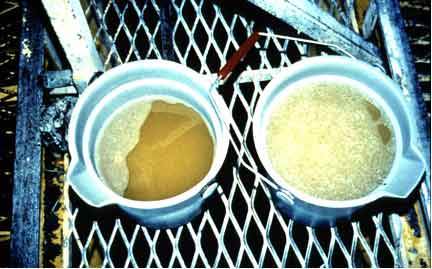
Sanitation chemicals not labeled/identified
Labels must be in English (plus other languages, if desired).
Under some circumstances, signs, placards, standard operating procedures, or batch tickets may substitute for individual container labels.
Portable containers do not have to be labeled if 1) the contents are transferred from labeled containers and 2) the contents are intended for the immediate use of the employee who makes the transfer.
- Develop and implement a written hazard communication program, including labels, MSDSs, and employee training and the list of chemicals, MSDSs, and label information.
A comprehensive written hazard communication program will include:
- provisions for container labeling;
- collection and availability of MSDSs
- employee training program
- list of hazardous chemicals
- how employees will be informed of hazards of non-routine tasks and the hazards of chemicals in unlabeled pipes
- procedures for sharing hazard information with other employers on-site
- Sample written programs are shown in Appendix E of OSHA Directive CPL 02-02-038 [CPL 2-2.38D].
- Communicate hazard information to their employees through labels, MSDSs, and formal training programs. Employees who are exposed to hazardous chemicals must be trained when they first work with the chemicals (and whenever there is a new hazard on which they have not been trained).
Elements of the information/training program:
- requirements of the standard
- components and implementation of employer's program
- operations where hazardous chemicals are present, and the hazards of the chemicals
- measures employees can take to protect themselves
- protective measures implemented by employer (engineering controls, work practices, or personal protective equipment)
- methods and observations (appearance or smell) workers can use to detect the presence of hazardous chemicals