|
Shipbuilding » Hot Work (including Welding, Cutting and Heating) |
|
Hot work includes welding, cutting, burning, abrasive blasting, and other
heat-producing operations. Hot work presents an increased risk of fire and explosion
hazards because it is most often performed in confined and enclosed
spaces. [29 CFR 1915.51,
29 CFR 1915.53,
29 CFR 1915.54,
29 CFR 1915.55, 29 CFR 1915.56,
and 29 CFR 1915
Subpart P].
Accidents may occur during hot work due to the structure of vessels, where hot
work in a space can cause fire or explosion in an adjacent
space that has not been evaluated safe for hot work. Special precautions
must be taken in adjacent spaces as well as confined and enclosed spaces.
Note: During shipbuilding operations, the need for testing by a SCP and CMC will depend on the progress of the vessel construction. Until there is a potential for a hazard, such as after the introduction of flammable liquids, testing may not be required.
Note: Confined space entry is one of the leading hazards associated with barge cleaning. Review the Confined or Enclosed
Spaces and Other Dangerous Atmospheres chapter for information on how to protect workers from this hazard.
Steps for safe hot work include:
Test Yourself: This interactive enhancement asks such questions as "Which
spaces need to be checked by a marine chemist before hot work?"
and "Who can approve the hot work?"
|
|
|
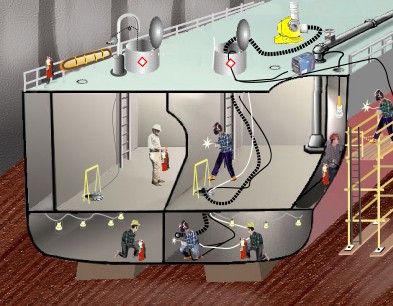 Figure 1: Hot Work Operations: