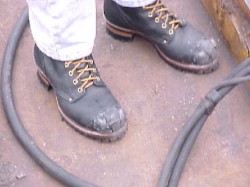
Figure 1: Worker with foot protection.
The OSHA
Hierarchy of Controls
- Engineering Controls
- Administration Controls
- Personal Protective Equipment (PPE)
Workers may be at risk of crushing injuries due to contact
with falling or rolling objects
[29 CFR 1915.156]; as well as punctures from sharp objects.
Additional hazards include contact with:
- Electrical or electricity
- Molten metals
- Hot surfaces
- Chemicals
- Wet or slippery surfaces
Injuries may be prevented by the use of appropriate footwear.
| Use and Selection of Foot Protection |
Potential Hazards:
Workers may be exposed to injuries including:
- Crushing from falling objects,
- Crushing from rolling cylinders,
- Punctures from sharp objects,
- Burns or shocks from electrical hazards,
- Burns from molten metal or hot surfaces,
- Skin contact or burns from chemicals, or
- Slips and falls from wet or slippery surfaces.
Requirements and Example Solutions:
- Workers must wear protective footwear when working in areas where
there is a danger of falling or rolling objects or objects piercing the
sole. [29 CFR 1915.156(a)] Examples include:
- Impact injuries from carrying
or handling materials such as equipment, objects, parts, or heavy
tools which could be dropped or from objects that may fall
during work activities.
- Compression injuries from work
activities involving forklifts, gas cylinders, and heavy pipes, which could
roll onto worker's feet.
- Puncture injuries from sharp objects such as
nails, screws, staples, scrap or sheet metal,
which workers may step on.
- Protective footwear must meet ANSI Z41 or
equivalent design requirements [29 CFR 1915.156(b)].
- Safety shoes or boots may be required to provide special
electrical conduction or insulation to prevent electric shock or
static electric spark.
- Chemical-resistant boots may be required to provide protection
from caustic, reactive, toxic, or corrosive materials during
cleaning, or surface preparation.
- Slip-resistant soled shoes should be worn when working on slippery
surfaces.
 Back to Top Back to Top |
|