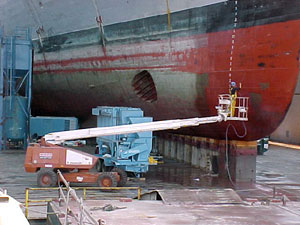
Figure 1: Manlift.
Aerial lifts (man lifts) are one of the
most common devices used to conduct work from elevated locations and are
commonly
used to replace traditional shipyard scaffolding. Aerial lifts are
defined as, "any vehicle-mounted device, telescoping or articulating, or
both, which is used to position personnel." [29 CFR 1910.67(a)(1)]
Commonly used terms in the shipyard for aerial lifts often refer to specific
brands, such as:
- JLG
- Genie High Lift
- Condor Lift
- Snorkel Lift
There is a difference between aerial lifts and scissor lifts.
| Requirements and Example Solutions |
- Lift controls must be tested daily. [29 CFR 1910.67(c)(2)(i)]
- Operators must be trained. [29 CFR 1910.67(c)(2)(ii)]
- Employees must work within the basket. [29 CFR 1910.67(c)(2)(iv)]
- Body belts with lanyards must be used. [29 CFR 1910.67(c)(2)(v)]
- Body belts are for positioning only, not for fall protection.
- Harnesses may be used in lieu of body belts.
- Load limit must not be exceeded. [29 CFR 1910.67(c)(2)(vi)]
- Brakes must be set; outriggers used, if so equipped; and wheels chocked; if on
incline. [29 CFR 1910.67(c)(2)(vii)]
- Unless designed, aerial lift trucks may not be moved
when the boom is elevated in a working position with workers in the
basket. [29 CFR 1910.67(c)(2)(viii)]
- Upper and lower controls are required and must be plainly marked. Lower
controls must be provided for overriding the upper controls. [29 CFR 1910.67(c)(2)(ix)]
- Special precautions should be made when aerial lifts
are used on vessels (for example barges, floats) to ensure the vessel and
the lifting device is stable.
- Personal flotation devices (PFD) should be used when working over
water.
- Caution should be taken for potential crushing hazards (for example
booming into the overhead, pinch point).
- ANSI has additional requirements for these types of devices. [ANSI/SIE A92.2
and A92.5]
 Back to Top Back to Top |
|