Installation/Disassembly: Fall Protection
SWP 2. Implement Precautions for Cable Hangers or "Rope Walkers"
The Need for Rope Walking
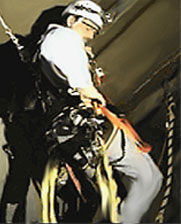
Rope walking is a method used for attaching suspension cable assemblies to overhead points.
Photo courtesy of OSHA.
|
|
One operation involved in the installation/disassembly
of marine hanging staging that cannot be carried out
on the ground is the attachment of suspension cable
assemblies to overhead structural supports.
Further,
in certain vessels, the use of ladders, mechanized
lifts, and other ground-based equipment to reach certain
attachment points on the overhead is impractical or
poses a greater hazard. Thus, to accomplish this operation,
the shipyard industry uses a method of working aloft
known as "rope
walking."
The Rope Walking Procedure
Rope walking is physically demanding
work. Protected with a full-body harness and a self-retracting lanyard/lifeline
(SRL) secured to an anchorage near the point of access,
a cable hanger or rope walker moves from point to point
across an overhead area. As the rope walker travels,
hanging and standing on “footholds” or
stirrups attached to weep holes
(also known as "rat holes") or other openings on
the overhead, the rope walker connects a succession
of stand-off pulleys that maintain downward tension
on the lifeline and prevent a swing fall.
|
Using safety hooks, the stirrups
are attached to the same kinds of openings in the overhead
supports that ultimately accommodate the attachments
for the scaffold's suspension cable assemblies.
In moving from location to location, the rope walker
hoists the suspension cable assemblies from the base
of the tank and attaches them to overhead supports
with S-hooks, pork chops, or beam clamps.
The procedure is similar whether the
rope walker is involved in installing or dismantling
a hanging scaffold.
 |
Video clips of rope walking activity. These video segments were filmed by OSHA at Newport News Shipbuilding in Virginia with the assistance of the Virginia Ship Repair Association, Inc. (VSRA).
To view the videos on a computer you will need to have Windows Media Player or equivalent. The videos have been optimized for connection speeds of 150 Kbps or greater. If your connection is less than 150 Kbps you may experience difficulties.
Note: The videos clips below do not contain audio.
|
Definitions:
|
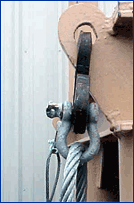
Attachment point.
Photo courtesy of VSRA.
|
More information:
| Important Considerations for Rope Walkers |
- Rope walkers must have 100% fall protection
at all times.
- Employers should assign the task of
rope walking only to workers with the physical
endurance and upper body strength necessary
for this kind of activity.
- Before assigning workers to the task
of rope walking, employers should evaluate
their capacity for such work by testing
them at ground level to determine their
familiarity with the procedures for rigging,
fall protection, and retrieval.
- Rope walkers must be trained to understand
the specialized rigging and fall protection
procedures established by their employers,
and to identify and use only those supporting
structures that are strong enough for the
intended loads. (See also Job
Hazard Analysis.)
- Equipment used by rope walkers (such
as full body harness, carabiners, and stirrups)
must comply with the strength and safe
working loads (SWL) (i.e., minimum tensile load) requirements of 29
CFR Part 1915.159.
- Rope walkers must examine their equipment,
tools, and personal fall arrest system
before each use. They should visually inspect
all safety hooks for damage and ensure their proper
attachment to the overhead supports.
- A coworker who is trained in appropriate
emergency response procedures should always
attend a rope walker. Where voice communication
between the rope walker and coworker is
impaired by location or surrounding noise
levels, other effective forms of communication
should be used.
- Self-retracting lanyard/lifelines (SRLs)
used in this application must be of a type
that will effectively deploy when arresting
forces are applied from both horizontal
and vertical directions. For purposes of
retrieval, SRLs used for rope walking should
incorporate a manual lowering feature.
|
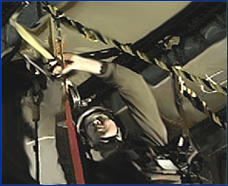
Rope walking is physically demanding and specialized work and it requires fall protection at all times.
Photo courtesy of OSHA.
|
|
|
 
|
