Annual Partnership Evaluation Report
2009 Annual Evaluation
| Partnership Name | ||||
|---|---|---|---|---|
| The International Union, United Automobile, Aerospace and Agricultural Implement Workers of America (UAW), the Ford Motor Company (Ford), and Automotive Component Holdings, LLC (ACH) | ||||
| Purpose of Partnership | ||||
| The partners agree to construct an OSHA Strategic Partnership (OSP) based on mutual respect and trust that leverages the resources of all the parties through the systematic anticipation, identification, evaluation and control of health and safety hazards at UAW/Ford and UAW/ACH locations under federal jurisdiction. | ||||
| Goal of Partnership | ||||
| Goal | Strategy | Measure | ||
| Reduce injuries and illnesses year-over-year at each OSP location |
|
|
||
| Anticipated Outcomes | ||||
|
||||
| Strategic Management Plan Target Areas (check one) | ||||
| Construction | Amputations in Manufacturing | |||
| General Industry | X | |||
| Strategic Management Plan Areas of Emphasis (check all applicable) | ||||
| Amputations in Construction | Oil and Gas Field Services | |||
| Blast Furnaces and Basic Steel Products | Preserve Fruits and Vegetables | |||
| Blood Lead Levels | Public Warehousing and Storage | |||
| Concrete, Gypsum and Plaster Products | Ship/Boat Building and Repair | |||
| Ergo/Musculoskeletal | X | Silica-Related Disease | ||
| Landscaping/Horticultural Services | ||||
|
Date of Evaluation Report Evaluation Period: |
||||
| Start Date | 01/01/2008 | End Date | 12/31/2008 | |
|
Evaluation OSHA Contact Person Originating Office |
Christian Wojnar Directorate of Cooperative and State Programs (DCSP), Office of Partnerships and Recognition (OPR), Washington, DC |
|||
| # Active Employers | 12 | # Active Employees | 14,124 | |
| Industry Coverage (note range or specific SIC and NAICS for each partner) | ||||
| Partner | SIC | NAICS | ||
| Chicago Assembly Plant, Chicago, Illinois | 3711 | 336111 | ||
| Chicago Stamping Plant, Chicago, Illinois | 3465 | 336370 | ||
| Kansas City Assembly Plant, Kansas City, Missouri | 3711 | 336111 | ||
| Buffalo Stamping Plant, Hamburg, New York | 3464 | 336170 | ||
| Cleveland Casting Plant, Brook Park, Ohio | 3356 | 331315 | ||
| Cleveland Engine Plant #1, Brook Park, Ohio | 3714 | 336312 | ||
| Cleveland Engine Plant #2, Brook Park, Ohio | 3714 | 336312 | ||
| Lima Engine Plant, Lima, Ohio | 3714 | 336312 | ||
| Ohio Assembly Plant, Avon Lake, Ohio | 3711 | 336111 | ||
| Sharonville Transmission Plant, Sharonville, Ohio | 3714 | 336350 | ||
| Walton Hills Stamping Plant, Walton Hills, Ohio | 3465 | 336370 | ||
| Sandusky Plastics Plant, Sandusky, Ohio (ACH, LLC) | 3089 | 326199 | ||
| *Tulsa Glass Plant, Tulsa, Oklahoma (ACH, LLC) | 3231 | 327215 | ||
*Tulsa Glass Plant was sold in April 2008 and as a result, left the OSP at that time; at the end of evaluation period, 12 sites were actively participating in the OSP
Section 2 Activities Performed
| Note whether an activity was provided for by the OSP and whether it was performed | ||
|---|---|---|
| Required | Performed | |
| a. Training | YES | YES |
| b. Consultation Visits | ||
| c. Safety and Health Management Systems Reviewed/Developed | YES | YES |
| d. Technical Assistance | ||
| e. VPP-Focused Activities | ||
| f. OSHA Enforcement Inspection | YES | |
| g. Offsite Verifications | ||
| h. Onsite Non-Enforcement Interactions | YES | YES |
| i. Participant Self-Inspections | YES | YES |
| j. Other Activities | ||
| 2a. Training (if performed, provide the following totals) | ||
| Training sessions conducted by OSHA staff | ||
| Training sessions conducted by non-OSHA staff | 27 | |
| Employees trained | 14,124 | |
| Training hours provided to employees | * | |
| Supervisors/managers trained | ** | |
| Training hours provided to supervisors/managers | * | |
| Comments/Explanations (briefly describe activities, or explain if activity provided for but not performed) | ||
|
Training courses offered in 2008 includes: Hazard Communications, Propane
Handling Safety, Energy Control Power Lockout, Energy Control Power Lockout
Refresher, Guidelines Responsibilities Safe Practices, Lifting and Rigging,
Trouble shooting, Maintenance Vehicle, Overhead and Gantry Crane Operator,
Overhead Crane Inspection, Hex Chrome, PMHV Pedestrian, PMHV Operator,
Confined Space Entry Entrant-Attendant, Confined Space Entry Permit Issuer,
Skilled Trades Job Safety Analysis, Working-at-Heights, Backflow Prevention
Certification, Construction Safety, OHSIM Investigator, General Safety
Orientation, and Other Emergency Preparedness Training (First Responder,
Incident Command, ERT, HAZMAT, SCBA, and Incipient Fire). *The number of training hours was not identified as the great majority of the training was done through Computer Based Training (CBT) and it is typically performed at the employee's/supervisor's pace making the number of hours difficult to ascertain. **The number of managers/supervisors trained is combined with the number of employees. |
||
| 2c. Safety and Health Management Systems (if performed, provide the following total) | |
|---|---|
| Systems implemented or improved using the 1989 Guidelines as a model | 13 |
| Comments/Explanations (briefly describe activities, or explain if activity provided for but not performed) | |
|
Corporate-Wide Improvements: Ford moved forward with its strategic planning of safety and health management. The six items listed below briefly describe the major initiatives pursued during the evaluation period: Zurich Top-6 Risk Management Initiatives: Based on comprehensive data analysis of historic injury-illness trends, UAW and Ford partnered with Zurich Risk Engineering to implement six risk-based initiatives to minimize the potential for injuries associated with: 1) Non-Standard Production Work; 2) Powered Material Handling Vehicle-Pedestrian Safety; 3) Personal Protective Equipment Process; 4) Energy Control & Power Lockout; 5) Work Rules-Safe Behavior Index; and 6) Walking and Working Surfaces. Safety and Health Assessment Review Process: UAW, Ford, and ACH completed the implementation of the new Safety and Health Assessment Review Process (SHARP), including training for assessors and site element leads. Baseline assessments were completed at all UAW-represented manufacturing sites. Risk Assessment Methodologies: UAW, Ford, and ACH continued to incorporate risk assessment methods into the design, build, modification, and commissioning phases for new machinery-equipment procurements to support the proactive identification and elimination of workplace hazards. New Machinery-Equipment Technology: Ford continued to incorporate new technology (e.g. control reliable) into new site manufacturing processes to ensure the integrity of machinery/equipment-related safety control systems that prevent exposures to uncontrolled hazards while ensuring safe work practices. 2008 President's Health and Safety Awards Program: Hosted by Mark Fields, President of the Americas at Ford World Headquarters, the program was developed to recognize North American site and organizational contributions supporting innovative solutions, best practices, safety leadership engagement, and safety professional achievements. Powered Train Operations (PTO): Safety Operating System: Ford completed its second year of implementation of a standardized Safety Operating System to manage completion/confirmation of critical safety tasks (i.e. regulatory, contractual, and corporate safety and health requirements) through increased employee engagement at all levels of the organization. Summaries of the improvements made at each OSP site as observed by OSHA Day attendees are included in Appendix A: Individual Site Summaries. Finally, during the October 2008 Partnership Management Team (PMT) meeting on October 9, 2008 in Detroit, Michigan, an OSHA representative provided a presentation on the Voluntary Protection Programs (VPP). At this same meeting, representatives from Michigan and Indiana's Departments of Labor also provided presentations on their respective VPPs. |
|
| 2f. OSHA Enforcement Activity (if performed, provide the following totals for any programmed, unprogrammed, and verification-related inspections) | |
|---|---|
| OSHA enforcement inspections conducted | 5 |
| OSHA enforcement inspections in compliance | 3 |
| OSHA enforcement inspection with violations cited | 2 |
| Average number of citations classified as Serious, Repeat, and Willful | 1 |
| Comments/Explanations (briefly describe activities, or explain if activity provided for but not performed) | |
|
Sharonville Transmission Plant
|
|
| 2h. Onsite Non-Enforcement Verification (if performed, provide the following total) | |
|---|---|
| Onsite non-enforcement verifications performed | 7 |
| Comments/Explanations (briefly describe activities, or explain if activity provided for but not performed) | |
|
Eleven (11) out of 13 sites had OSHA Day events. Tulsa
Glass Plant did not have an OSHA Day visit because it was sold in April 2008.
The Ohio Assembly Plant did not have an OSHA Day visit because an OSHA
enforcement inspection was conducted on October 22, 2008.
Areas identified for improvement based on a review of OSHA Day documentation/reports included:
For individual site observations noted during each OSHA Day, see Appendix A: Individual Site Summaries. |
|
| 2i. Participant Self-Inspections (if performed, provide the following total) | |
|---|---|
| Self-inspections performed | 5,317 |
| Hazards and/or violations identified and corrected/abated | 2,454 |
| Comments/Explanations (briefly describe activities, or explain if activity provided for but not performed) | |
|
The following inspections are done on a regular basis at the Ford sites:
|
|
Section 3 Illness and Injury Information
Partnership Totals
| Year | Hours | Total Cases | TCIR | DART Cases | DART | LTCR Cases | LTCR |
| 2006 | 42,838,377 | 4,083 | 19.1 | 2,106 | 9.8 | 408 | 1.9 |
| 2007 | 38,210,104 | 3,213 | 16.8 | 956 | 5.0 | 198 | 1.0 |
| 2008 | 29,511,822 | 1,935 | 13.1 | 412 | 2.8 | 114 | 0.8 |
| Total | 110,560,303 | 9,231 | 3,474 | 720 | |||
| Three-year Rate (2006-2008) | 16.7 | 6.3 | 1.3 | ||||
| Comments | |
|---|---|
|
In 2008 the OSP sites continued to improve their injury and illness rates, including TCIR, DART rate, and LTCR. The information provided below is a summary of each site's performance. For additional detailed site information (including individual incidence rates and the 2007 BLS Industry Averages), see Appendix A. 2008 Results
3-Year Results
The DART rate is an indicator of severity. The significant reductions in DART rate (both overall and individual site reductions) point to the OSP's success in reducing serious injuries and illnesses. Introduction to Charts The first three charts (Figure 1 TCIR; Figure 2 DART; and Figure 3 LTCR) illustrate the percentage change between 2007 and 2008 for the particular measure. For example, a bar at -20% means that the site reduced its rate by 20% over the course of the year. The last two charts show how each site's 1-year and 3-year TCIR and DART rates compare to 2007 industry average rates published by the Bureau of Labor Statistics. For example, a bar at 250% means that the site's rate is 250% higher than its respective industry average. |
|
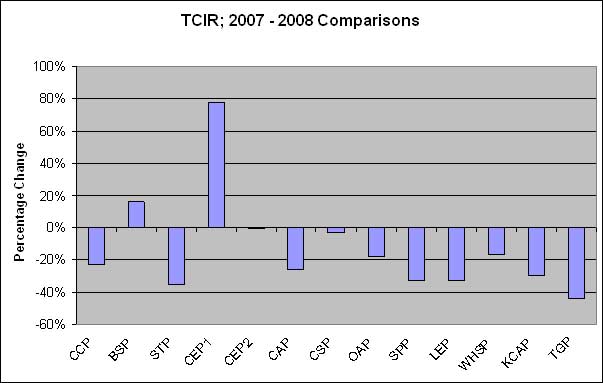
Figure 1
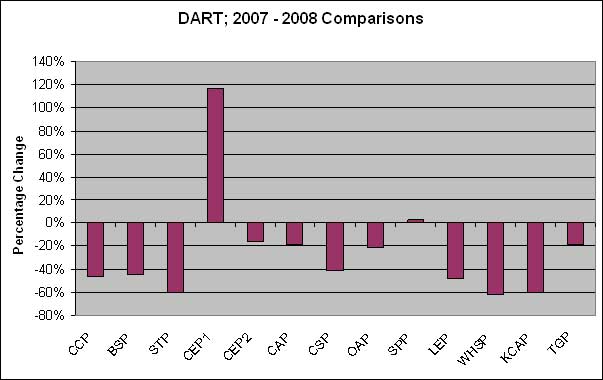
Figure 2
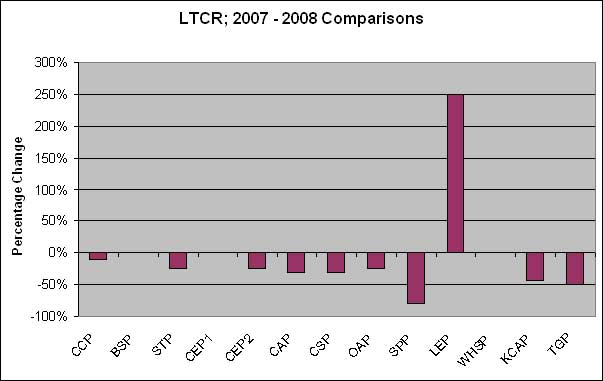
Figure 3
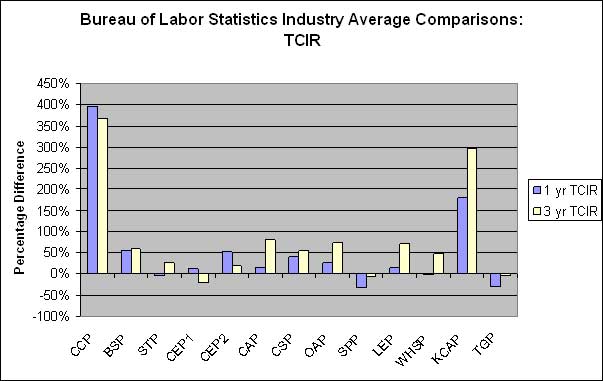
Figure 4
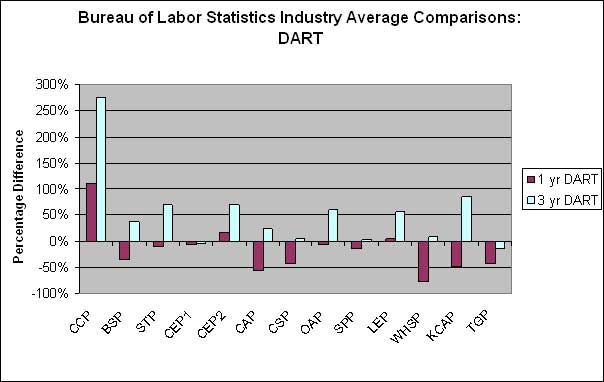
Figure 5
Section 4 Partnership Plans, Benefits, and Recommendations
| Changes and Challenges (check all applicable) | ||
|---|---|---|
| Changes | Challenges | |
| Management Structure | X | |
| Participants | X | |
| Data Collection | X | X |
| Employee Involvement | ||
| OSHA Enforcement Inspection | ||
| Partnership Outreach | ||
| Training | ||
| Other (Specify) | ||
| Comments | ||
|
Management Structure: As described in the 2007 Annual Evaluation and also
briefly described in Section 2c above (SHMS Improvements), UAW, Ford, and ACH
have overhauled the assessment process and taken several steps that show
management commitment to strengthening the safety and health aspect of overall
corporate governance. In addition, safety and health effectiveness is one of
the criteria used to evaluate management/executive performance. Participants: The Tulsa Glass Plant of ACH was sold in April. As of December 31, 2008, there is only one ACH site in the OSP. Data Collection: Data collection continues to present a challenge. There are thirteen sites from which data must be collected. Interpretations of certain data points continue to vary among the sites, making it difficult to ensure that the data collection process is consistent. However, the PMT has taken several steps to coordinate and streamline the process and intends to continue to improve the data collection process for the final year of the OSP. |
||
| Plans to Improve (check all applicable) | ||
|---|---|---|
| Improvements | N/A | |
| Meet more often | ||
| Improve data collection | X | |
| Conduct more training | ||
| Change goals | ||
| Comments | ||
| See Changes and Challenges for a discussion on data collection issues. | ||
| Partnership Benefits (check all applicable) | |
|---|---|
| Increased safety and health awareness | X |
| Improved relationship with OSHA | X |
| Improved relationship with employers | |
| Improved relationship with employees or unions | |
| Increased number of participants | |
| Other (specify) | |
| Comments | |
|
Among its participating sites, the OSP has experienced reductions in its overall injury and illness rates since its inception in 2000. The trends in injury and illness rate reductions continue as UAW and Ford continue to enhance their safety and health management efforts through the overhaul of their self-assessment process (SHARP). The benefits of participating in the OSP are becoming evident at the individual site level. In addition to the trends of reductions to their injury and illness rates, some sites have begun to outperform their industry counterparts. In 2008, three sites participating in the OSP achieved a TCIR which was below the 2007 BLS Industry average for their NAICS classification. Further in 2008, ten out of twelve OSP participating sites experienced a DART rate below their industry average. |
|
| Status Recommendations (check one) | |
|---|---|
| Partnership Completed | |
| Continue/Renew | X |
| Continue with the following provisions: | |
| Terminate (provide explanation) | |