OSHA Strategic Partnership Program (OSPP)
Partnership Evaluation Report
Close-Out
These tables are best viewed on tablets, notebooks, or desktop computer screens.
| Partnership ID# | 97 |
|---|
| OSHA Strategic Partnership (OSP) Name | ||
|---|---|---|
The International Union, United Automobile, Aerospace and Agricultural Implement Workers of America (UAW), the Ford Motor Company (Ford), Michigan Occupational Safety and Health Administration (MIOSHA) | ||
| Purpose of OSP | ||
|---|---|---|
| The partners agree to construct an OSHA Strategic Partnership (OSP) based on mutual respect and trust, leveraging the resources of all the parties through the systematic anticipation, identification, evaluation and control of health and safety hazards at UAW/Ford, and MIOSHA locations. |
| Goals of OSP | ||
|---|---|---|
Goal |
Strategy |
Measure |
(1) Perform Reduce injuries year-over-year at each OSP location. |
|
|
| Anticipated Outcomes | |||
|---|---|---|---|
*The Lost Time Case Rate (LTCR) is maintained and reported by the partners. The LTCR is not a rate traditionally used in OSPs as there is no Bureau of Labor Statistics rate available for comparison. |
| Strategic Management Plan Target Areas (check one) | |||
|---|---|---|---|
| Construction | X | Manufacturing Amputations |
X | Non-Construction |
|
|
| Strategic Management Plan Areas of Emphasis (check all applicable) | |||
| Amputations in Construction |
| Oil and Gas Field Services |
| Blast Furnaces and Basic Steel Products |
| Preserve Fruits and Vegetables |
| Blood Lead Levels |
| Public Warehousing and Storage |
| Concrete, Gypsum and Plaster Products |
| Ship/Boat Building and Repair |
X | Ergo/Musculoskeletal |
| Silica-Related Disease |
| Landscaping/Horticultural Services |
|
|
Section 1 General Partnership Information
| Date of Evaluation Report | October 21, 2015 | |||
|---|---|---|---|---|
| Evaluation Period | ||||
Start Date | August, 2000 | End Date | December, 2014 |
|
| Evaluation Contact Person | Jacqueline R. Annis | |||
|---|---|---|---|---|
| Originating Office | OSHA National Office - Washington DC | |||
| Partnership Coverage | ||||
|---|---|---|---|---|
Active Participating Sites (at close out) | 24 | # Active Employees | 36,032 | NAICS |
Woodhaven Forge Plant | MIOSHA |
| 97 | 332111 |
Chicago Assembly | OSHA |
| 4166 | 336111 |
Dearborn Diversified Manufacturing Plant/Dearborn Stamping Plant (DDMP/DSP) | MIOSHA |
| 931 | 336111 |
Dearborn Truck Plant (DTP) | MIOSHA |
| 3671 | 336111 |
Kansas City Assembly | OSHA |
| 4311 | 336111 |
Michigan Assembly | MIOSHA |
| 5300 | 336111 |
Ohio Assembly | OSHA |
| 2031 | 336111 |
|
|
|
|
|
Cleveland Engine #1 | OSHA |
| 1161 | 336312 |
Cleveland Engine #2 | OSHA |
| 1200 | 336312 |
Dearborn Engine | MIOSHA |
| 700 | 336312 |
Lima Engine | OSHA |
| 1018 | 336312 |
Romeo Engine Plant | MIOSHA |
| 798 | 336312 |
|
|
|
|
|
Livonia Transmission | MIOSHA |
| 1007 | 336350 |
Sharonville Transmission Plant | OSHA |
| 1900 | 336350 |
Sterling Axle | MIOSHA |
| 1874 | 336350 |
Van Dyke Transmission | MIOSHA |
| 1291 | 336350 |
|
|
|
|
|
Buffalo Stamping | OSHA |
| 374 | 336370 |
Chicago Stamping | OSHA |
| 1050 | 336370 |
Dearborn Tool & Die | MIOSHA |
| 300 | 336370 |
Walton Hills Stamping | OSHA |
| 374 | 336370 |
Woodhaven Stamping | MIOSHA |
| 1148 | 336370 |
|
|
|
|
|
Brownstone Parts Redistribution Center | MIOSHA |
| 448 | 423120 |
National Parts Distribution Center (NPDC) | MIOSHA |
| 115 | 423120 |
Rawsonville Parts | MIOSHA |
| 767 | 423120 |
Background
OSHA, the Ford Motor Company and the United Auto Workers (UAW) have a long partnership history. Ford and the UAW have been active participants with OSHA in the OSHA Strategic Partnership Program (OSPP) since 1999. A renewal of the OSP was signed in 2010 and included MIOSHA as signatory to the partnership. This was the first time a State Plan OSHA had been a signatory to an OSHA Strategic Partnership (OSP). MIOSHA had been engaged in a parallel partnership with Ford and the UAW up until 2010.
Introduction
Almost all of this partnership's activities during CY 2013 and CY 2014 were devoted to discussion regarding OSP renewal. However, following these discussions, there was a mutual decision to close-out the national partnership and, given the concentration of participating sites in Michigan and OSHA's Region 5, explore a more limited partnership with MIOSHA, OSHA's Region 5, or both. This evaluation serves as the close-out evaluation for the National partnership.
During 2013 and 2014 the partnership did not collect the data and information traditionally collected for an OSP annual evaluation. As a result, OSHA is providing the evaluation in a format that best provides information about the partners' efforts to achieve the established goal of the partnership while working through the renewal period.
The success of the OSHA/Ford/UAW/MIOSHA OSP was due to many factors, only one of which is the collaborative relationship built over time between government, labor and industry. Throughout the life of the OSP, all of the partners were diligent in their efforts to protect the workers employed in the participating facilities. The number of the facilities changed from year to year based on plant mergers and closures. In 2012, the annual evaluation reported the participation of 24 manufacturing and distribution facilities, but there had been other participating sites throughout the lengthy OSP. The same 24 facilities referenced in the 2012 evaluation are listed above for this close-out evaluation.
Partnership Results
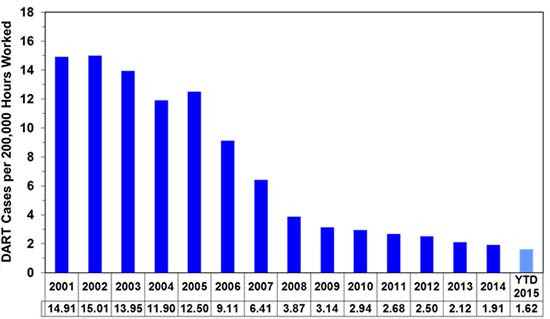
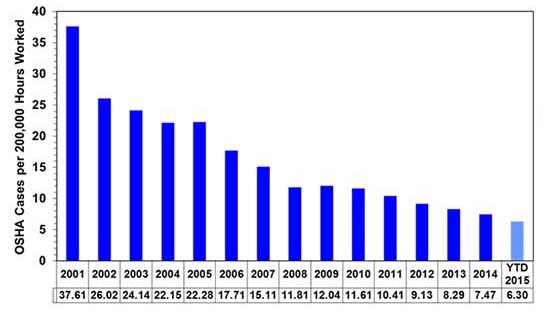
Injury and Illness Rates: The graphs below (CHARTS 1 and 3) reflect Ford's injury and illness performance over the life of the partnership. As noted, OSHA was not able to obtain the participant site-specific injury and illness data for 2013 and 2014 following the conclusion of the OSP. The graphs below depict the reductions in TCIR and DART rates for all Ford U.S. UAW facilities (not just those in the partnership). These graphs were provided to OSHA by the UAW-Ford National Joint Committee on Safety and Health. From 2001 to the end of 2014 the TCIR and DART rates for all Ford-UAW facilities in the United States was reduced by 80% and 87% respectively.
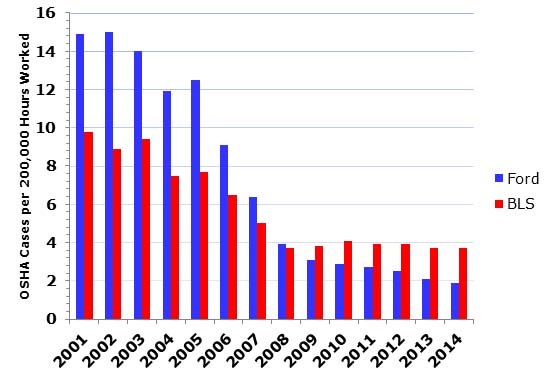
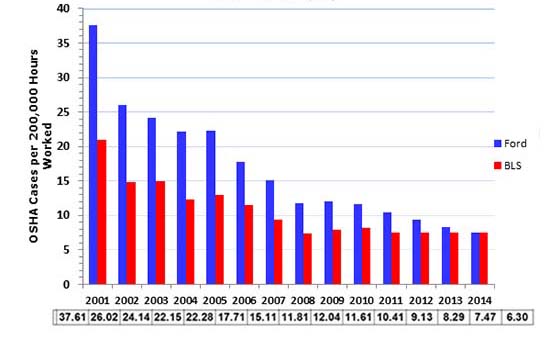
Injury and Illness Rates: The graphs below (CHARTS 2 and 4) depict the Ford U.S. UAW facilities TCIR and DART rates compared to those published by the BLS for the same time period. For calendar years 2001 and 2002 the Standard Industrial Classification of 3711 for Automobile Manufacturing was used. For calendar years 2003 to 2013 the North American Industry Classification (NAICS) of 33611 for Automobile Manufacturing was used. The NAICS for 2013 was also used to compare the Ford 2014 data; as of this writing, the 2014 BLS injury and illness rates have not been published.
Looking at the CHART comparisons the rates have steadily declined for both the U.S. Ford UAW facilities as well as for the industry as a whole. While the Ford TCIRs remain above the BLS rates their DART rates have consistently been below those of the BLS since 2009. This reduction is remarkable in that the DART rate is used as a measure of injury/illness severity based on lost/restricted work time.
U.S. UAW Locations Employee DART Rate
Ford Motor Company
January 2001 to February 2015
Ford Motor Company vs Bureau of Labor Statistics
DART Rate Automobile Manufacturing
2001 to 2014
U.S. UAW Locations Employee OSHA Recordable Rate
Ford Motor Company
January 2001 to February 2015
Ford Motor Company vs Bureau of Labor Statistics
Total Case Incident Rate (TCIR)
2001 to 2014
Partnership Activities: Summary
Information presented below details the work done by the OSP during its 15 years. This information has been culled from the partnership annual evaluations from 2003 through 2012. The OSP had only one goal, to reduce worker injury and illness rates year over year. In order to accomplish this, many strategies were used and successes realized along the way.
As illustrated by the data presented above, the OSP did achieve its primary goal. The partners collectively benefited from this collaborative relationship in many ways. Some of the additional successes are outlined below in a chronology.
Highlights of Partnership Successes
1999 to 2003
- The participating facilities experienced reductions in both the number of serious injuries and the severity of those injuries.
- The OSP reported improved communication and information sharing between UAW/Ford/Visteon and OSHA. The OSP Steering Committee communicated regularly (through meetings and conference calls). They planned and executed an all hands meeting Day on October 17, 2002.
- The partners developed 14 inspection protocols, based on the safety and health procedures and policies linked to the highest incidences of serious injuries and illnesses. These protocols were developed for use in implementing a focused inspection process for the participating facilities.
2004 to 2007
- OSHA's Directorate of Enforcement indicated that the inspection protocols implemented for this Partnership would be transferrable across many industries. By using the OSP-established protocols during enforcement OSHA reported successes in leveraging inspection resources more effectively.
- OSHA enjoyed an improved relationship with each of the partners. The partners continued to report improvements in communication and cooperation with OSHA. They reported that the improved relationship led to an increased level of safety and health awareness at the plant level, as indicated by the continuous drop in injury and illness rates.
- The Partnership Management Team (PMT) worked to finalize a standardized data package for Ford to provide to OSHA in advance of OSHA Day Verification visits. This allowed OSHA a consistent mechanism for conducting the verifications.
- Ford conducted an analysis of the use of PPE at certain points in the manufacturing process and implemented controls for the use of gloves for certain processes, drastically reducing occurrences of cuts and lacerations
- Ford conducted worker safety awareness surveys: responses showed improvements, as a result of the partnership, due to increased management commitment, and the incorporation of S&H and ergonomics planning during equipment design phase.
- In March of 2005, OSHA hosted a National OSP Conference. The conference provided the partners with an opportunity to network with other National Partners, discuss best practices and lessons learned, and participate in brainstorming sessions to help improve the partnership process.
- Noted frequently during this time frame was the diligent work of Ford/UAW on safety and health management systems including developing new global policies and standards. They also implemented an auditing process for manufacturing facilities
2008 to 2012
- The partners continued efforts to establish a strong safety and health culture through the use of safety and health management systems (SHMS) enhancements. With assistance from the UAW and significant worker involvement, Ford implemented the following enhancements at each participating site:
- An updated Safety Health Assessment Review Process (SHARP)
- Incorporation of risk assessment methods into the various phases of machinery-equipment procurements
- Incorporation of new safety-control technology in manufacturing processes.
- Ford also partnered with Zurich Risk Engineering to develop management tools designed to minimize the potential for injuries associated with automotive industry related hazards
- To enhance senior joint leadership support of its safety and health policies, Ford, with the UAW and Canadian Auto Workers (CAW), developed a Joint Safety Charter. This initiative put into place bimonthly Manufacturing Safety Council meetings with company and union leadership in attendance. Participants at the Management Safety Council meetings review safety trends, processes, and upcoming safety initiatives to ensure support by all stakeholders and streamline the dissemination of safety information and processes to all of its plants.
- Ford/UAW implemented initiatives and standards impacting, their energy control and power lock out; confined space entry training; Global standard for safety in walking/working Surfaces; and updated electrical safety policies to align with a new NFPA 70E Standard
- During 2011 Ford conducted several cross plant audits of their Safety Operating System (SOS). The cross plant audits were conducted by teams comprised of members from other plants' safety, manufacturing, and engineering departments. Ford reported that these audits were beneficial as they allowed a "fresh eyes" perspective at each of the plants.
- MIOSHA joined the existing OSP. Their addition nearly doubled the number of facilities participating in the OSP from 14 to 26. The inclusion of MIOSHA provides Federal OSHA with an opportunity work jointly with a State Plan state and increases the reach of the OSP. This also allows for collection of increased injury and illness data for the partnership.
- Throughout the partnership the relationship between government, industry and labor continued to improve. On many occasions the partners collectively discussed outstanding issues related to safety and health to successful outcomes for worker safety.
- Results the OSHA/MIOSHA-Day Verifications continued to reveal that multiple plants have implemented Best Practices or program elements that are notable. A recommendation was made to increase sharing some of their successes with other facilities that may benefit from this information.
2013 to 2015: Plans were made to conclude the existing partnership.
Conclusion
The significant reduction in injury and illness rates is notable. The OSHA/Ford/UAW/MIOSH OSP successfully achieved its primary goal of reducing injuries and illnesses in the participating plants and had a corporate-wide impact through the development and use of risk assessment practices, best practices, and safety and health management enhancements. As noted, between 1999 and 2014 the TCIR and DART rates for all Ford-UAW facilities in the United States were significantly reduced, by 80% and 87% respectively, which is a remarkable achievement. Although not every Ford facility experienced the same level of success, overall in the last decade the success experienced by Ford-UAW in injury and illness rate reductions is undeniable.
The improved relationships among the partners, and the commitment and hard work by all of the partners resulted in other immeasurable benefits as well, through enhancements to Ford's safety and health culture and coordinated and collaborative work on initiatives outside the partnership.
After the Partnership Conclusion letter was sent by OSHA's Assistant Secretary Michaels, the Assistant Director - Health & Safety UAW National Ford Department and the Company Co-Chair for the UAW-Ford National Joint Committee on Safety & Health made the following statement "...honored to have been involved the partnership since Day 1, and equivocally can say we are "better together" (labor, management, and OSHA working together for a common goal)."