Slide 1 Home Next »
TEXT VERSION OF SLIDE:
Title: SARS: Protecting Workers
Type: Text Slide
Content:
SARS: Protecting Workers
Speaker Notes:
Title Slide
Slide 2 « Previous Next »
TEXT VERSION OF SLIDE:
Title: OSHA Guidance for Employers on Severe Acute Respiratory Syndrome (SARS)
Type: Text Slide
Content:
- Potentially deadly respiratory disease
- Coronavirus is the leading suspected causative agent
- Most U.S. cases contracted by those who have traveled to Asia, more recently also Toronto
- Spread primarily by close person-to-person contact
- In the U.S., healthcare workers face greatest risk of workplace transmission
Speaker Notes:
2. Severe Acute Respiratory Syndrome, known as SARS, is a potentially fatal respiratory disease. Believed to originate in China in November 2002, the disease is thought to be caused by a coronavirus—the same family of viruses that causes the common cold. Most of those in the U.S. who've contracted the disease have traveled to ASIA recently. A cluster of cases has also appeared in Toronto, Canada. The disease is not caused by casual contact. Healthcare workers and family members of SARS patients face the highest risk of developing the disease.
Slide 3 « Previous Next »
TEXT VERSION OF SLIDE:
Title: SARS: Possible Symptoms
Type: Text and Picture Slide
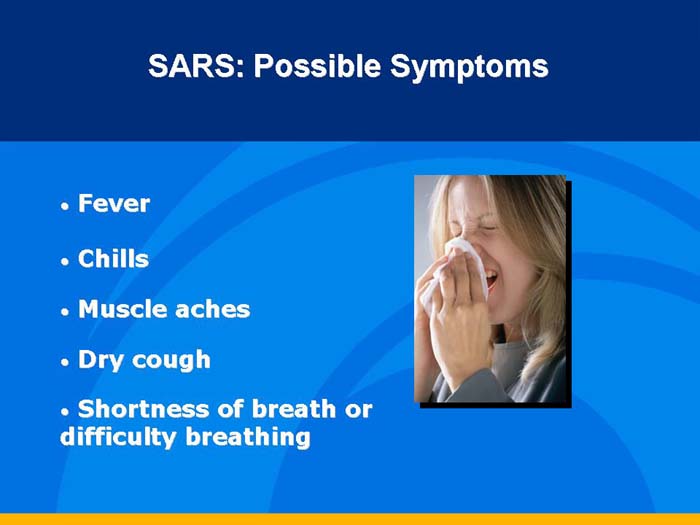
Content: [Includes photo of woman sneezing.]
- Fever
- Chills
- Muscle aches
- Dry cough
- Shortness of breath or difficulty breathing
Speaker Notes:
3. The symptoms of SARS are similar to those for flu or respiratory illness.
Slide 4 « Previous Next »
TEXT VERSION OF SLIDE:
Title: Suspect Cases of SARS
Type: Text Slide
Content:
- Onset within 10 days foreign travel or close contact with someone with SARS
- Fever of at least 100.4 degrees F
- Respiratory illness—cough, shortness of breath, difficulty breathing
Speaker Notes:
4. The symptoms of the disease are flu-like—a fever of at least 100.4 degrees and typical symptoms of respiratory illness. Usually symptoms appear 3 to 5 days after exposure. Those who've been in close contact with SARS patients are most likely to become ill. That means those who have cared for or lived with someone who has the disease and has had direct contact with respiratory secretions or body fluids. However, recent information suggests the SARS virus can live on common surfaces, which indicates it is possible to become infected from touching a tabletop, doorknob or other object. When there is x-ray evidence of pneumonia or acute respiratory distress syndrome, a "suspect" case becomes a "probable" case.
Slide 5 « Previous Next »
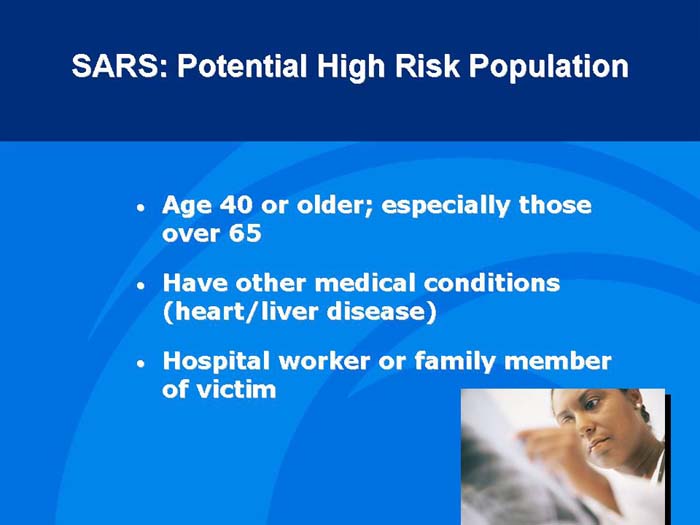
TEXT VERSION OF SLIDE:
Title: SARS: Potential High Risk Population
Type: Text and Picture Slide
Content: [Includes photo of doctor looking at an x-ray.]
- Age 40 or older; especially those over 65
- Have other medical conditions (heart/liver disease)
- Hospital worker or family member of victim
Speaker Notes:
5. Those who are 40 or older, especially those who are over 65, and anyone who has heart or liver disease face the greatest risk for severe disease and possible death. Healthcare workers and patients' families—those most likely to be in close contact with SARS victims—are most likely to contract the disease.
Slide 6 « Previous Next »
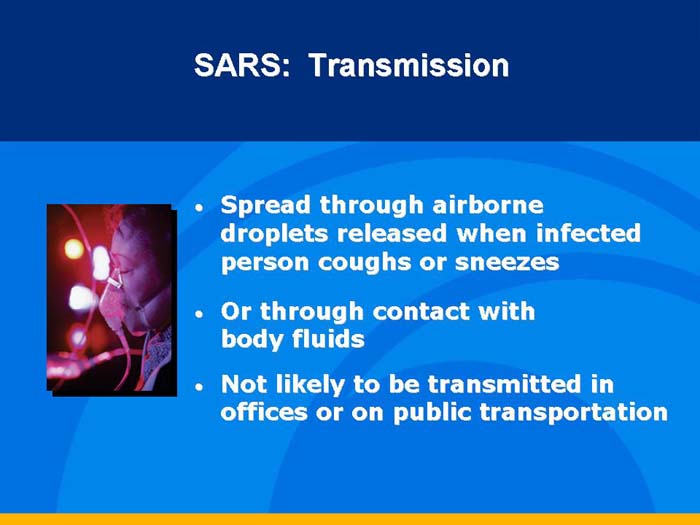
TEXT VERSION OF SLIDE:
Title: SARS: Transmission
Type: Text and Picture Slide
Content: [Includes photo of woman wearing an oxygen mask.]
- Spread through airborne droplets released when infected person coughs or sneezes
- Or through contact with body fluids
- Not likely to be transmitted in offices or on public transportation
Speaker Notes:
6. SARS can be spread through the air, when patients cough or sneeze, or through contact with body fluids. It is less likely, though possible, to contract the disease through casual contact, such as on public transportation or in most workplaces.
Slide 7 « Previous Next »
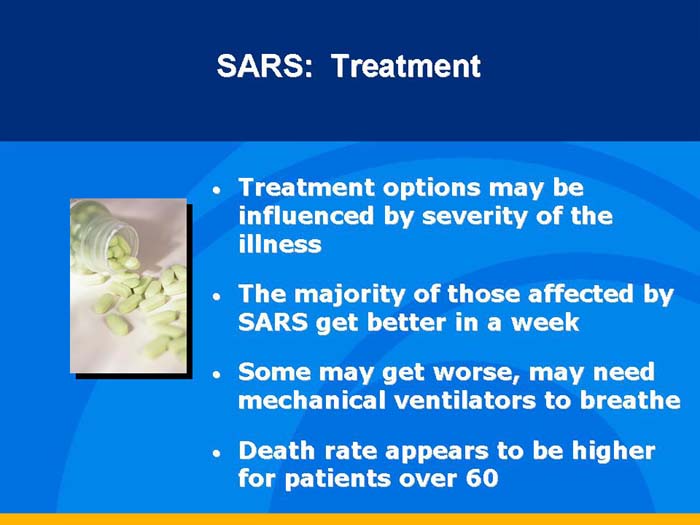
TEXT VERSION OF SLIDE:
Title: SARS: Treatment
Type: Text and Picture Slide
Content: [Includes a photo of an open bottle of pill spilled onto a table.]
- Treatment options may be influenced by severity of the illness
- The majority of those affected by SARS get better in a week
- Some may get worse, may need mechanical ventilators to breathe
- Death rate appears to be higher for patients over 60
Speaker Notes:
7. SARS can be fatal, but most people get better after a week or so. Only about 6 percent of those infected with SARS have died. Treatment options include medications (e.g., steroids). Treatment is highly dependent on the severity of the illness.
Slide 8 « Previous Next »
TEXT VERSION OF SLIDE:
Title: SARS: Precautions for Workplaces
Type: Text Slide
Content:
Centers for Disease Control documents provide most up-to-date information
See also the World Health Organization SARS webpage
Speaker Notes:
8. Information is changing daily on SARS. For the most up-to-date information on SARS, please check the Centers for Disease Control website or the World Health Organization website.
Slide 9 « Previous Next »
TEXT VERSION OF SLIDE:
Title: SARS: OSHA Recommendations
Type: Text Slide
Content:
See OSHA suggested practices
Or click on "S" in the OSHA homepage index
Speaker Notes:
9. Based on the information from CDC and WHO, OSHA is providing suggested practices to guard against workplace transmission of SARS on its own website.
Slide 10 « Previous Next »
TEXT VERSION OF SLIDE:
Title: Precautions for Healthcare Facilities
Type: Text Slide
Content:
- Universal or standard precautions, including frequent handwashing
- PPE: gowns, gloves, N95 respirators, eye protection
- Airborne precautions, including isolation rooms with negative pressure for suspected SARS cases
- Low or Intermediate level disinfectants
Speaker Notes:
10. Healthcare workers face the greatest risk of acquiring SARS through their jobs. Therefore the precautions recommended for them are the most stringent. They need to wear full PPE, and acute care facilities need to provide appropriate ventilation to eliminate the potential for exposure to airborne infectious disease. Individuals with suspected cases of SARS should be placed in an isolation room with negative pressure. If air recirculation is unavoidable, infected individuals should be placed in an area that exhausts room air directly to the outdoors or through HEPA filters. Workers should use low or intermediate chemical germicides for disinfecting. Although there isn't a specific disinfectant registered by EPA for the virus that causes SARS, low and intermediate-level disinfectants are known to inactivate related viruses similar to SARS.
Slide 11 « Previous Next »
TEXT VERSION OF SLIDE:
Title: Precautions for Laboratories
Type: Text and Picture Slide
Content: [Includes a photo of a worker looking through a microscope.]
- PPE: disposable gloves, gowns, eye protection and respiratory protection—N95, N100, or PAPR with HEPA filters
- Manipulation/testing of specimens—certified biological safety cabinet
- Low or intermediate level disinfectants
Speaker Notes:
11. Laboratories working with specimens known to be from SARS patients need to take similar precautions, following the biosafety preventive measures established by CDC. Workers need to wear N95 or N100 or powered air purifying respirators equipped with HEPA filters. They need to manipulate or test specimens at the appropriate biosafety level using certified biological safety cabinets. They also should use low or intermediate level chemical germicides to disinfect laboratory surfaces.
Slide 12 « Previous Next »
TEXT VERSION OF SLIDE:
Title: Precautions for Airline Flight Crews/Airport Personnel
Type: Text Slide
Content:
- All workers should use good hygiene practices, including frequent hand washing
- Respiratory protection has not been recommended by CDC for airline crews
- Airline cleaning crews, INS, TSA workers should wear gloves where appropriate
Speaker Notes:
12. CDC does not recommend respiratory protection for airline flight crews or airline personnel. But cleaning crews, Transportation Security Agency and Immigration and Naturalization Service workers should wear gloves. If a person on a flight is suspected of being infected with SARS, that individual should be separated from other passengers and provided a surgical mask, if available. All airline workers should wash their hands with soap and water frequently to prevent infection. In addition, aircraft crew members should notify the U.S. quarantine station if a passenger on an international flight entering the U.S. is suspected of having SARS.
Slide 13 « Previous Next »
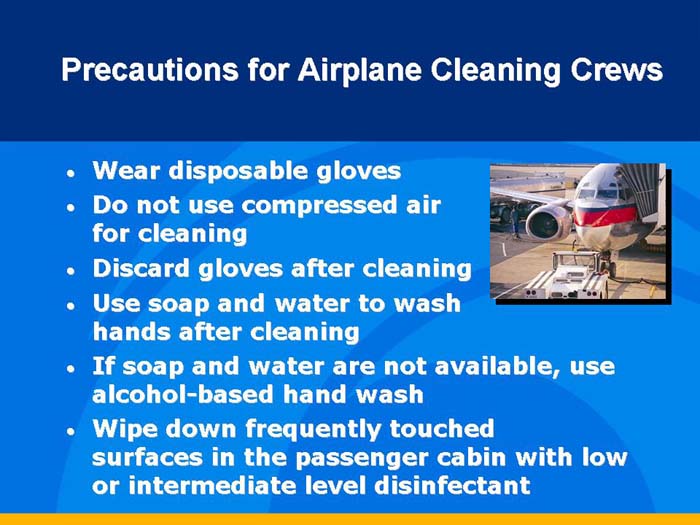
TEXT VERSION OF SLIDE:
Title: Precautions for Airplane Cleaning Crews
Type: Text and Picture Slide
Content: [Includes photo of an airplane.]
- Wear disposable gloves
- Do not use compressed air for cleaning
- Discard gloves after cleaning
- Use soap and water to wash hands after cleaning
- If soap and water are not available, use alcohol-based hand wash
- Wipe down frequently touched surfaces in the passenger cabin with low or intermediate level disinfectant
Speaker Notes:
13. Airline cleaning crews should wear gloves that should be replaced during cleaning if soiled or damaged and disposed of properly after the work shift. Crew members should NOT use compressed air to clean planes since this could spread any infectious particles. They should use a low to intermediate level disinfectant to wipe down frequently touched surfaces in the passenger cabin. After discarding their gloves, they need to wash their hands with soap and water. If soap and water are unavailable, they can use an alcohol-based cleaning agent. It's important for employers of airline cleaning crews to make their personnel aware of the symptoms of SARS so that they can notify their company immediately should they develop any symptoms.
Slide 14 « Previous Next »
TEXT VERSION OF SLIDE:
Title: Precautions for Air Medical Transport of SARS Patients
Type: Text Slide
Content:
- Use respiratory protection (N95)
- Wear appropriate gloves
- Wear protective clothing if there is potential for exposure to blood or body fluids
- Follow standard hygiene practices, including frequent handwashing
Speaker Notes:
14. Personnel involved in air medical transport of SARS patients need to take additional precautions, including wearing respiratory protection. If they anticipate exposure to blood or other potentially infectious materials, they must follow appropriate precautions under the bloodborne pathogens standard, including use of proper PPE, safe needles, etc. They also should follow good hygiene practices, washing hands frequently.
Slide 15 « Previous Next »
TEXT VERSION OF SLIDE:
Title: Precautions for Handling Human Remains of SARS Patients
Type: Text Slide
Content:
- Use N95 or higher respirators
- Wear surgical scrub suit, surgical cap, gown or apron, eye protection, shoe covers, double gloves
- Use good hygiene practices, frequent handwashing
- Refer to CDC website for more detailed precautions
Speaker Notes:
15. Workers who must handle remains of deceased SARS patients must wear respiratory protection and full PPE. They must follow similar good hygiene practices, including frequent handwashing.
Slide 16 « Previous Next »
TEXT VERSION OF SLIDE:
Title: Employee Training
Type: Text Slide
Content:
- All employees with potential exposure should receive training
- Training should cover hazards and protocols at worksite to reduce exposures and isolate and report SARS casess
- Workers who experience SARS symptoms should be excluded from duty and referred to a healthcare provider
Speaker Notes:
16. Employers whose personnel may face exposure to SARS need to educate and train their workers appropriately. Workers need to know about the hazards they face and how to protect themselves as well as how to isolate patients and report potential infections. Any workers who experience symptoms of SARS need to be removed from duty and exposure to others immediately.
Slide 17 « Previous Next »
TEXT VERSION OF SLIDE:
Title: CDC Suggestions for Family Members Caring for SARS Patients at Home
Type: Text Slide
Content:
- Detailed guidance for family members of SARS patients available from CDC
Speaker Notes:
17. Family members who care for SARS patients at home need to take extra precautions. CDC offers detailed guidance on its website.
Slide 18 « Previous Home
TEXT VERSION OF SLIDE:
Title: OSHA - Occupational Safety and Health Administration
Type: Text Slide
Content:
Speaker Notes:
Title Slide OSHA - Occupational Safety and Health Administration