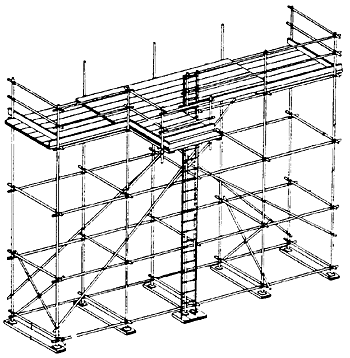
SUMMARY
The Occupational Safety and Health Administration (OSHA) hereby revises the
construction industry safety standards which regulate the design, construction, and use
of scaffolds. The final rule updates the existing scaffold standards and sets
performance-oriented criteria, where possible, to protect employees from scaffold-related
hazards such as falls, falling objects, structural instability, electrocution and
overloading.
In particular, the final rule has been updated to address types of scaffolds -- such as
catenary scaffolds, step and trestle ladder scaffolds, and multi-level suspended
scaffolds -- not covered by OSHA's existing scaffold standards. In addition, the final
rule allows employers greater flexibility in the use of fall protection systems to protect
employees working on scaffolds and extends fall protection to erectors and dismantlers
of scaffolds to the extent feasible.
Another area that the final rule strengthens is training for workers using scaffolds; the
conditions under which such employees must be retrained are also specified in the final
rule. Finally, the language of the rule has been simplified, duplicative and outdated
provisions have been eliminated, overlapping requirements have been consolidated,
and the performance orientation of the rule has been enhanced to allow employers as
much flexibility in compliance as is consistent with employee protection.
EFFECTIVE DATES
This standard will become effective on November 29, 1996,
except for §1926.453(a)(2), which will not become effective until an Office of Management and
Budget (OMB) Control number is received and displayed for this "collection of
information" in accordance with the Paperwork Reduction Act of 1995 (44 U.S.C. 3501
et seq.).
The incorporations by reference of certain publications listed in this final rule are
approved by the Director of the Federal Register as of November 29, 1996.
In addition, employers are required to comply with the provisions of paragraphs (e)(9) and
(g)(2) of §1926.451, which address safe access and fall protection, respectively, for
employees erecting and dismantling supported scaffolds starting on September 2,
1997.
I. Background
Congress amended the Contract Work Hours Standards Act in 1969 by adding a new
section 107 to provide employees in the construction industry with a safer work
environment and to reduce the frequency and severity of construction accidents and
injuries. The amendment, commonly known as the Construction Safety Act (CSA),
significantly strengthened employee protection by authorizing the promulgation of
construction safety and health standards for employees of the building trades and
construction industry working on federal and federally-financed or federally-assisted
construction projects.
The Occupational Safety and Health Act of 1970 (the OSH Act) authorized the
Secretary of Labor to adopt established federal standards issued under other statutes,
including the CSA, as occupational safety and health standards. Accordingly, the
Secretary of Labor adopted the Construction Standards, which had been issued under
the CSA, as OSHA standards. The Safety and Health Regulations for Construction
were subsequently redesignated as 29 CFR part 1926. Standards addressing scaffolds,
§§1926.451 and 1926.452, were adopted in subpart L of part 1926 as OSHA
standards as part of this process.
Various amendments were made to subpart L during the first two years of the OSH Act.
The amendments revised scaffold provisions that addressed planking grades, wood
pole scaffold construction, overhead protection, bracket scaffold loading, and plank
spans. Also, substantive provisions concerning pump jack scaffolds, height of catch
platforms, and guardrails were added.
Based on concerns regarding the effectiveness of the existing scaffold standards,
OSHA began a complete review of subpart L in 1977. The Agency consulted the
Advisory Committee on Construction Safety and Health (ACCSH) several times
regarding draft revisions to subpart L.
Based on its review of existing subpart L, OSHA believes that certain provisions in the
existing standards are outdated, redundant, or ambiguous. In addition, some types of
scaffolds used in construction (e.g., catenary scaffolds) are not clearly addressed by
the existing standards, and some provisions cover only certain types of scaffolds when
they should apply to all. The final rule eliminates those unnecessary, outdated and
redundant provisions (e.g., revised subpart L states the requirement for guardrails
once, rather than 19 separate times as in the existing standard).
II. Hazards Involved
Scaffold-related incidents resulting in injuries and fatalities continue to occur despite the
fact that OSHA has had a scaffold standard in place since 1971. However, the Agency
believes that compliance with the new standard will be better than it has been in the
past because this standard has been simplified, brought up to date, and strengthened
to provide additional protection.
Although specific accident ratios cannot be projected for the estimated 3.6 million
construction workers currently covered by subpart L, the Economic Analysis that
accompanies this final rule estimates that, of the 510,500 injuries and illnesses that
occur in the construction industry annually, 9,750 are related to scaffolds. In addition,
of the estimated 924 occupational fatalities occurring annually, at least 79 are
associated with work on scaffolds.
OSHA prepared the following statistical estimates (based on 4.5 million construction
workers then covered by subpart L) to support the 1986 proposal for subpart L, based
on a review of accident data prepared by the Bureau of Labor Statistics (BLS) (Ex. 3-1).
The revised scaffold standards contain a number of provisions designed specifically to
address the findings of this analysis.
- Seventy-two percent of the workers injured in scaffold accidents covered by
the BLS study attributed the accident either to the planking or support giving way, or to
the employee slipping, or being struck by a falling object. Plank slippage was the most
commonly cited cause.
- About 70 percent of the workers learned of the safety requirements for
installing work platforms, assembling scaffolds, and inspecting scaffolds through on-the-job
training. Approximately 25 percent had no training in these areas.
- Only 33 percent of scaffolds were equipped with a guardrail.
Based on its analysis of the available data and its field experience in enforcing
construction standards, the Agency has determined that employees using scaffolds are
exposed to a significant risk of harm. Specifically, scaffold related fatalities still account
for approximately 9% of all fatalities in the construction workplace.
In addition, the above data indicate that the revised final standard would have
prevented many of these accidents more effectively than compliance with the existing
scaffold standards. Consequently, OSHA finds that the revision of its scaffold
standards for construction is necessary to improve employee protection. OSHA has
determined that, as revised, the standard clearly states employers' duties and the
appropriate compliance measures.
III. Summary and Explanation of the Final Rule
The following explains how the final rule corresponds to or differs
from the existing standard.
§1926.450 Scope, application and definitions applicable to this subpart.
Paragraph (a) The final rule applies to all scaffolds used in construction, alteration,
repair (including painting and decorating), and demolition operations covered under 29
CFR part 1926, except that crane or derrick suspended personnel platforms will
continue to be regulated under §1926.550(g). In addition, aerial lifts are covered
exclusively in §1926.453, as noted in paragraph (a) of §1926.450.
OSHA will continue to regulate temporary elevated work platforms, such as false cars
and go-devils used in elevator shaft construction, as scaffolds.
Paragraph (b) of §1926.450 lists and defines all major terms used in subpart L.
OSHA is revising its definitions for particular types of scaffolds by specifying whether a
particular type of scaffold is a "supported" or a "suspension scaffold." OSHA believes
that adding this information will make it easier for employers to identify the appropriate
general requirements in final rule §1926.451.
The Agency has also revised subpart L definitions by deleting language that limits the
use of a particular type of scaffold. Such substantive limitations are more appropriately
placed in regulatory text. Accordingly, for example, OSHA has revised the definition for
"bricklayers' square scaffolds" (a scaffold composed of framed wood squares which
support a platform, limited to light and medium duty) by deleting the words "limited to
light and medium duty". Similarly, OSHA has revised the definition for "coupler" to be
"a device for locking together the component tubes of a tube and coupler scaffold",
deleting language addressing the material used for the coupler because such
requirements are more properly located in §§1926.451 or 1926.452.
Paragraph 1926.451(a) Capacity
Paragraph (a) sets the minimum strength criteria for all scaffold components and
connections. The final rule sets scaffold capacity requirements that are substantively
the same as those in existing subpart L, while eliminating ambiguities and apparent
inconsistencies.
Paragraph (a)(1) requires that each scaffold and scaffold component be capable of
supporting, without failure, its own weight and at least 4 times the maximum intended
load applied or transmitted to it. Paragraphs (a)(2), (a)(3), (a)(4), (a)(5) and (g) of
§1926.451 provide exceptions to this general rule, and are discussed below.
The final rule clearly provides that the 4 to 1 factor for a component applies only to the
load which is actually applied or transmitted to that component, and not to the total load
placed on the scaffold. The Agency requires that each component be adequate to
meet the 4 to 1 factor, but only for the portion of the MIL applied or transmitted to that
component. The MIL for each component depends on the type and configuration of the
scaffold system.
Paragraph (a)(2) requires that direct connections to roofs and floors and
counterweights used to balance adjustable suspension scaffolds be capable of resisting
at least 4 times the tipping moment imposed by the scaffold operating at the rated load
of the UL rated hoist or at 1.5 (minimum) times the tipping moment imposed by the
scaffold operating at the stall load for hoist not UL rated, whichever is greater.
OSHA agrees that the safety factors for the counterweights, riggings, direct connections
to roofs and floors, and suspension ropes of adjustable suspension scaffolds should be
related to the rated load of the hoist and the stall load of the hoist, and not be based on
the maximum intended load.
Paragraph (a)(3) provides that "each suspension rope, including its connecting
hardware, used on non-adjustable suspension scaffolds shall be capable of supporting,
without failure, at least 6 times the maximum intended load applied or transmitted to
that rope."
Paragraph (a)(4) of the final rule provides that "each suspension rope, including
connecting hardware, used on adjustable suspension scaffolds shall be capable of
supporting, without failure, at least 6 times the maximum intended load applied or
transmitted to that rope with the scaffold operating at either (a) the rated load of the
hoist, or (b) 2 (minimum) times the stall load of the hoist, whichever is greater".
Paragraph (a)(5) requires that the stall load of any scaffold hoist not exceed 3 times its
rated load. OSHA finds that this requirement is reasonably necessary to prevent
accidental overloading of suspension scaffold support systems. U.L. standard 1323
limits the output force of a scaffold hoist to three times the rated load of the hoist. As
far as OSHA has been able to determine, the other laboratories which test and list
scaffold hoists adhere to the requirements of U.L. 1323.
Paragraph (a)(6) requires that scaffolds be designed by a qualified person and
constructed and loaded in accordance with that design.
Paragraph 1926.451(b) Scaffold Platform Construction
Paragraph 1926.451(b) provides criteria for the construction of scaffolds.
Paragraph (b)(1) requires all platforms, except walkways and those platforms used by
employees performing scaffold erection and dismantling operations, to be fully decked
or planked.
Paragraph (b)(1)(I) requires that platform units be placed so that spaces between units
do not exceed 1-inch, except where employers establish that more space is needed.
For example, this would be necessary to fit around uprights when using side brackets
to extend platform width.
Paragraph (b)(1)(ii) provides that, where the exception created by paragraph (b)(1)(I)
applies, employers shall place platform units as close together as possible, with the
space between the platform and uprights not to exceed 9½ inches. OSHA set 9½
inches as the maximum space allowed, because the minimum width for scaffold units
that could be expected to sustain a working load is just over 9½ inches.
In a situation where no work, other than erecting or dismantling the scaffold, is being
done at intermediate levels, the final rule requires only that the planking established by
the employer as necessary to provide safe working conditions for employees erecting
or dismantling the scaffold be used. On the other hand, if scaffold erection or
dismantling is being performed from an intermediate level platform that is being or will
be used as a work area, that platform must be fully planked in accordance with
paragraph (b)(1).
The Agency believes that platforms used solely as walkways or solely by employees
erecting or dismantling scaffolds should be at least 2 planks wide. This is consistent
with the current practice, and the requirements of §1926.451(b)(2).
Paragraph (b)(2) requires that all scaffold platforms and walkways be at least 18
inches (46 cm) wide, with lesser widths allowed for ladder jack scaffolds, top plate
bracket scaffolds, pump jack scaffolds, roof bracket scaffolds, and boatswains' chairs,
and for scaffolds in areas shown to be too narrow to accommodate an 18-inch wide
surface.
The rationale for setting a 12-inch minimum width for ladder jack scaffolds was the
difficulty of handling one 18-inch wide plank or two 9-inch planks on a ladder, which the
Agency considered more hazardous than working on a 12-inch wide plank. Pump jack
scaffolds are the exception to paragraph (b)(2), for which a minimum platform width of
12 inches is permitted. In addition, top plate bracket scaffolds are permitted to have
platforms not less than 12" in width.
Paragraph (b)(3) sets the requirements for the space between the front edge of a
platform and the face of the structure where the scaffold is being used. It requires that,
except as provided in paragraphs (b)(3)(I) and (b)(3)(ii), the front edge of all platforms
must be no more than 14 inches from the face of the structure, unless the employer
implements guardrail systems or personal fall arrest systems that comply with
paragraph (g) of the final rule to protect employees from falling between the platform
and the structure.
Paragraph (b)(3)(I) requires that the front edges of outrigger scaffolds be no more
than three inches from the face of the structure, as is required by §1926.451(g)(4) of
OSHA's existing standard.
Paragraph (b)(3)(ii) requires that the front edges of scaffolds used for plastering and
lathing operations be no more than 18 inches from the face of the structure.
Paragraph (b)(4) requires each end of a platform unit, unless cleated or otherwise
restrained by hooks or equivalent means, to extend over the center line of its support at
least six inches (15 cm). The use of cleats, hooks, and similar securing devices is
allowed as an alternative to the six inch extension, because of their ability to restrain
movement of platform units.
Paragraph (b)(5)(I) provides that each end of a platform unit 10 feet (3 m) or less in
length shall not extend over its support more than 12 inches (30 cm) unless the unit is
designed, and installed so that the cantilevered portion of the unit is able to support
employees or material without tipping or has guardrails which prevent employee access
to the cantilevered end.
Paragraph (b)(5)(ii) provides that each platform unit greater than 10 feet in length shall
not extend over its support more than 18 inches (46 cm), unless the unit is designed
and installed so that the cantilevered portion of the unit is able to support employees
without tipping, or that the unit has guardrails which block employee access to the
cantilevered end.
Paragraph (b)(6), where platform units are abutted to create a long platform, each abutted end shall
rest on a separate support surface. Abutted platform units do not rest
one on another, but instead are end-to-end. Consequently, one unit does not support
the other, and proper support can only be provided by separate support surfaces.
Paragraph (b)(7) provides that where platforms are overlapped to create a long
platform, the overlap shall occur only over supports, and shall not be less than 12
inches (30 cm) unless the platforms are nailed together or otherwise restrained to
prevent movement.
Paragraph (b)(8) requires that at all points of a scaffold where the platform changes
direction, such as turning a corner, any platform that rests on a bearer at an angle other
than a right angle shall be laid first and platforms which rest at right angles over the
same bearer shall be laid second, on top of the first platform.
Paragraph (b)(9) provides that wood platforms shall not be covered with opaque
finishes, except that platform edges may be covered or marked for purposes of
identification. Platforms may be coated periodically with wood preservatives, fire-retardant
finishes, and slip-resistant finishes, but the coating may not obscure the top or
bottom wood surfaces. This paragraph is intended to ensure that structural defects in
platforms are not covered from view by the use of an opaque coating or finish. Hairline
cracks can significantly reduce the strength of a wood member, so early detection of
structural defects is important. Opaque finishes can cover such cracks and make them
difficult to discover. The edges of platform units are excepted from this rule to allow
identification marks, grading marks, or other similar type of marks to be placed on the
unit edges.
Paragraph (b)(10) requires that scaffold components manufactured by different
manufacturers not be intermixed unless the component parts fit together without force
and the resulting scaffold's structural integrity is maintained by the user. Scaffold
components manufactured by different manufacturers shall not be modified in order to
intermix them unless the resulting scaffold is determined by a competent person to be
structurally sound. OSHA expects that the competent person who evaluates the
scaffold will have the appropriate knowledge, skill and experience regarding scaffold
systems and components.
Paragraph (b)(11) provides that
scaffold components made of dissimilar metals shall not be used together unless a competent
person has determined that galvanic action will not reduce the strength of any component to
a level below that required by §1926.451(a).
Paragraph 1926.451(c) Criteria for Supported Scaffolds
Final rule §1926.451(c) sets criteria for the use of supported scaffolds.
Paragraph (c)(1) requires that supported scaffolds with a height to base width ratio of
more than 4 to 1 (including outrigger supports, if used) be restrained from tipping by
guying, tying, bracing, or equivalent means.
Paragraph (c)(1)(I) requires that guys, ties, and braces be installed at locations where
horizontal members support both inner and outer legs. Paragraph (c)(1)(ii) requires:
1) Guys, ties, and braces shall be installed according to the scaffold
manufacturer's recommendations or at the closest horizontal member to the 4:1
height and be repeated vertically at locations of horizontal members every 20
feet (6.1 m) or less thereafter for scaffolds 3 feet (0.91 m) wide or less and every
26 feet (7.9 m) or less thereafter for scaffolds greater than 3 feet (0.91 m) wide;
2) The top tie, guy or brace of a completed scaffold shall be placed no further
than the 4:1 height from the top; and,
3) Such guys, ties and braces be installed at each end of the scaffold and at
horizontal intervals not to exceed 30 feet (9.1 m) (measured from one end [not
both] towards the other).
Paragraph (c)(1)(iii) requires that scaffolds with eccentric loads (such as cantilevered
work platforms) be restrained from tipping through the use of ties, guys, braces or
outriggers.
Paragraph (c)(2) requires that supported scaffold poles, legs, posts, frames, and
uprights bear on base plates and mud sills or other adequate firm foundation.
Paragraph (c)(2)(I) requires that such footings be level, sound, rigid, and capable of
supporting the scaffold in a loaded condition without settling or displacement.
Paragraphs (c)(2)(ii) and (iii)
provide that unstable objects shall neither be used to
support scaffolds or platform units, nor be used as working platforms, respectively.
Paragraph (c)(2)(iv) provides that front-end loaders and similar pieces of equipment
shall not be used as scaffold supports unless they have been specifically designed by
the manufacturer for such use.
Paragraph (c)(2)(v) requires that fork-lifts not be used to support scaffold platforms
unless the entire platform is attached to the fork and the fork-lift is not moved
horizontally while the platform is occupied. Both these requirements relate to the need
for solid support for scaffold platforms and reflect the fact that front-end loaders, forklifts
and other such equipment are not generally designed for this purpose. The other
requirements of §1926.451 would have to be met.
Paragraph (c)(3) of the final rule requires that supported scaffold poles, legs, posts,
frames, and uprights be plumb and braced to prevent swaying and displacement.
Paragraph 1926.451(d) Criteria for Suspension Scaffolds
Paragraph (d) sets criteria for the use of suspension scaffolds.
Paragraph (d)(1) requires that all suspension scaffold support devices, such as
outrigger beams, cornice hooks, parapet clamps, and similar devices, rest on surfaces
capable of supporting at least 4 times the loads imposed on them by the scaffold
operating at the rated load of the hoist (or at least 1.5 times the loads imposed on them
by the scaffold operating at the stall load of the hoist, whichever is greater).
Paragraph (d)(2) requires that suspension scaffold outrigger beams, when used, be
made of structural metal, or equivalent strength material, and be restrained to prevent
movement.
Paragraph (d)(3) sets requirements for the stabilization of outrigger beams. The
paragraph requires that outrigger beams be secured directly to the supporting surface
or be stabilized using counterweights, except that masons' multi-point adjustable
suspension scaffolds shall not be stabilized by counterweights. The rule does not allow
counterweights for stabilizing such masons' suspension scaffolds because, with the
large loads often placed on masons' multi-point adjustable suspension scaffolds and
the large counterweights that would be necessary to anchor such systems, OSHA is
concerned that the supporting roof or floor would become dangerously overloaded.
Paragraph (d)(3)(I) provides that direct connections shall be evaluated by a competent
person who affirms, based on that evaluation, that supporting surfaces can support the
anticipated loads. In addition, the paragraph requires masons' multi-point adjustable
suspension scaffold connections to be designed by an engineer experienced in such
scaffold design. OSHA anticipates that compliance with these provisions will ensure
that roof or floor decks are capable of supporting the loads to be imposed.
Paragraphs (d)(3)(ii) through (d)(3)(v) require that counterweights be made of non-flowable
material; be specifically designed for use as scaffold counterweights; be
secured to outrigger beams to prevent accidental displacement; and not be removed
from an outrigger beam until the scaffold is disassembled, respectively. These
requirements are necessary to ensure that counterweights are used only for their
intended purpose and are not displaced or removed prematurely.
Paragraphs (d)(3)(vi) through (d)(3)(x) set requirements for securing outrigger
beams. In particular, outrigger beams not stabilized by direct connections to the
supporting surface shall be secured by tiebacks (paragraph (d)(3)(vi)). Tiebacks must
be as strong as the suspension ropes (paragraph (d)(3)(vii)), be secured to a
structurally sound anchorage (paragraph (d)(3)(ix)), and be installed perpendicular to
the structure unless opposing angle tiebacks are installed (paragraph (d)(3)(x)). In
addition, paragraph (d)(3)(viii) requires that outrigger beams be placed perpendicular to
their bearing support, with the exception described more fully below.
OSHA has determined that it is reasonably necessary to require that counterweights be
designed for no other purpose than to counterweight the system, and to prohibit the use
of construction materials as counterweights. In addition, OSHA has determined that it is
appropriate to require the marking of counterweights with their weights because that
information is needed for the proper design, selection and installation of
counterweights.
Paragraph (d)(4) specifies the construction requirements for outrigger beams used
with suspension scaffolds. This provision requires that suspension scaffold outrigger
beams be: provided with stop bolts or shackles at both ends; securely fastened
together with the flanges turned out when channel iron beams are used in place of I-beams;
installed with all bearing supports perpendicular to the beam center line; and
set and maintained with the web in a vertical position. In addition, when an outrigger
beam is used, the shackle or clevis with which the suspension rope is attached to the
outrigger beam shall be placed directly over the hoisting machine, i.e., over the center
line of the stirrup.
Paragraph (d)(5) sets requirements for suspension scaffold support devices other
than outrigger beams. These devices include cornice hooks, roof irons, parapet
clamps, or similar devices. Under this provision, those devices must be: made of steel,
wrought iron, or materials of equivalent strength; supported by bearing blocks; secured
against movement by tiebacks installed at right angles to the face of the building or
structure unless opposing angle tiebacks are installed and secured to a structurally
sound point of anchorage on the building or structure (sound points of anchorage
include structural members, but do not include standpipes, vents, other piping systems,
or electrical conduit); and tiebacks shall be equivalent in strength to the strength of the
hoisting rope.
Paragraph (d)(6) specifies the minimum length of suspension rope to be used with
different kinds of hoists. In particular, winding drum hoists are required to have at least
four wraps of suspension rope at the lowest point of scaffold travel. All other types of
hoists are required to have suspension rope long enough to lower scaffolds to the level
below, without having the rope end pass through the hoist, or to have the rope end
configured or provided with means so that the end does not pass through the hoist.
Final rule paragraph (d)(7) states "The use of repaired wire rope as suspension rope
is prohibited."
Paragraph (d)(8) provides that wire suspension ropes shall not be joined together
except through the use of eye splice thimbles connected with shackles or cover plates
and bolts.
Paragraph (d)(9) provides that the load end of wire suspension ropes shall be
equipped with proper size thimbles and secured by eye splicing or equivalent means.
Paragraph (d)(10) requires that ropes be inspected for defects by a competent person
prior to each work shift and after every occurrence which could affect a rope's integrity.
The wire rope shall be replaced if the rope has any physical damage which impairs its
function and strength; any kinks that might impair the tracking or wrapping of rope
around the drum(s) or sheave(s); six randomly distributed broken wires in one rope lay
or three broken wires in one strand in one rope lay; abrasion, corrosion, scrubbing,
flattening or peening causing loss of more than one-third of the original diameter of the
outside wires; evidence of any heat damage resulting from a torch or any damage
caused by contact with electrical wires; or evidence that a secondary brake has been
activated during an overspeed condition and engages the suspension rope (paragraphs
(d)(10)(I) through (vi)).
Paragraph (d)(11) requires that swaged attachments or spliced eyes on wire
suspension ropes not be used unless they are made by the wire rope manufacturer or a
qualified person. This provision is essential to ensure the strength and integrity of such
attachments as eyes.
Paragraph (d)(12) requires that, when wire rope clips are used on suspension
scaffolds, there shall be a minimum of 3 wire rope clips installed, with the clips a
minimum of 6 rope diameters apart; employers shall follow the manufacturer's
recommendations when installing clips, retightening clips after initial loading, and
inspecting and retightening clips at the start of each work shift; U-bolt clips (a variety of
wire rope clip) shall not be used at the point of suspension for any scaffold hoist; and
when U-bolt clips are used, the U-bolt shall be placed over the dead end of the rope,
and the saddle shall be placed over the live end of the rope.
Paragraph (d)(13) requires that suspension scaffold power-operated hoists and
manually operated hoists be of a type tested and listed by a qualified testing laboratory.
Paragraph (d)(14) requires
that gasoline-powered equipment and hoists not be used on suspension scaffolds.
Paragraph (d)(15) requires that gears and brakes of power operated hoists used on
suspension scaffolds be enclosed.
Paragraph (d)(16) provides that, in addition to the normal operating brake, suspension
scaffold power operated hoists and manually operated hoists shall have a braking
device or locking pawl which engages automatically when a hoist makes either of the
following uncontrolled movements: an instantaneous change in momentum or an
accelerated overspeed.
Paragraph (d)(17) provides that "Manually operated hoists shall require a positive
crank force to descend."
Paragraph (d)(18) provides that two-point and multi-point suspension scaffolds shall be
tied or otherwise secured to prevent them from swaying, as determined necessary
based on an evaluation by a competent person. This paragraph requires, in addition,
that window cleaners' anchors not be used for the purpose of preventing swaying. This
prohibition is based on the fact that window cleaners' anchors are not designed for the
load that could be imposed.
Paragraph (d)(19) requires that single function emergency escape and rescue devices
not be used as working platforms. This paragraph also provides that the prohibition
does not apply to systems which are designed to function both as working platforms
and as emergency systems.
Paragraph 1926.451(e) Access
Paragraph (e) sets the requirements for safe access to scaffolds. The introductory text
states that employers must provide scaffold access which complies with paragraph (e)
for each affected employee. It also specifies that the access requirements for
employees erecting or dismantling supported scaffolds are prescribed in paragraph
(e)(9).
Paragraph (e)(1) provides that access to and between scaffold platforms more than
two feet (0.6 m) above or below the point of access shall be by portable ladders, hook-on
ladders, attachable ladders, scaffold stairways, stairway-type ladders (such as
ladder stand), ramps, walkways, integral prefabricated scaffold access, or equivalent
means, or by direct access from another scaffold, structure, personnel hoist, or similar
surface. In addition, the final rule requires that cross braces not be used as a means of
access.
Paragraph (e)(2) sets requirements for portable, hook-on and attachable ladders. A
note to this paragraph indicates that additional requirements for the proper construction
and use of portable ladders are contained in subpart X of this part--Stairways and
Ladders-- of the construction standards.
Paragraph (e)(2)(I) provides that portable, hook-on, and attachable ladders shall be
positioned so as not to tip the scaffold.
Paragraphs (e)(2)(ii)-(vi) provide that hook-on and attachable ladders shall have
bottom rungs positioned not more than 24 inches (61 cm) above the scaffold supporting
level; have rest platforms at 35 foot (10.7 m) maximum vertical intervals on all
supported scaffolds more than 35 feet (10.7 m) high; be specifically designed for use
with the manufactured type of scaffold to be used; have a minimum rung length of 11-1/2 inches (29 cm); and have uniformly spaced rungs with a maximum spacing
between rungs of 16-3/4 inches, respectively.
Paragraph (e)(3) sets requirements for stairway-type ladders.
Paragraphs (e)(3)(I) through (v)
require that stairway-type ladders be positioned so
that the bottom step is not more than 24 inches (61 cm) above the scaffold supporting
level; be provided with rest platforms at 12 foot (3.7 m) maximum vertical intervals;
have a minimum step width of 16 inches (41 cm) (except for mobile scaffold stairway-type
ladders, which are permitted to have a minimum step width of 11 ½ inches); and
have slip-resistant treads on all steps and landings..
Paragraph (e)(4) lists requirements for scaffold stairway towers used for access to
scaffolds and other elevated work surfaces.
Paragraph (e)(4)(I) requires that a stairrail consisting of a toprail and a midrail be
provided on each side of each scaffold stairway.
Paragraph (e)(4)(ii) requires that the toprail of each stairrail system shall be capable of
serving as a handrail, unless a separate handrail is provided.
Paragraph (e)(4)(iii) requires that handrails, and toprails that serve as handrails,
provide a handhold for employees grasping them to avoid falling.
Paragraph (e)(4)(iv) requires that stairrail systems and handrails be surfaced in a
manner that prevents injury to employees from punctures or lacerations, and to prevent
snagging of clothing.
Paragraph (e)(4)(v) requires that the ends of stairrail systems and handrails be
constructed in a manner that does not constitute a projection hazard.
Paragraph (e)(4)(vi) requires that scaffold stairway handrails, and toprails that are
used as handrails, have a minimum clearance of 3 inches (7.6 cm) between the
handrail or toprail and other objects. Inadequate hand clearances can render handrails
essentially useless.
Paragraph (e)(4)(vii) requires that stairrails be no less than 28 inches (71 cm) or more
than 37 inches (94 cm) from the upper surface of the stairrail to the surface of the
tread, in line with the face of the riser at the forward edge of the tread. This provision
differs from the stairrail height requirements of subpart X, which was never intended to
apply to scaffold stairways.
Paragraph (e)(4)(viii) requires that scaffold stairways be provided with landing
platforms that are at least 18 inches wide and at least 18 inches (45.7 cm) long at each
level. This provision provides adequate protection for employees without impeding the
use of most scaffold stairways now in use.
Paragraph (e)(4)(ix) requires that each scaffold stairway be at least 18 inches (45.8
cm) wide between stairrails.
Paragraph (e)(4)(x) requires that
treads and landings have slip-resistant surfaces.
Paragraph (e)(4)(xi) requires that scaffold stairways be installed between 40 degrees
and 60 degrees from the horizontal. OSHA has determined that scaffold stairways
installed in the range of 40 degrees to 60 degrees from the horizontal will provide safe
employee access and will still be capable of fitting into the confines of the scaffold
frames.
Paragraph (e)(4)(xii) requires that guardrails meeting the requirements of
1926.451(g)(4) be provided on the open sides and ends of each landing.
Paragraph (e)(4)(xiii) requires riser heights within each flight of scaffold stairs to be
uniform within 1/4 inch. OSHA believes that a uniform riser height within 1/4 inch (0.6
cm) for all steps in each flight of stairs is necessary in order to minimize the possibility
that employees will slip, trip, and fall while they are on the stairs. OSHA recognizes
that there are situations where the level of the ground or of the structure to which the
stair tower is connected will cause the spacing of the top or bottom step of the stairway
system to deviate from uniformity with the other steps by more than 1/4 inch. The
Agency has determined that such deviation will not compromise employee safety, so
long as the stair tower otherwise complies with the requirements of paragraph (e)(4).
This is consistent with §1926.1052(a)(3).
Paragraph (e)(4)(xiv) requires that tread depth be uniform, within 1/4 inch, for each
flight of stairs.
Paragraph (e)(5) sets requirements
for ramps and walkways used to access scaffolds.
Paragraph (e)(5)(I) provides that ramps and walkways six (6) feet (1.8 m) or more
above lower levels shall be provided with guardrail systems in accordance with the
provisions of Part 1926, Subpart M--Fall Protection.
Paragraph (e)(5)(ii) provides that ramps and walkways shall not exceed a slope of one
(1) vertical to three (3) horizontal (20 degrees above the horizontal).
Paragraph (e)(5)(iii) also requires that if the slope of a ramp or walkway is steeper
than one (1) vertical in eight (8) horizontal, the ramp or walkway must have cleats not
more than fourteen (14) inches (35 cm) apart which are securely fastened to the
planking to provide secure footing.
Paragraph (e)(6) sets requirements for integral prefabricated scaffold access frames.
Paragraph (e)(6)(I) provides that such frames shall be specifically designed and
constructed for use as ladder rungs.
Paragraph (e)(6)(ii) requires that
the frames have a rung length of at least 8 inches.
Paragraph (e)(6)(iii) prescribes that rungs less than 11-1/2 inches in length shall be
used for access only and not as work platforms unless fall protection, or a positioning
device, is used.
Paragraphs (e)(6)(iv) through (vi) require that integral prefabricated scaffold access
frames be uniformly spaced within each frame section; provided with rest platforms at
35 foot (10.7 m) maximum vertical intervals on all supported scaffolds more than 35
feet (10.7 m) high; and have a maximum spacing between rungs of 16-3/4 inches (43
cm), respectively.
Paragraph (e)(6)(vi) provides that non-uniform rung spacing caused by joining end
frames together is allowed, provided the resulting spacing does not exceed 16-3/4
inches (43 cm).
Paragraph (e)(7) provides that all steps and rungs of all ladder and stairway type
access shall line up vertically with each other between rest platforms.
Paragraph (e)(8) provides that direct access to or from another surface shall be
allowed only when the pertinent surfaces are not more than 14 inches (36 cm) apart
horizontally and not more than 24 inches (61 cm) apart vertically.
Paragraph (e)(9) of the final rule sets access requirements for employees erecting or
dismantling supported scaffolds. The introductory language of paragraph (e)(9)
requires employers to comply with final paragraphs (e)(9)(I)-(iv) starting on September
2, 1997. OSHA has delayed implementation of this paragraph (as well as paragraph
(g)(2)) so that affected employers have sufficient time to develop and implement the
necessary measures. In addition, the delayed implementation allows time for OSHA to
complete work on non-mandatory Appendix B, discussed below, which will provide
examples of considerations that employers complying with paragraphs (e)(9) and (g)(2)
would take into account.
Paragraph (e)(9)(I) provides that the means of access for erectors or dismantlers shall
be determined by a competent person, based on specific site conditions and the type of
scaffold being erected. As discussed in relation to the introductory text of final rule
paragraph (e), while the Agency originally proposed to exempt erectors and dismantlers
working on supported scaffolds from requirements for safe access, careful review of the
record has led OSHA to the conclusion that a competent person is the appropriate
individual to decide what the appropriate means of access for scaffold erectors and
dismantlers is on any particular job, based on specific site conditions. Employers are
required to have the erection, dismantling or alteration of a scaffold conducted under
the supervision and direction of a competent person who is qualified in the pertinent
subject matter.
Paragraph (e)(9)(ii) of the final rule requires that hook-on or attachable ladders be
installed as soon as practical after the scaffold erection has progressed to the point
permitting their installation and use. Sectional ladders can be used for access once
adequate support is available. Note: This entire section applies only to erectors and
dismantlers.
Paragraph (e)(9)(iii) of the final rule recognizes that the end frames of tubular welded
frame scaffolds that meet certain requirements can be safely used as a means of
access for scaffold erectors and dismantlers. These requirements are based on
section 1637(n)(2)(C) of the California code.
Paragraph (e)(9)(iv)
of the final rule provides that cross bracing is not an acceptable
means of access on tubular welded frame scaffolds, because cross braces are
designed to provide diagonal stability to the scaffold and are not designed to withstand
the forces that could be applied by employees climbing up and down on them. This
provision is consistent with ANSI A10.8, section 4.18, and with the general prohibition in
final rule paragraph (e)(1), discussed above.
Paragraph §1926.451(f) Use
Paragraph (f) of the final rule addresses safe work practices for the use of scaffolds
and the activities which take place on scaffolds.
Paragraph (f)(1) provides that scaffolds and scaffold components shall not be loaded
in excess of their maximum intended loads or rated capacities, whichever is less.
Compliance with this rule ensures that the scaffold's capacity is not exceeded. OSHA
believes it is appropriate to take into account the "expected" burden as well as the
burden a scaffold "can" support without failure.
Paragraph (f)(2) prohibits the use of shore or lean-to scaffolds. Such scaffolds are not
properly designed nor properly constructed, and pose a serious threat to anyone
working on them.
Paragraph (f)(3) requires that scaffolds and scaffold components be inspected for
visible defects by a competent person prior to each work shift and after any occurrence
which could affect a scaffold's structural integrity. OSHA has determined that
inspections conducted by a competent person before each shift and after any
occurrence that would affect the scaffold's integrity will adequately protect employees
working on scaffolds and ensure that defects are detected in a timely fashion.
Paragraph (f)(4) requires that any part of a scaffold whose strength has been reduced
to less than that required by §§1926.451(a) shall be immediately repaired or replaced,
braced to meet those provisions, where appropriate, or be removed from service until
repaired. This paragraph applies whenever a scaffold component, for any reason,
lacks the required strength. In particular, under this provision employers must follow
through to address problems identified pursuant to paragraph (f)(3) of this section.
Paragraph (f)(5) provides that scaffolds shall not be moved horizontally while
employees are on them, unless they have been designed by a registered professional
engineer specifically for such movement or, for mobile scaffolds, where provisions of
§1926.452(w) are followed.
Paragraph (f)(6) of the final rule addresses the use of scaffolds near exposed and
energized power lines. In particular, this paragraph requires employers to maintain
clearance between power lines and scaffolds, including any conductive materials on the
scaffold. The minimum clearance for all uninsulated lines and for insulated lines of
more than 300 volts is 10 feet. The minimum clearance for insulated lines of less than
300 volts is 3 feet.
Paragraph (f)(6)(I) provides that scaffolds and materials may be closer to power lines
than specified above only where necessary to do the work, and only after the utility
company or electrical system operator has been notified of the need to work closer and
the utility company or electrical system operator has deenergized the lines, relocated
the lines, or installed protective coverings to prevent accidental contact with the lines.
Paragraph (f)(7) of the final rule provides that scaffolds shall only be erected, moved,
dismantled, or altered under the supervision and direction of a competent person. It
further provides that the listed activities shall be performed only by experienced and
trained employees selected for such work by the competent person.
Paragraph (f)(8) provides that employees are prohibited from working on scaffolds
covered with snow, ice, or other slippery material except as necessary for removal of
such materials.
Paragraph (f)(9) requires that, where swinging loads are being hoisted on, to, or near
scaffolds such that the loads could contact the scaffold, tag lines or equivalent
measures shall be utilized to stabilize the loads. This provision covers all hoisting
operations in proximity to scaffolds, because a swinging load can pose a hazard
regardless of its destination.
Paragraph (f)(10) requires that support ropes used with adjustable suspension
scaffolds have sufficient diameter for functioning of the brakes and the hoist
mechanism.
Paragraph (f)(11) requires that suspension ropes be shielded when a heat-producing
process is performed. When acids or other corrosive substances are used on a
scaffold, the ropes shall be shielded, treated to protect against the corrosive
substances, or shall be of a material which is not adversely affected by the substance
being used.
Paragraph (f)(12) prohibits work on or from scaffolds during storms or high winds
unless a competent person has determined that it is safe for employees to be on the
scaffold and these employees are protected by a personal fall arrest system or wind
screens. Wind screens shall not be used unless the scaffold is secured against the
forces imposed.
Paragraph (f)(13) provides that debris shall not be allowed to accumulate on platforms,
where it could pose a slip, trip, or fall hazard to employees on or below the platform.
This provision is consistent with ANSI A10.8-1988, Section 4.24.
Paragraph (f)(14) provides that makeshift devices, such as but not limited to boxes and
barrels, shall not be used on top of scaffold platforms to increase the working level
height of employees. The Agency has concluded that these makeshift devices will not
meet the pertinent criteria of this final rule, in terms of strength and stability.
Paragraph (f)(15) prohibits the use of ladders on scaffolds to increase the employee's
working level except when the employees are on large area scaffolds and the ladder is
used in accordance with the applicable provisions of final rule paragraph (f)(15)(I)-(iv),
discussed below.
Paragraph (f)(15)(I) provides that when a ladder is placed against a structure which is
not a part of the scaffold, the scaffold must be secured against the sideways thrust
exerted by the ladder.
Paragraphs (f)(15)(ii) through (iv) require that the platform units be secured to the
scaffold to prevent them from moving; that the ladder legs are all on the same platform
unit unless other means have been provided to stabilize the ladder against platform unit
deflection; and that the ladder legs be secured to prevent them from slipping and being
pushed off the platform unit. The Agency believes that compliance with these
provisions will prevent the tipping and instability hazards that led OSHA to propose a
prohibition against the use of ladders on all scaffolds.
Paragraph (f)(16) provides that platform units shall not deflect more than 1/60 of the
span when loaded. This provision intended to limit the amount platform units can
deflect under load without becoming over stressed and without their ends being pulled
from their supports.
Paragraph (f)(17) requires employers to reduce the possibility of welding current arcing
through suspension wire rope while employees are performing welding from suspended
scaffolds by insulating the suspended platform and its rigging. OSHA is adding this
new provision to protect employees from the electrocution and platform collapse hazards posed by
arcing welding current. In particular, the Agency requires that employers rig affected
scaffolds with insulated thimbles (paragraph (f)(17)(I)), insulated
wire rope (paragraph (f)(17)(ii)), and insulated hoist mechanisms (paragraph (f)(17)(iii)).
This paragraph also specifies precautions for grounding the scaffold to the structure on
which welding is being performed (paragraphs (f)(17)(iv - vi)). These provisions are
consistent with ANSI A10.8-1988, Section 6.2.9.
OSHA has determined that compliance with the provisions of paragraph (f)(17), taken
together, will minimize the hazards of electric arcing during welding operations on
suspended scaffolds. The Agency has concluded that it is appropriate to address the
hazard of arcing welding current during welding operations on suspended scaffolds in
the final rule for scaffolds, rather than in the welding standards, because the
precautions in question relate to the scaffold rigging, not to welding procedures, and
because placing the pertinent regulatory text in the rule will facilitate compliance.
Paragraph 1926.451(g) Fall protection
Paragraph (g) sets fall protection requirements for employees working on scaffolds,
including criteria for guardrail systems. Fall hazards account for a high percentage of
the injuries and fatalities experienced by scaffold workers. OSHA has determined that
compliance with this paragraph will effectively protect employees from those hazards.
Paragraph (g)(1) sets 10 feet as the threshold height above which fall protection is
required and indicates (paragraphs (g)(1)(I) - (vii)) what fall protection measures are
required for particular types of scaffolds. In addition, the introductory text references
paragraph (g)(2), which addresses the fall protection requirements for employees
erecting and dismantling supported scaffolds. Finally, a note has been added at the
end of paragraph (g)(1), to indicate clearly that the fall protection requirements for
employees installing suspension scaffold support systems on floors, roofs, and other
elevated surfaces are set forth in subpart M of the construction standards.
OSHA has carefully analyzed all of the comments and data available in the record and
has determined that it is appropriate to maintain the 10-foot fall protection threshold.
This is also the height requirement recommended by the current national consensus
standard, ANSI A10.8-1988. This level differs from the 6-foot threshold for fall
protection set in subpart M (Fall Protection) for other walking/working surfaces in
construction because scaffolds, unlike these other surfaces, are temporary structures
erected to provide a work platform for employees who are constructing or demolishing
other structures. The same features that make scaffolds appropriate for short-term
use in construction, such as ease of erection and dismantling) also make them less
amenable to the use of fall protection at the time the first level is being erected. For
example, the site preparation (such as leveling of the ground) that is done before a
scaffold is erected is less thorough than the leveling performed prior to constructing a
building. In addition, there is often no structure adjacent to a scaffold that can be used
to anchor a personal fall arrest system, because the adjacent structure is in the process
of being built or demolished.
Paragraphs (g)(1)(I) through (vii) of the final rule specify the types of fall protection to
be used on particular types of scaffolds.
Paragraph (g)(1)(I) recognizes that personal fall arrest systems, not guardrails, are
appropriate for use on boatswains' chairs, catenary scaffolds, float scaffolds, needle
beam scaffolds, and ladder jack scaffolds. This requirement is being applied to
catenary scaffolds and ladder jack scaffolds for the first time.
Paragraph (g)(1)(ii) requires personal fall arrest systems and guardrail systems for all
single-point adjustable suspension scaffolds (except boatswains' chairs), and for all
two-point adjustable suspension scaffolds. The requirement to have guardrails and
personal fall arrest systems on two-point scaffolds is based on the fact that a guardrail
system alone does not provide adequate fall protection when a suspension rope fails
and causes the scaffold to tip or hang from only one end. Personal fall arrest system
protection is also necessary for single-point systems, because the fall hazard related to
suspension rope failure is as serious as it is with the two-point scaffold. However,
because personal fall arrest systems would be the primary means of fall protection on
single-point and two-point systems, the provision allows a lower minimum strength
guardrail system to be used.
Paragraph (g)(1)(iii) provides that "Each employee on a crawling board (chicken
ladder) shall be protected by a personal fall arrest system, a guardrail system (with
minimum 200 pound toprail capacity), or by a three-fourth inch (1.9 cm) diameter
grabline or equivalent handhold securely fastened beside each crawling board."
Paragraph (g)(1)(iv) provides that employees on self-contained scaffolds be protected
by both personal fall arrest systems and guardrail systems when the platform is
supported by ropes (as when the scaffold is being raised or lowered on some systems)
and by guardrail systems when the platform is supported directly by the scaffold frame.
Paragraph (g)(1)(v) requires guardrails to be used along scaffold walkways and to be
located within 9 ½ inches horizontally of at least one side of the walkway. The
provision that guardrails need only to be provided along one side applies only when the
platform is used solely as a means of access to get from one point on the scaffold to
another. If work activities other than access are performed on or from the walkway,
then the platform is not considered to be a walkway (see definition of "walkway"), and
other provisions of paragraphs (g)(1), as appropriate, would apply.
Paragraph (g)(1)(vi) provides that fall protection (i.e., a personal fall arrest system or
guardrail) be provided on all open sides and ends of scaffolds from which employees
are performing overhand bricklaying operations and/or related work, except those sides
and ends next to the wall being laid.
Paragraph (g)(1)(vi) of the final rule is consistent with §1926.501(b)(9), which
addresses fall protection for employees performing overhand bricklaying while on
elevated surfaces other than scaffolds.
Paragraph (g)(1)(vii) requires that employees
on scaffolds not addressed elsewhere in paragraph (g)(1) be protected either by guardrails or personal
fall arrest systems.
Note
Paragraph (g)(1) does not apply where there are no "open sides or ends" on the scaffold (see
definition in §1926.451(b)). For the scaffold to be considered completely enclosed, no perimeter
face of the scaffold may be more than 14 inches from a wall. The requirements for fall protection
will apply at openings such as hoist ways, elevator shafts, stairwells, or similar openings in the
scaffold platform, or openings in the walls of the structure surrounding the platform.
Paragraph (g)(2) of the final rule addresses fall protection for employees erecting or dismantling
supported scaffolds. OSHA has determined that it is appropriate to delay the implementation of
paragraph (g)(2) until September 2, 1997. The delay will allow affected employers sufficient time to
implement the appropriate procedures for addressing the fall protection needs of employees erecting
or dismantling scaffolds. In addition, deferring compliance will allow time for the Agency to
complete non-mandatory Appendix B, which will provide examples of considerations that a competent
person would take into account when evaluating fall protection options for scaffold erectors and
dismantlers. As discussed above in relation to final rule paragraph (e)(9), the Agency has also
deferred requirements for safe access for scaffold erectors and dismantlers until September 2, 1997.
Paragraph (g)(2) requires that employers whose employees erect or dismantle supported scaffolds
after September 2, 1997, ensure that a competent person determines the feasibility and safety of
providing fall protection for such employees. This paragraph further requires that affected
employers provide fall protection for employees erecting or dismantling supported scaffolds where
the installation and use of such protection is feasible and does not create a greater hazard.
The Agency recognizes the importance of training and hazard awareness programs to employee safety,
but finds that these precautions alone are not adequately protective because site conditions change
and mistakes are made. The Agency finds that providing appropriate fall protection, whenever it is
feasible or will not create a greater hazard, is the best way to ensure that erectors and
dismantlers are appropriately protected from fall hazards.
The Agency agrees that, if fall protection can be provided, it is the employer's responsibility to
take the actions necessary to protect employees. However, OSHA has determined, based on the
information in the record, that in some situations, it is not possible to provide fall protection
for erectors and dismantlers of supported scaffolds.
Employers must have valid reasons for not providing fall protection to scaffold erectors and
dismantlers, but OSHA does not agree that the employer must put these reasons in writing. Compliance
officers can substantiate employer claims of in feasibility or greater hazard through on-site
observations and discussion with the competent person and other workers.
Paragraph (g)(3) provides that personal fall arrest systems must comply with the pertinent
provisions of §1926.502(d) and, in addition, must be attached by lanyard to a vertical lifeline,
horizontal lifeline, or scaffold structural member. However, when overhead obstructions such as
overhead protection or additional platform levels are part of a single-point or two-point adjustable
suspension scaffold, then vertical lifelines must not be used, because, in the event of a scaffold
collapse, the overhead components would injure an employee who was tied off to a vertical lifeline.
Paragraph (g)(3)(I) requires that vertical lifelines, when used, be fastened to a fixed safe point
of anchorage, be independent of the scaffold, and be protected from sharp edges and abrasion. Based
on concern that inadequate anchor points may be used, this paragraph also incorporates the language
of the note to proposed §1926.451(e)(3), which stated that safe points of anchorage include
structural members of buildings, but do not include standpipes, vents, other piping systems,
electrical conduit, outrigger beams, or counterweights.
Paragraph (g)(3)(ii) states that horizontal
lifelines, when used, shall be secured to two or more structural members of the scaffold, and shall
not be attached only to the suspension ropes.
Paragraph (g)(3)(iii) provides that, when lanyards are connected to horizontal lifelines or
structural members on a single-point or two-point adjustable suspension scaffold, the scaffold must
be equipped with additional independent support lines and automatic locking devices capable of
stopping the fall of the scaffold in the event one or more of the suspension ropes fail. The
independent support lines must be equal in number and strength to the suspension ropes. OSHA
believes that in the event of a suspension rope failure, the additional support lines will keep the
scaffold from falling.
Paragraph (g)(3)(iv) provides that vertical lifelines, independent support lines, and suspension
ropes must not be attached to each other, or be attached to or use the same point of anchorage, or
be attached to the same point on the scaffold or body belt/harness system.
Paragraph (g)(4) sets criteria for guardrail
systems used to provide fall protection for employees working on scaffolds.
Paragraph (g)(4)(I) provides that guardrail systems be installed along all open sides and ends of
platforms. In the case of suspended scaffolds, guardrails must be installed before any employee is
allowed on a hoisted scaffold. In the case of supported scaffolds, installation must occur before
employees are permitted to work from the scaffold. When an employee is on a supported scaffold
during the scaffold erection process, fall protection is covered by final rule paragraph (g)(2).
Paragraph (g)(4)(ii) provides that the top edge height of toprails or equivalent members on
supported scaffolds manufactured or placed into service after January 1, 2000 must be between 38
inches (0.97 m) and 45 inches (1.2 m) above the platform surface. The top edge height of guardrails
on supported scaffolds manufactured and placed into service before January 1, 2000 and on all
suspended scaffolds where both a guardrail and a personal fall arrest system are required must be
between 36 inches (0.9 m) and 45 inches (1.2 m). The final rule also provides that toprail height
may exceed 45 inches if the other criteria of paragraph (g)(4) have been satisfied.
Paragraph (g)(4)(iii) states that, when midrails, screens, mesh, intermediate vertical members (such
as balusters), solid panels, or equivalent structural members are used, they are to be installed
between the top edge of the guardrail system and the scaffold platform.
Paragraphs (g)(4)(iv) through (vi) specify the criteria necessary to ensure that the midrails,
screens, mesh, and baluster type protection required by paragraph (g)(4)(iii) will be properly
placed and effective.
Paragraph (g)(4)(iv) requires that midrails, when used, be installed at a height midway between the
top edge of the guardrail system and the platform surface.
Paragraph (g)(4)(v) requires that screens and mesh, when used, extend from the top edge of the
guardrail system to the scaffold platform, and along the entire opening between the supports.
Paragraph (g)(4)(vi) requires that intermediate vertical members (such as balusters or additional
rails), when used, be not more than 19 inches (48 cm) apart.
Paragraph (g)(4)(vii) of the final rule provides that toprails or equivalent members be capable of
withstanding, without failure, a force applied in any downward or horizontal direction at any point
along their top edge of at least 100 pounds (445 n) for guardrail systems installed on single-point
adjustable suspension scaffolds and on two-point adjustable suspension scaffolds, and at least 200
pounds (890 n) for guardrail systems installed on all other scaffolds.
Paragraph (g)(4)(viii) provides that when
the loads specified in paragraph (g)(4)(vii) are applied in a downward direction, the top edge
may not drop below the height above the platform surface prescribed in paragraph (g)(4)(ii).
Paragraph (g)(4)(ix) states that midrails, screens, mesh, intermediate vertical members, solid
panels, and equivalent structural members must be capable of withstanding, without failure, a force
applied in any downward or horizontal direction at any point along the midrail or other member of at
least 75 pounds (333 n) for guardrail systems with a minimum 100 pound toprail capacity, and at
least 150 pounds (666 n) for guardrail systems with a minimum 200 pound toprail capacity.
Paragraph (g)(4)(x) provides that a separate guardrail section is not required on the ends of
suspension scaffolds when the scaffold's support system (stirrup) or hoist prevents passage of
employees.
Paragraph (g)(4)(xi) requires that guardrail systems be so surfaced as to prevent injury to an
employee from punctures or lacerations, and to prevent the snagging of clothing.
Paragraph (g)(4)(xii) requires that toprails
and midrails not be so long as to constitute a hazard.
Paragraph (g)(4)(xiii) prohibits the use of steel banding and plastic banding as toprails or
midrails. Although such banding can often withstand a 200 pound load, it can tear easily if twisted.
In addition, such banding often has sharp edges which can cut a hand if seized.
Paragraph (g)(4)(xiv) requires that guardrail
systems using manila, plastic or synthetic rope as rails be inspected by a competent person as
frequently as necessary to ensure that the guardrails comply with the performance criteria in final
rule §1926.451(g).
Paragraph (g)(4)(xv) permits the use of cross bracing in lieu of either a midrail or a toprail when
certain criteria are met. Cross bracing would be accepted in lieu of a toprail when the crossing
point is between 38 and 48 inches above the work surface. Also, cross bracing would be accepted in
lieu of a midrail when the crossing point is between 20 and 30 inches above the work surface. In
addition, the end points of each upright must be no more than 48 inches apart, which will reduce the
slope of the cross bracing and result in a surface that is similar to that of a standard guardrail.
Paragraph 1926.451(h). Falling object protection
Paragraph (h)(1) provides that employees working on scaffolds wear hardhats and be protected from
falling hand tools, debris, and other small objects through the installation of toeboards, screens,
or guardrail systems or through the erection of debris nets, catch platforms, or canopy structures
that deflect falling objects. In addition, when the falling objects to which employees on scaffolds
may be exposed are too large, heavy or massive to be contained or deflected by any of the
above-listed measures, the employer must protect affected employees by placing any such potential
falling objects away from the edge of a surface from which they might fall and must secure those
materials as necessary to prevent their falling.
Paragraph (h)(2) requires employers to protect employees working below from objects falling from
scaffold.
Paragraph (h)(2)(I) provides for the use of barricades on lower levels to exclude employees from
areas where falling objects might land. Compliance with this new provision will enable employers to
eliminate employee exposure to the hazard.
Paragraph (h)(2)(ii) would require employers to provide toeboards along the edge of platforms more
than ten feet above lower levels for a distance sufficient to protect workers below, except that on
float (ship) scaffolds, an edging of 3/4 inch x 1-1/2 inch wood, or a material with equivalent
strength, may be used in lieu of a toeboard.
Paragraph (h)(2)(iii) provides, as an alternative, for erection of paneling or screening in cases
where tools or other materials are piled to a height higher than the top edge of a toeboard. The
panel or screen must extend from the toeboard (or platform) to the top of the guardrail and be
erected for a distance sufficient to protect employees below. In addition, the panel or screen would
need to be capable of withstanding, without failure, a force of at least 150 pounds, applied in any
downward or outward direction at any point along the screen (to comply with paragraph (g)(4)(ix)).
Paragraph (h)(2)(iv) allows employers to protect employees from falling objects through the
installation of a guardrail system which complies with §1926.451(g)(4) and which has openings small
enough to reject passage of potential falling objects.
Paragraph (h)(2)(v) provides that employers can protect employees working below scaffolds from
falling objects through the installation of debris nets, catch platforms, or canopies that have
sufficient strength to withstand the impact forces of potential falling objects.
Paragraph (h)(3) sets criteria for the use of canopies.
Paragraph (h)(3)(I) requires that canopies
be installed between the falling object hazard and the employees.
Paragraph (h)(3)(ii) requires the use of additional independent support lines to support the
scaffold in the event of suspension support rope failure, in cases where canopies are used for
falling object protection on suspended scaffolds.
Paragraph (h)(3)(iii) requires that independent
support lines and suspension ropes not be attached to the same point of anchorage. This new provision
will prevent the loss of the backup safety systems in the event of suspension rope anchorage failure.
Paragraph (h)(4) sets strength criteria for toeboards.
Paragraph (h)(4)(I) requires that toeboards be capable of withstanding, without failure, a force of
at least 50 pounds applied in any downward or horizontal direction at any point along the toeboard.
Paragraph (h)(4)(ii) sets forth the construction requirements for toeboards. This provision requires
that toeboards be at least three and one-half inches high, fastened securely in place, and have not
more than 1/4-inch clearance above the walking/working surface. In addition, toeboards must be solid
or have openings no greater than one inch in the greatest dimension.
§1926.452 Additional Requirements Applicable to Specific Types of Scaffolds
Section 1926.452 of the final rule contains requirements that supplement the requirements of
§1926.451 with regard to particular types of scaffolds. The identified scaffolds have unique
features which require specific attention.
OSHA has determined that compliance with the performance-oriented provisions of final rule
§§1926.451 and 1926.452, taken together, will provide adequate protection for employees working on
scaffolds. Further, the Agency believes that the specification language suggested by the commenters
would limit innovation and impose unreasonable burdens on employers.
Paragraph (a) Pole Scaffolds
Paragraph (a) sets requirements for the proper use of bearers, braces and runners on pole scaffolds.
The final rule has deleted the word "wood" from the title of the paragraph, since pole scaffolds can
be constructed of other materials. In addition, the final rule provides that pole scaffolds over 60
feet in height be designed by a registered professional engineer, and must be constructed and loaded
in accordance with that design. The provision also notes that non-mandatory Appendix A contains
examples of criteria that will enable an employer to comply with design and loading requirements for
pole scaffolds under 60 feet in height.
Paragraph (b) Tube and Coupler Scaffolds
Paragraph (b) sets requirements for the use of bearers, bracing, runners and couplers on tube and
coupler scaffolds. In addition, the final rule provides that tube and coupler scaffolds over 125
feet in height be designed by a registered professional engineer, and be constructed and loaded in
accordance with such design.
Paragraph (b)(1) requires that platforms not be moved until the next location has been properly
prepared to support the platform being moved.
Paragraph (b)(2) requires the installation of transverse bracing at the scaffold ends and, at least,
at every third set of posts horizontally and every fourth post vertically. This paragraph provides
for diagonal bracing from the outer or inner posts or runners upward to the next outer or inner
posts or runners. In addition, building ties must be installed at the bearer levels between the
diagonal braces in conformance with §1926.451(c)(1).
Paragraph (b)(3) sets requirements for the installation of longitudinal bracing across the inner and
outer rows of posts for straight run scaffolds. In particular, such bracing must be installed
diagonally in both directions and shall extend from the base of the end posts upward to the top of
the scaffold at a 45 degree angle. Where scaffold length is greater than height, bracing shall be
repeated at least at every fifth post (ref. Page 316 of current SIA Handbook and drawing of tube &
coupler scaffold in the standard). Where scaffold length is less than height, such bracing shall be
installed from the base of the end posts upward to the opposite end posts and then in alternating
directions until reaching the top of the scaffold. In addition, bracing shall be installed as close
as possible to the intersection of the bearer and post or of the runner and post.
Paragraph (b)(4) requires that bracing be attached to the runners as close to the post as possible,
where conditions preclude attachment of bracing to posts. Agency recognizes that attachment to the
post, while the most desirable option, is not always possible. In circumstances where such
attachment is not possible, OSHA has determined that attachment to the runner, as close as possible
to the post, will still maximize directional stability and provide the strength necessary to
properly brace the scaffold.
Paragraph (c) Fabricated frame scaffolds
Paragraph (c) provides additional requirements for fabricated frame scaffolds (tubular welded frame
scaffolds).
Paragraph (c)(1) requires that platforms not
be moved until the next location is properly prepared and ready to support the platform being moved.
Paragraphs (c)(2), (c)(3) and (c)(6) are
effectively identical to existing §1926.451(d)(3), (5) and (9), respectively.
Paragraph (c)(4) requires the locking together of end frames. This requirement only applies where
uplift forces are strong enough to displace the end frames or panels, such as when a hoist is being
used that could snag the scaffold during a hoist operation.
Paragraph (c)(5) specifies the proper placement
of platform support brackets. Improper placement of such cantilever supports can significantly reduce
their support capacity and thus endanger employees working on top of the platform.
Paragraph (d) Plasterers', decorators' and large area scaffolds
Paragraph (d) requires that plasterers', decorators' and large area scaffolds be constructed in
accordance with §1926.452(a), (b), or (c) of this section. Paragraph (d) references the provisions
of paragraphs (a), (b), and (c) because plasters', decorators' and large area scaffolds are almost
always constructed using pole scaffolds, tube and coupler scaffolds, or fabricated frame scaffolds.
Paragraph (e) Bricklayers' square scaffolds (Squares)
Paragraph (e) This paragraph requires that scaffolds made of wood be reinforced with gussets on both
sides of each corner (paragraph (e)(1)); that diagonal braces be installed on all sides of each
square (paragraph (e)(2)); that diagonal braces be installed between squares on the rear and front
sides of the scaffold, and extend from the bottom of each square to the top of the next square
(paragraph (e)(3)); and that scaffolds of this type not exceed three tiers in height, that they be
constructed and arranged so that one square rests directly above the other, and that the upper tiers
stand on a continuous row of planks laid across the next lower tier and be nailed down or otherwise
secured to prevent displacement (paragraph (e)(4)).
Paragraph (f) Horse scaffolds
Paragraph (f) This paragraph requires that horse scaffolds not be constructed or arranged more than
two tiers or 10 feet (3.0 m) in height, whichever is less (paragraph (f)(1)); when arranged in
tiers, that each horse be placed directly over the horse in the tier below (paragraph (f)(2)); when
arranged in tiers, the legs of each horse shall be nailed down or otherwise secured to prevent
displacement (paragraph (f)(3)); and that, when arranged in tiers, each tier shall be cross braced
(paragraph (f)(4)).
Paragraph (g) Form scaffolds and carpenters' bracket scaffolds
Paragraph (g) provides additional rules for form scaffolds and carpenters' bracket scaffolds.
Paragraph (g)(1) carries forward the requirements for attachment of a scaffold to a supporting
framework or structure set by existing §1926.451(m)(2), (x)(4)(ii), and (x)(5).
Paragraph (g)(2) maintains the existing §1926.451(x)(6)(I) requirement that wooden bracket form
scaffolds be an integral part of the form panel.
Paragraph (g)(3) requires that folding type
metal brackets, when extended for use, shall be either bolted or secured with a locking-type pin.
Paragraph (h) Roof bracket scaffolds
Paragraph (h) This paragraph requires that scaffold brackets be constructed to fit the pitch of the
roof and provide a level support for the platform (paragraph (h)(1)); and that brackets be anchored
in place by nails unless it is impractical to use nails (paragraph (h)(2)). Paragraph (h)(2) further
provides that brackets shall be held in place with first-grade manila rope of at least three-fourth
inch diameter, or a rope with equivalent strength, when nails are not used. Reference
451(g)(1)(viii) for fall protection.
Paragraph (I) Outrigger scaffolds
Paragraph §1926.452(I) Paragraphs (I)(1) through (I)(4), set requirements for the proper positioning
and securing of outrigger beams. Paragraphs (I)(5) and (I)(6) require that the inboard ends of
outrigger beams be securely anchored and that the entire supporting structure be securely braced.
Paragraph (I)(7) requires that platform units be nailed, bolted or otherwise secured to outriggers,
to prevent displacement.
Paragraph (I)(8) requires that scaffolds and scaffold components be designed by a registered
professional engineer and constructed and loaded in accordance with such design. This provision
reflects OSHA's determination that the design of this type of scaffold involves calculations that
required the skills of a registered professional engineer, and that the criteria in the proposed
rule had such limited applicability as to be of virtually no help to employers in almost all
situations.
Paragraph (j) Pump jack scaffolds
Paragraph (j)(1) requires that pump jack brackets, braces, and
accessories be fabricated from metal plates and angles. In addition, each pump jack bracket shall
have two positive gripping mechanisms to prevent any failure or slippage.
Paragraph (j)(2) requires that poles be secured to the structure by rigid triangular bracing or
equivalent, at the bottom, top, and other points as necessary. In addition, that provision further
requires that when the pump jack has to pass bracing that is already installed, an additional brace
must be installed approximately four feet (1.2 m) above the brace to be passed. That additional
brace must be left in place until the pump jack has been moved and the original brace reinstalled.
Paragraph (j)(3) provides, when guardrails are used for fall protection, that a workbench may be
used as the toprail only if the workbench complies with the requirements of §§1926.451(g)(4)(ii),
(vii), (viii) and (xiii).
Paragraph (j)(4) provides that work benches
shall not be used as scaffold platforms.
Paragraph (j)(5) provides, when poles are made of wood, that the pole lumber shall be
straight-grained, free of shakes, large loose or dead knots, and other defects which might impair
strength.
Paragraph (j)(6) provides, when wood poles are
constructed of two continuous lengths, that the lengths shall be joined together with the seam parallel
to the bracket.
Paragraph (j)(7) requires, when two by fours
are spliced to make a pole, that mending plates be installed at all splices to develop the full strength
of the member.
Paragraph (k) Ladder jack scaffolds
Paragraph 1926.452(k) of the final rule provides additional
requirements for ladder jack scaffolds.
Paragraph (k)(1) provides that platforms shall not exceed a height of 20 feet (6.1 m).
Paragraph (k)(2) requires that all ladders used to support ladder jack scaffolds meet the
requirements of subpart X of 29 CFR part 1926--Stairways and Ladders, except that job-made ladders,
which are permitted by subpart X, are not permitted to be used to support ladder jack scaffolds.
Paragraph (k)(3) provides that the ladder jack be so designed and constructed that it will bear
either on the side rails and ladder rungs or on the ladder rungs alone. This paragraph further
requires that the bearing area for a ladder jack that bears only on the rungs shall be at least 10
inches (25.4 cm) on each rung to ensure adequate support.
Paragraph (k)(4) requires that ladders used to
support ladder jacks be placed, fastened, or equipped with devices to prevent slipping.
Paragraph (k)(5) provides that scaffold platforms shall not be bridged one to another. The provision
would prohibit situations where, for example, four ladders are used to support three platforms. OSHA
is prohibiting bridging because this practice often leads to overloading of the two ladders in the
middle. This provision does not prohibit passage from one scaffold to another if the scaffolds are
close enough for employees to walk (but not to jump or swing) from one scaffold to the other.
Paragraph (l) Window jack scaffolds
Paragraph (l) This paragraph provides that window jack scaffolds shall be securely attached to the
window opening (paragraph (l)(1)), shall be used only for the purpose of working at the window
opening through which the jack is placed (paragraph (l)(2)) and shall not be used to support planks
placed between one window jack and another, or to support other elements of scaffolding. These
requirements are necessary to ensure the safety of employees working from these platforms.
Paragraph (m) Crawling boards
Paragraph (m) of the final rule provides additional requirements for crawling boards (chicken
ladders). The final rule requires that crawling boards extend from the roof peak to the eaves when
used in connection with roof construction, repair, or maintenance (paragraph (m)(1)), and that
crawling boards be secured to the roof by ridge hooks or by means which satisfy equivalent criteria
(e.g., strength and durability) (paragraph (m)(2)). These requirements are designed to ensure that
crawling boards used by employees performing roof work are as secure as possible. Reference
451(g)(1)(iii) for fall protection.
Paragraph (n) Step, platform, and trestle ladder scaffolds
Paragraph (n) provides additional requirements for step, platform,
and trestle ladder scaffolds.
Paragraph (n)(1) provides that scaffold platforms not be placed any higher than the second highest
rung or step of the ladder supporting the platform. This provision is consistent with paragraphs
17.4 and 17.5 of ANSI A10.8-1988, and is intended to ensure the stability of this type of scaffold.
Paragraph (n)(2) requires that all ladders used
in conjunction with step, platform and trestle ladder scaffolds meet the requirements of subpart X of
29 CFR part 1926--Stairways and Ladders, except that job-made ladders must not be used to support such
scaffolds.
Paragraph (n)(3) provides that ladders used to support step, platform, and trestle ladder scaffolds
shall be placed, fastened, or equipped with devices to prevent slipping. Paragraph (n)(4) requires
that scaffolds not be bridged one to another. Bridging, as discussed above under paragraph (k)(5),
occurs when four ladders are used to support three platforms. OSHA is prohibiting bridging because
this practice often leads to overloading of the two ladders in the middle. Although step, platform
and trestle ladder scaffolds were not specifically addressed in OSHA's existing scaffold rule, they
are covered by the general requirements in existing rule §1926.451(a).
Final rule paragraphs (n)(2), (3), and (4) correspond to the ladder jack scaffold provisions in
final rule §1926.451(k)(2), (4) and (5), respectively. The "ladder-type" scaffolds covered by
paragraph (n) differ from ladder jack scaffolds in that the platform rests directly on the ladder
step or rung, whereas ladder jack scaffold platforms rest on brackets.
Paragraph (o) Single-point adjustable scaffolds
Paragraph (o) This paragraph combines existing §1926.451(k),
single-point adjustable suspension scaffolds, and §1926.451(l), boatswains' chairs, because
boatswains' chairs are a form of single-point adjustable suspension scaffold.
Paragraph (o)(1) provides, when two single-point adjustable suspension scaffolds are combined to
form a two-point adjustable suspension scaffold, that the resulting scaffold meet the requirements
for two-point adjustable suspension scaffolds in final rule paragraph (p).
Paragraph (o)(2) addresses the circumstances under which the supporting rope between a scaffold and
a suspension device is permitted to deviate from a vertical position (i.e., at a 90 degree angle
from level grade). This paragraph requires that the supporting rope between the scaffold and the
suspension device be kept vertical unless the following four conditions are met: the rigging must
have been designed by a qualified person; the scaffold must be accessible to rescuers; the
supporting rope must be protected to ensure that it will not chafe at any point where a change in
direction occurs; and the scaffold must not be able to sway into another surface. Whenever swaying
of the scaffold could bring the scaffold into contact with another surface, the supporting rope must
be vertical, with no exceptions.
Paragraph (o)(3) requires that the tackle used with boatswains' chairs be ball bearing or bushed
blocks containing safety hooks and properly "eye" spliced minimum five-eight (5/8) inch (1.6 cm)
diameter first grade manila rope, or other rope that meets the performance criteria of the
above-specified manila rope. OSHA recognizes that the use of an open hook could allow a chair to be
dislodged if the rigging hung up on an obstruction. The corresponding ANSI standard, A10.8-1988,
paragraph 6.14.5, provides for the use of a hook with a safety latch over the opening (safety hook)
to prevent dislodging of the chair. The Agency agrees that it is appropriate to explicitly require
that employers who have their employees use boatswains' chair rig their scaffolds with safety hooks.
In addition, OSHA believes that locking safety hooks, such as are required for use with crane and
derrick suspended personnel platforms (§1926.550(g)(4)(iv)(B)), would provide the most effective
protection for affected employees.
Paragraph (o)(4) provides that boatswains' chair seat slings be reeved through four corner holes in
the seat; shall cross each other on the underside of the seat; and shall be rigged so as to prevent
slippage which could cause an out-of-level condition. This paragraph is intended to prevent tipping
of the chair.
Paragraph (o)(5) requires, except as provided
in paragraph (o)(6), that boatswains' chair seat slings be a minimum of five-eight (5/8) inch (1.6 cm)
diameter fiber or synthetic rope or other rope which satisfies equivalent performance criteria.
Paragraph (o)(6) requires that boatswains' chair seat slings be a minimum of three-eight (3/8) inch
(1.0 cm) wire rope, when a heat-producing process such as gas or arc welding is being conducted.
This provision is necessary to ensure that the chair's sling is made of fire-resistant materials.
Paragraph (o)(7) requires that non-cross-laminated wood boatswains's chairs be reinforced on their
underside by cleats securely fastened to prevent the board from splitting.
Paragraph (p) Two-point adjustable suspension scaffolds
Paragraph (p) provides additional requirements for two-point adjustable suspension scaffolds (swing
stages).
Paragraph (p)(1) provides that platforms not
be more than 36 inches (0.9 m) wide unless designed by a qualified person to prevent unstable conditions.
Paragraph (p)(2) requires that the platform
be securely fastened to hangers (stirrups) by U-bolts or other means which satisfy §1926.451(a).
Paragraph (p)(3) provides that the blocks for fiber or synthetic ropes consist of at least one
double and one single block, and that the sheaves of all blocks fit the size of the rope used.
Paragraph (p)(4) requires that platforms be
of the ladder-type, plank-type, beam-type, or light-metal type. Light metal-type platforms having a
rated capacity of 750 pounds or less and platforms 40 feet (12.2 m) or less in length shall be tested
and listed by a nationally-recognized testing laboratory.
Paragraph (p)(5) requires that two-point scaffolds not be bridged or otherwise connected one to
another during raising and lowering operations unless the bridge connections are articulated and the
hoists properly sized. It is not intended to prohibit passage from one scaffold to another, but to
prevent significant overloading of the hoist nearest the bridging device during operation of the
hoist, or displacement of the bridge if the hoist is used to raise or lower one of the scaffolds.
Many hoists are only sized to support one end of a two-point system. If one of two bridged scaffolds
were to be raised by a hoist, a bridge laid between the scaffolds could be displaced unless the
bridge is articulated (connected). This could also significantly increase the load on the hoist if
it is not properly sized. The final rule addresses these two hazards by requiring bridge connections
to be articulated and requiring that hoists be properly sized.
Paragraph (p)(6) allows passage from one platform to another only when the platforms are at the same
height, when the platforms abut each other, and when walk-through stirrups specifically designed for
this purpose are used.
Paragraph (q) Multi-point suspension scaffolds, stone setters' multipoint adjustable suspension
scaffolds, and masons' multi-point adjustable suspension scaffolds
Paragraph 1926.452(q) provides additional requirements for multi-point suspension scaffolds, stone
setters' multi-point adjustable suspension scaffolds, and masons' multipoint adjustable suspension
scaffolds.
Paragraph (q)(1) provides that, when two or more
scaffolds are used, they shall not be bridged one to another unless they are designed to be bridged,
the bridge connections are articulated (connected), and the hoists are properly sized.
Paragraph (q)(2) provides that, if bridges are not used, passage may be made from one platform to
another only when the platforms are at the same height and are abutting.
Paragraph (q)(3) requires that scaffolds be suspended from metal outriggers, brackets, wire rope
slings, hooks, or equivalent means.
Paragraph (r) Catenary scaffolds
Paragraph 1926.452(r) of the final rule provides additional requirements for catenary scaffolds.
Paragraph (r)(1) allows no more than one platform to be placed between consecutive vertical pickups,
and no more than two platforms to be used on a catenary scaffold. These requirements are intended to
prevent overloading of this type of scaffold.
Paragraph (r)(2) requires that platforms supported by wire ropes have hook-shaped stops on each end
of the platforms to prevent the platforms from slipping off the wire ropes. These hooks shall be so
placed that they will prevent the platforms from falling if one of the horizontal wire ropes breaks.
This language is consistent with the corresponding provision of ANSI A10.8-1988, paragraph 20.1.
Paragraph (r)(3) of the final rule provides
that wire ropes shall not be tightened to the extent that the application of a scaffold load will
over stress them. This provision is consistent with the corresponding language of ANSI A10.8-1988,
paragraph 20.2.
Paragraph (r)(4) requires that wire ropes be continuous and without splices between anchors. This
language is consistent with the corresponding language in ANSI A10.8-1988, paragraph 20.2, and is
necessary to ensure that the rope has sufficient integrity to handle the load.
Paragraph (s) Float (ship) scaffolds
Paragraph (s) provides additional requirements for float (ship) scaffolds.
Paragraph (s)(1) requires that the platform
be supported by a minimum of two bearers, each of which
shall project a minimum of six inches (15.2 cm) beyond the platform on both sides. This will ensure
that the platform will be fully supported. In addition, each bearer shall be securely fastened to
the platform to prevent slippage.
Paragraph (s)(2) provides that rope connections shall be such that the platform cannot shift or
slip. Platform slippage is a significant factor in scaffold accidents.
Paragraph (s)(3) provides that, when only two ropes are used with each float, those ropes shall be
arranged so as to provide four ends which are securely fastened to overhead supports, and each
supporting rope shall be hitched around one end of the bearer and pass under the platform to the
other end of the bearer where it is hitched again, leaving sufficient rope at each end for the
supporting ties.
Paragraph (t) Interior hung scaffolds
Paragraph (t) provides additional requirements for interior hung scaffolds.
Paragraph (t)(1) requires that scaffolds
be suspended only from the roof structure or other structural members such as ceiling beams.
This requirement is necessary to ensure that these suspended scaffolds are supported by structural
members with adequate capacity for safe use.
Paragraph (t)(2) requires that the supporting members be inspected and checked for strength before
the scaffold is erected. This requirement is necessary because such points of support cannot be
assumed to be strong enough to support a scaffold since they may already be loaded to their capacity
or they may have deteriorated over time. This provision is consistent with ANSI A10.8-1988,
paragraph 16.7.
Paragraph (t)(3) provides that suspension ropes and cables be connected to the overhead supporting
members by shackles, clips, thimbles, or by other means which provide equivalent strength, security
and durability.
Paragraph (u) Needle beam scaffolds
Paragraph (u) of the final rule provides additional requirements
for needle beam scaffolds.
Paragraph (u)(1) requires that scaffold support beams be installed on edge.
Paragraph (u)(2) provides that ropes or hangers be used for supports, except that one end of a
needle beam scaffold may be supported by a permanent structural member. This provision is based on
existing §§1926.451(p)(2) and (8), and is necessary to ensure that these scaffolds are properly
supported by rope or hangers that meet the strength criteria of §1926.451(a).
Paragraph (u)(3) requires that the ropes be securely attached to the needle beams. This is a change
from existing §1926.451(p)(3), which specified that all rope attachments must be either a scaffold
hitch or properly made eye splices. OSHA determined that the existing rule is too restrictive,
because other knots and means of attachment, such as wire rope clips, can adequately support the
scaffold without decreasing employee safety.
Paragraph (u)(4) provides that the support connection be arranged so as to prevent the needle beam
from rolling or becoming displaced, which could result in tipping of the platform.
Paragraph (u)(5) provides that platform units shall be securely attached to the needle beams by
bolts or equivalent means. In addition, cleats and overhang are not considered to be adequate means
of attachment.
Paragraph (v) Multi-level suspended scaffolds
Paragraph 1926.452(v) of the final rule provides additional requirements for multi-level suspended
scaffolds. These scaffolds are suspended scaffolds with more than one working level.
Paragraph (v)(1) requires that multi-level suspended platform scaffolds be equipped with additional
independent support lines, equal in number to the number of points supported and of equivalent
strength to the suspension ropes, and be rigged to support the scaffold in the event the suspension
rope(s) fail. These additional lines would support the scaffold, and prevent collapse in the event
of primary support line failure.
Paragraph (v)(2) provides that the independent support lines and suspension ropes shall not be
attached to the same points of anchorage. This provision reflects OSHA concern that the independent
support lines would not protect workers from scaffold collapse if the independent lines and the
suspension ropes were attached to the same anchorage point when the anchorage failed.
Paragraph (v)(3) requires that supports for platforms be attached directly to the support stirrup
and not to any other platform. This provision is intended to protect against platform overloading.
Paragraph (w) Mobile scaffolds (Does not include scissor lifts)
Paragraph (w) provides additional rules for mobile scaffolds. This
paragraph applies to all mobile scaffolds, not just to those which are manually propelled.
Paragraph (w)(1) provides that scaffolds shall be braced by cross, horizontal, or diagonal braces,
or combination thereof, to prevent racking or collapse of the scaffold and to secure vertical
members together laterally so as to automatically square and align the vertical members. In
addition, scaffolds shall be plumb, level, and squared. All brace connections shall be secured. This
paragraph also provides that scaffolds constructed of tube and coupler components shall conform to
the requirements of §1926.452(b) (paragraph (w)(1)(I)), and that scaffolds constructed of fabricated
frame components shall conform to the requirements of §1926.452(c) (paragraph (w)(1)(ii)).
Paragraph (w)(2) requires that scaffold casters and wheels be locked with positive wheel and/or
wheel and swivel locks, or equivalent means, to prevent movement of the scaffold while the scaffold
is used in a stationary manner.
Paragraph (w)(3) provides that manual force used to move the scaffold shall be applied as close to
the base as practicable, but not more than five feet (1.5 m) above the supporting surface. The final
rule limits the height at which the force can be applied to 5 feet above the supporting surface, to
minimize overturning forces.
Paragraph (w)(4) requires that power systems
used to propel mobile scaffolds be designed for such use. In addition, forklifts, trucks, similar
motor vehicles, or add-on motors shall not be used to propel scaffolds unless the scaffold is
designed for such propulsion systems.
Paragraph (w)(5) requires that scaffolds be stabilized to prevent tipping during movement.
Paragraph (w)(6) provides that employees shall
not be allowed to ride on scaffolds unless the following conditions exist:
- The surface on which the scaffold is being moved shall be within three degrees of level, and free
of pits, holes, and obstructions (w)(6)(I));
- The height to base width ratio of the scaffold during movement shall be two to one or less,
unless the scaffold is designed and constructed to meet or exceed nationally-recognized stability
test requirements (w)(6)(ii));
- Outrigger frames, when used, shall be installed on both sides of the scaffold (w)(6)(iii));
- When power systems are used, the propelling force shall be applied directly to the wheels, and
shall not produce a speed in excess of one foot per second (0.3 mps) (w)(6)(iv)); and
- No employee is on any part of the scaffold which extends outward beyond the wheels, casters, or
other supports (w)(6)(v)).
Paragraph (w)(7) requires that platforms not extend outward beyond the base supports of the scaffold
unless outrigger frames or equivalent devices are used to ensure stability. Compliance with this
provision will prevent eccentric loading of the scaffold frame that could cause the scaffold to tip
over.
Paragraph (w)(8) provides that, where leveling of the scaffold is necessary, screw jacks or
equivalent means be used. This provision is consistent with the corresponding provision in ANSI
A10.8-1988, paragraph 11.1.4.
Paragraph (w)(9) requires that caster stems and wheel stems be pinned or otherwise secured to
scaffold legs or adjustment screws.
Paragraph (w)(10) provides that, before a
scaffold is moved, employees on the scaffold shall be made aware of the move.
(x) Repair bracket scaffolds.
The Agency described such scaffolds as consisting of platforms supported by brackets which are
secured in place by one or more wire ropes placed in an approximately horizontal plane around the
circumference of the structure and tensioned by a turnbuckle.
Paragraph (x)(1) requires employers to secure brackets in place with ½ inch diameter wire rope that
extends around the circumference of the chimney.
Paragraph (x)(2) requires that each bracket be attached to the securing wire rope (or ropes) by a
positive locking device capable of preventing the unintentional detachment of the bracket from the
rope, or by some other means which prevents unintentional detachment.
Paragraph (x)(3) requires that each bracket, at the contact point between the supporting structure
and the bottom of the bracket, be provided with a "shoe" (heel block or foot) capable of preventing
the lateral movement of the bracket.
Paragraph (x)(4) requires that platform units be secured to brackets in a manner that prevents the
separation of platform units from brackets and prevents movement of platform units or brackets on a
completed scaffold.
Paragraph (x)(5) provides that, when a wire rope is placed around a structure to provide safe
anchorage for personal fall arrest systems that are used by employees erecting or dismantling repair
bracket scaffolds, the wire rope shall be at least 5/16 inches in diameter and shall, in all other
respects, satisfy the requirements of subpart M, OSHA's Fall Protection Standard.
Paragraph (x)(6) requires that each wire rope used for securing brackets in place or as an anchorage
for personal fall arrest systems be protected from damage due to contact with edges, corners,
protrusions, or other discontinuities of the supporting structure or scaffold components.
Paragraph (x)(7) provides that tensioning of each wire rope used for securing brackets in place or
as an anchorage for personal fall arrest systems shall be by means of a turnbuckle at least 1 inch
in diameter, or by some other equivalent means. OSHA has allowed employers the flexibility to use
means other than a single turnbuckle for tensioning wire ropes, where the alternative means provide
equivalent tension, because the Agency wants to encourage innovation and provide flexibility. In
addition, OSHA anticipates that there may be circumstances where more than one turnbuckle will be
needed to tension the wire rope, depending on the diameter of the chimney.
Paragraph (x)(8) requires that each turnbuckle
be connected to the other end of its rope by use of a proper-size eye splice thimble.
Paragraph (x)(9) provides that U-bolt wire rope clips shall not be used on any wire rope used to
secure brackets or to serve as an anchor for personal fall arrest systems. OSHA is concerned that
the use of U-bolt wire rope clips as wire rope fasteners on the horizontal support ropes could
result in damage to the dead end of the rope. Further, if a segment of damaged dead end later were
to become part of the live end due to an increase in the circumference of the structure, the Agency
was concerned that the wire rope would be unable to support the loads imposed on it.
Paragraph (x)(10) requires employers to ensure that materials are not dropped to the outside of the
supporting structure.
Paragraph (x)(11) requires that erection of a repair bracket scaffold be performed in only one
direction around the structure.
Paragraph (y) Stilts
Paragraph (y) provides requirements for the use of stilts.
Paragraph (y)(1) requires that employees not
wear stilts on scaffolds except when the employees are on large area scaffolds.
Paragraph (y)(2) provides, when employees wearing stilts are on large area scaffolds where guardrail
systems are being used, that the dimensions of the guardrail system shall be increased to offset the
height of the stilts.
Paragraph (y)(3) of the final rule provides that all surfaces on which stilts are used shall be flat
and free of pits, holes and obstructions, such as debris, as well as all other tripping and falling
hazards.
Paragraph (y)(4) of the final rule provides
that stilts shall be properly maintained and that any alterations of the original equipment must be
approved by the manufacturer.
§1926.453 Aerial lifts
The introductory text to this section indicates that §1926.453 applies only to ANSI A92.2 type
equipment (vehicle mounted elevating and rotating work platforms), and further notes that the
requirements of §1926.451 and §1926.452 do not apply to this type of equipment.
Paragraph (a) addresses general requirements for aerial lifts, while paragraph (b) contains specific
requirements for this equipment. Paragraph (b)(1) through (b)(5) specify requirements for ladder
trucks and tower trucks, extensible and articulating boom platforms, electrical tests, bursting
safety factors, and welding standards for aerial lifts, respectively
§1926.454 Training requirements
Sets certain criteria allowing employers to tailor training to fit their workplace circumstances.
Paragraph (a) sets training requirements for employers who have employees working on scaffolds. It
requires employers to ensure that each employee whose employment involves being on a scaffold is
trained to recognize the hazards associated with the type of scaffold being used and to understand
the procedures which must be followed to control or minimize those hazards.
Paragraphs (a)(1) through (a)(5) address
five areas in which training must be provided, as applicable.
Paragraph (a)(1) requires that affected employees be trained in the nature of any electrical
hazards, fall hazards and falling object hazards in the work area. Many employees have been killed
or seriously injured because they were unaware of workplace hazards or did not understand the
consequences of exposure to those hazards. This provision clearly indicates the hazards (i.e.,
electrocution, falls and falling objects) regarding which training must be provided.
Paragraph (a)(2) requires that affected employees be trained in the correct procedures for
protection from electrical hazards and for erecting, maintaining, and disassembling the required
fall protection systems and falling object protection systems. Employees who are on scaffolds while
working need to know how protective systems function, so that they know how to install, maintain or
remove these systems, as necessary. For example, where a scaffold has been erected without the
protective measures necessary for work to be performed on or from the scaffold, the employees
subsequently coming onto the scaffold would need to install them. Even where the scaffold erectors
have installed the required protection for affected employees, the employees working on the scaffold
need to know when and how to maintain that protection, so that a hazardous situation does not
develop during scaffold use.
Paragraph (a)(3) requires that employees be
trained in the proper use of the scaffold and in the proper handling of materials on the scaffold.
Paragraph (a)(4) requires that employees be
trained in the maximum intended load and the load-carrying capacities of the scaffolds used.
Paragraph (a)(5) requires that employees be trained in the pertinent requirements of subpart L.
Paragraph (b) addresses training for employees assembling, maintaining or dismantling scaffolds.
Paragraph (b) requires that the employer have each employee who erects, disassembles, moves,
operates, repairs, maintains, or inspects a scaffold trained by a competent person so that the
employee can recognize any hazards related to such work duties. It is designed to differentiate
clearly between the training needed by employees erecting and dismantling scaffolds and the training
needed by employees who are on scaffolds in the course of their work. It requires the employer to
ensure that each affected employee has been trained by a competent person in four areas, as
applicable.
Paragraph (b)(1) requires that affected employees be trained in the nature of scaffold hazards.
Paragraph (b)(2) requires that affected employees be trained in the correct procedures for erecting,
disassembling, moving, operating, repairing, inspecting, and maintaining the type of scaffold in
question. Training provided to an employee to construct, repair or dismantle one type of scaffold
will not necessarily enable that employee to repair another type.
Paragraph (b)(3) requires that affected employees
be trained in the design criteria, maximum load-carrying capacity, and intended use of the scaffold.
Paragraph (b)(4) requires that affected employees be trained in the pertinent requirements of
subpart L.
Paragraph (c) requires the employer to retrain any employee when the employer has reason to believe
that the employee does not have the understanding and skill required by paragraph (a) or (b) of this
section. Employees must be retrained, as necessary, to restore the requisite scaffold-related
proficiency. Circumstances where the provision requires retraining include, but are not limited to,
the following situations: first, whenever there is a change at the worksite that presents a hazard
about which the employee has not been trained (paragraph (c)(1)(I)); second, where changes in the
types of scaffolds, fall protection, falling object protection, or other equipment present a hazard
about which the employee has not been trained (paragraph (c)(1)(ii)); and, third, where inadequacies
in an affected employee's work practices involving scaffolds indicate that the employee has not
retained the requisite proficiency (paragraph (c)(1)(iii)).
Non-mandatory Appendix A to Subpart L--
Scaffold Specifications.
This appendix is provided as a guide to assist employers in complying with the requirements of
§1926.451. This appendix is non-mandatory. As stated above in the discussion of paragraph
1926.451(a), scaffolds built in accordance with this Appendix A will be considered to meet the
intent of this revised subpart L.
Non-mandatory Appendix B to subpart L--
Criteria for Determining the Feasibility and Safety of Providing
Safe Access and Fall Protection for Scaffold Erectors and Dismantlers.
This space is being reserved for publication of informational guidance at a later date.
Non-mandatory Appendix C to Subpart L--
List of National Consensus Standards
This Appendix is provided to serve as a guide to employers required to provide appropriate employee
protection under §1926.453, Aerial Lifts. This Appendix reflects the proliferation of
equipment-specific ANSI A92 standards since the adoption of ANSI A92.2-1969.
Non-mandatory Appendix D to Subpart L--
List of Training Topics for Scaffold Erectors and Dismantlers
OSHA has developed this Appendix to assist employers in identifying appropriate topics for training
scaffold erectors and dismantlers.
Non-mandatory Appendix E to Subpart L--
Drawings and Illustrations
This Appendix provides drawings of particular types of scaffolds and scaffold components, and
graphic illustrations of bracing patterns and tie spacing patterns. It is intended to provide visual
guidance to assist the user in complying with the requirements of this standard.
SUBPART L--SCAFFOLDS
See:
Safety Standards for Scaffolds Used in the Construction Industry. OSHA Federal Register Final
Rule - 61:46025-46075 (1996, August 30)
|
 Printing Instructions