| <<< Back to OSHA's New National Emphasis Program: Crystalline Silica |
 Printing Instructions | Text Version Printing Instructions | Text Version |
|
|
TEXT VERSION OF SLIDE:
Title: Crystalline Silica
Content:
- SiO2 –silicon dioxide
- Also known as "free silica"
- Significantly more hazardous than amorphous silica
- 3 mineralogical forms
- Quartz—most common
- Cristobalite
- Tridymite
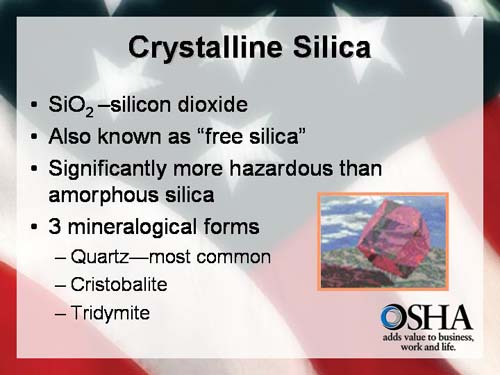
[Includes illustration of silica crystal and the OSHA logo]
Speaker Notes:
Silica is a naturally-occurring mineral compound that occurs as both crystalline and
non-crystalline (or amorphous) forms.
Crystalline silica is significantly more hazardous to workers.
Of the 3 crystalline forms, quartz is the most stable and is much more common. It is a major
component of soils and is readily found in both sedimentary and igneous rocks.
--Granite is about 30% quartz.
--Shales contain about 20% quartz.
--Beach sand or sandstone may be nearly pure quartz.
Some volcanic rock contains cristobalite and tridymite. Heating (calcining) of diatomaceous earth
(amorphous silica) converts it to a product containing up to 75% cristobalite. Cristobalite is also
found in superficial layers of refractory brick subjected to contact with molten metal.
|