
Diesel Exhaust/Diesel Particulate Matter
Diesel engines provide power to a wide variety of vehicles, heavy equipment, and other machinery used in a large number of industries including mining, transportation, construction, agriculture, maritime, and many types of manufacturing operations. The exhaust from diesel engines contains a mixture of gases and very small particles that can create a health hazard when not properly controlled.
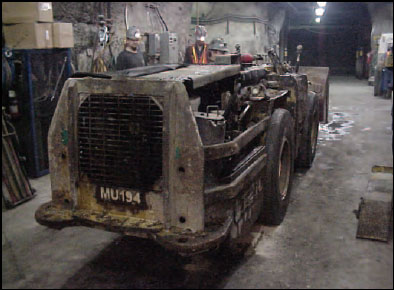
Diesel-powered equipment is often used in underground mines
Photo courtesy of MSHA
What is Diesel Particulate Matter (DPM)?
- DPM is a component of diesel exhaust (DE) that includes soot particles made up primarily of carbon, ash, metallic abrasion particles, sulfates and silicates.
- Diesel soot particles have a solid core consisting of elemental carbon, with other substances attached to the surface, including organic carbon compounds known as aromatic hydrocarbons.
Who can be exposed to DE/DPM?
Occupations with potential exposure to DE/DPM include miners, construction workers, heavy equipment operators, bridge and tunnel workers, railroad workers, oil and gas workers, loading dock workers, truck drivers, material handling operators, farmworkers, long-shoring workers, and auto, truck and bus maintenance garage workers.
Most heavy-and medium-duty trucks are equipped with diesel engines, as well as equipment used in mines; buses, locomotives and ships; heavy equipment such as bulldozers and tractors; and other types of equipment such as bucket lifts and generators. Miners and other workers in the vicinity of diesel powered equipment may be exposed to DE/DPM.
What are the health effects of DE/DPM?
- Short term exposure to high concentrations of DE/DPM can cause headache, dizziness, and irritation of the eye, nose and throat severe enough to distract or disable miners and other workers.
- Prolonged DE/DPM exposure can increase the risk of cardiovascular, cardiopulmonary and respiratory disease and lung cancer.
In June, 2012, the International Agency for Cancer Research (IARC) classified DE (including DPM) as a known human carcinogen (Group 1).
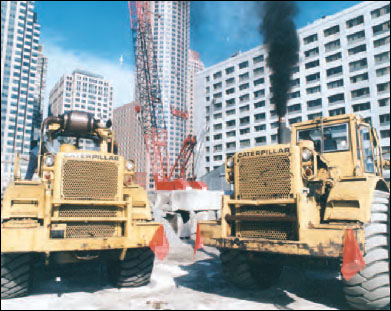
Heavy equipment operators can be exposed to diesel exhaust at construction sites
Photo courtesy of NESCAUM
How can exposures to DE/DPM be controlled?
Engineering controls are the most effective strategy for minimizing worker exposure to DE/DPM. A combination of controls is often required. Examples include:
- Performing routine preventive maintenance of diesel engines to minimize emissions,
- Installing engine exhaust filters,
- Installing cleaner burning engines,
- Installing diesel oxidation catalysts,
- Using special fuels or fuel additives (e.g., biodiesel),
- Providing equipment cabs with filtered air, and
- Installing or upgrading main or auxiliary ventilation systems, such as tailpipe or stack exhaust vents to capture and remove emissions in maintenance shops or other indoor locations.
Administrative controls refer to changes in the way work tasks are performed to reduce or eliminate the hazard. Examples include:
- Limiting speeds and using one-way travel routes to minimize traffic congestion,
- Prohibiting and/or restricting unnecessary idling or lugging of engines,
- Restricting the amount of diesel-powered equipment and total engine horsepower operating in a given area and ensure that the number of vehicles operating in an area does not exceed the capacity of the ventilation system, and
- Designate areas that are off-limits for diesel engine operation and/or personnel travel.
What standards are in place to protect miners and other workers from exposures to DE/DPM?
Miners are covered by the Mine Safety and Health Administration (MSHA). Workers in general industry, agriculture, construction and maritime industries are covered by the Occupational Safety and Health Administration (OSHA).
MSHA currently enforces DPM standards at underground metal/nonmetal mines and at underground coal mines.
Underground Metal/Nonmetal Mines
- A miner's personal exposure to DPM must not exceed 160 micrograms per cubic meter (μg/m3) of total carbon (TC) when measured as an 8-hour time-weighted average.
- Feasible engineering and administrative controls are required to reduce a miner's exposure to or below the permissible exposure limit (PEL).
- Respiratory protection must be used to supplement feasible engineering and administrative controls if such controls do not reduce a miner's exposure to the PEL, the engineering or administrative controls are infeasible, or the engineering and administrative controls fail to produce a significant reduction in DPM exposure.
- When respiratory protection is required, an air-purifying respirator equipped with a filter that meets one of the following: certified by NIOSH under 30 CFR Part 11 as a high-efficiency particulate air (HEPA) filter; under 42 CFR Part 84 as 99.97% efficient; or certified by NIOSH for DPM.
- Rotation of miners to comply with the PEL is prohibited.
- Evaluation of a miner's medical ability to wear a respirator and transfer rights for miners unable to wear respirators.
- Other requirements include:
- Fueling practices, including sulfur content and fuel additives,
- Maintenance of diesel-powered equipment,
- Limits on engine emissions,
- Annual training for miners,
- Exposure monitoring,
- Recordkeeping, and
- Miners' and former miners' rights to access certain records related to their own exposures.
Underground Coal Mines
- DPM emissions of diesel-powered equipment are restricted to the levels indicated below based on laboratory tests on the engine exhaust:
- Permissible Equipment - 2.5 grams/hour
- Heavy-Duty nonpermissible - 2.5 grams/hour
- Light Duty nonpermissible - 5.0 grams/hour or EPA standards
- MSHA laboratory testing establishes the level of DPM filtration required on specific diesel engines.
- Coal mine operators are required to:
- Perform weekly examinations of diesel equipment and perform maintenance with certified mechanics,
- Use low sulfur fuel,
- Provide training to miners annually on DPM risks and controls used at the specific mine,
- Maintain exhaust gas concentrations at or below established standards, and
- Provide ventilating air where diesel engines are operated.
General Industry, Agriculture, Construction and Maritime Operations
| Substance | PEL |
|---|---|
| Carbon Monoxide (CO) | 50 ppm |
| Nitric Oxide (NO) | 25 ppm |
| Nitrogen Dioxide (NO2) | 5 ppm (ceiling) |
The Occupational Safety and Health Administration does not have a a permissible exposure limit (PEL) for DPM. However, OSHA has PELs for other components of diesel exhaust. Monitoring for these gases can provide an indication of the presence of DE, and can be of help in evaluating the effectiveness of engineering and administrative controls implemented to minimize the potential for exposure to DE when working with or around diesel-powered equipment.
Where can I get additional information?
The links below can be used to access additional information regarding diesel regulations and technical information on control measures.
Code of Federal Regulations, underground metal/nonmetal mines
Information Regarding Diesel Regulations
OSHA's Safety and Health Topics page on diesel exhaust
OSHA's partial list of chemicals found in diesel exhaust
The EPA recommends strategies for reducing diesel exhaust on their website.
Contacts
MSHA:
For questions, information or advice:
- Metal/Nonmetal Mine Safety and Health, Division of Health, Reginald J. Richards, DrPH, CIH, (202) 693-9632, richards.reginald.j@dol.gov
- Coal Mine Safety and Health, Division of Health, Robert A. Thaxton, (202) 693-9515, thaxton.robert@dol.gov
To report an emergency, fatality or catastrophe, or to file a confidential hazard complaint, contact your nearest MSHA district or field office, visit www.msha.gov, or call MSHA at 1-800-746-1553.
OSHA:
For questions, information or advice, to report an emergency, fatality or catastrophe, or to file a confidential complaint, contact your nearest OSHA office, visit www.osha.gov, or call at 1-800-321-OSHA (6472).
Disclaimer
This Hazard Alert is not a standard or regulation, and it creates no new legal obligations. It contains recommendations as well as descriptions of mandatory safety and health standards [and other regulatory requirements]. The recommendations are advisory in nature, informational in content, and are intended to assist employers in providing a safe and healthful workplace. The Occupational Safety and Health Act requires employers to comply with safety and health standards and regulations promulgated by OSHA or by a state with an OSHA-approved state plan. In addition, the Act's General Duty Clause, Section 5(a)(1), requires employers to provide their employees with a workplace free from recognized hazards likely to cause death or serious physical harm.
DSG 01/2013
OSHA - HA-3590-2012