
Subpart F | General Working Conditions in Shipyard Employment - Lockout/Tags-plus Coordination
This fact sheet describes the lockout/tags-plus coordination requirements of subpart F - General Working Conditions in Shipyard Employment, as specified in 29 CFR 1915.89. These provisions are effective October 31, 2011.
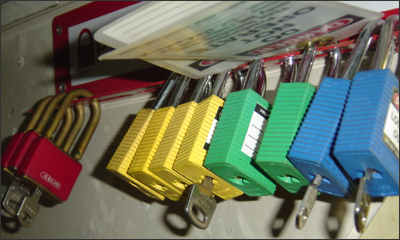
Servicing, maintenance, and repair of ship's systems present considerable risk to employees. Consequently, machinery, equipment, and systems found aboard vessels and vessel sections differ substantially from those found in landside facilities of general industry. Machinery, equipment, and systems in general industry often have individual disconnect or cutoff mechanisms that completely isolate them from other machinery, equipment, or systems in a facility.
Need for Lockout/Tags-plus Coordination
Coordination is critical to servicing machinery, equipment, and systems in shipyard employment. In shipyards, employees face numerous issues that can complicate servicing operations, such as:
- Large and complex machinery, equipment, and systems aboard vessels and vessel sections;
- Machinery, equipment, and systems that have multiple power sources, isolation points, and types of energy; and
- Difficulty identifying all energy sources due to faulty engineering drawings and schematics.
Further, there are times when employees are performing separate servicing operations on the same machine, equipment, or system, necessitating coordination between the employees involved in these operations.
Lockout/Tags-plus Coordinator
Employers must designate a Lockout/Tags-plus Coordinator to coordinate and oversee all lockout/tags-plus applications for: (1) multiple servicing operations on the same machinery, equipment, or system at the same time, whether on vessels, in vessel sections, or at landside facilities; and (2) servicing operations on multiple machinery, equipment, or systems on the same vessel or vessel section at the same time. During these specific situations, the Coordinator is responsible for: (1) overseeing and approving the application of each lockout and tags-plus system; (2) verifying hazardous-energy isolation prior to any servicing operation; and (3) removing each lockout or tags-plus system when work is completed.
- Example: Multiple Servicing Operations on the Same Machinery, Equipment, or System. A group of employees is repairing a high-pressure steam line in a location forward of a vessel’s machinery space, while another employee performs additional repairs on the same system in a location two levels below and aft of the vessel's machinery space. In such a situation, coordination between each separate servicing operation is necessary to avoid harming an employee servicing one part of a system because another employee restores power to that system without knowledge of the first employee. The presence of a Coordinator, who would know about the status of each separate servicing operation, would eliminate the possibility of an employee taking action that would endanger another employee.
- Example: Servicing Operations on Multiple Machinery, Equipment, or Systems. A generator aboard a vessel supplies power to the vessel's propulsion system and to the lighting system for a particular part of a vessel. If the authorized employee secures the generator to permit servicing of both of these systems, and the employee servicing the propulsion system restores power to the generator for testing or troubleshooting, an employee servicing the lighting system at the same time would be at risk of electrocution. The presence of a Coordinator, who would oversee removal of the lockout/tags-plus system for the two operations, would eliminate this risk.
Lockout/Tags-plus Log
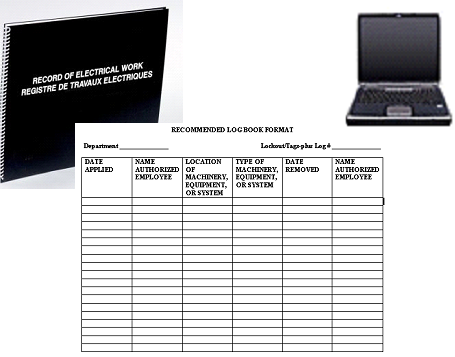
The Coordinator also must maintain a lockout/tags-plus log. Each log must be specific to each vessel, vessel section, or landside work area, and contain the:
- Location of machinery, equipment, or system identified for servicing;
- Type of machinery, equipment, or system identified for servicing;
- Name of the authorized employee applying the lockout/tags-plus system;
- Date the authorized employee applied the lockout/tags-plus system;
- Name of the authorized employee removing the lockout/tags-plus system; and
- Date the authorized employee removed the lockout/tags-plus system.
Remember
- Employers have the discretion to assign an employee to be the Coordinator as his or her sole task, or as collateral duty. Further, employers have flexibility to determine whether one Coordinator for each vessel is adequate, or if one Coordinator serving multiple vessels is adequate. This decision depends on the size of the vessel, the number of servicing operations, the number of employees working at the same time, or any other factors that could affect the duty of the Coordinator.
- Employers can develop and maintain lockout/tags-plus logs in many different formats under the discretion of the employer. For example, a log may be a traditional hand-written log book, or the employer may track lockout/tags-plus applications electronically through a computer software program.
- A copy of the log must be (1) included as part of a written incident-investigation report, and (2) reviewed during a program audit.