
Subpart F | General Working Conditions in Shipyard Employment - Medical Services and First Aid
This fact sheet describes the medical services and first aid requirements of subpart F - General Working Conditions in Shipyard Employment, as specified in 29 CFR 1915.87. These provisions are effective August 1, 2011.
Shipyard employment involves many workplace activities that are inherently dangerous, some of which take place on vessels operating at sea or outdoors during harsh weather conditions. Other shipyard employment activities take place at landside facilities and on vessel sections being constructed. The risk for severe or even fatal injuries is significant. Employers must ensure that emergency medical services and first aid for employees are readily accessible for response in a manner that mitigates the severity and increases survival from life-threatening injuries or illnesses.
Readily Accessible Services/Supplies
Employers must ensure that first aid and medical services are available and located close enough to the injured/ill employee so that appropriate intervention can be provided. Factors to be considered when determining the number of first aid providers and type/amount of first aid supplies at each worksite include:
- The size and location of each shipyard worksite. Large worksites that contain many work areas that are spread out need more first aid-trained employees and first aid kits than small worksites to ensure they are readily accessible if an employee gets injured. In addition, remote work areas or other shipyard work areas that are far away from rescue squads or hospitals may need to have more first aid-trained employees and first aid supplies (or a broader range of supplies).
- The number of employees at each worksite. When there is a large number of employees, or a surge in contract or temporary workers at a worksite, the employer will need to provide additional first-aid trained personnel and first aid supplies to prepare for the possibility of multiple employee injuries or illnesses, or for the possibility of several accidents occurring within a short period of time.
- The hazards present at each worksite. Depending on the hazards present at each worksite, first aid kits must contain the type and quantity of supplies needed to effectively treat the injuries and illnesses. In addition, first aid responders must be trained appropriately to render immediate and temporary care until a trained medical professional is available to provide treatment. For example, shops where hot work is performed require first aid supplies for burns, while in outdoor areas, first aid items for insect or animal bites may be needed.
- The distance of each worksite from hospitals, clinics, and rescue squads. In determining the location, amount, and type of first aid supplies needed, employers must evaluate the distance from, and the time needed to get to, hospitals or clinics (on-site or off-site), and the time needed for rescue squads to respond. A single first aid kit may be adequate for small worksites that are close to on-site infirmaries or local emergency services. However, additional kits and types of supplies may be necessary when medical services are farther away.
First Aid and Emergency Services
Employers may supplement trained first aid employees at each worksite, provided that (1) there is an on-site clinic or infirmary with first aid providers during each workshift; or (2) outside first aid providers (i.e., emergency medical services) can reach the worksite within 5 minutes from the report of injury or illness.
First Aid Training and Certification
First aid service is the immediate and temporary care provided to a victim of sudden injury or illness until a trained medical professional is available to provide treatment. Examples of such immediate and temporary care include: the correct bandaging of a wound; the application of splints for fractures and dislocations; and treatment of bites and stings, burns, and heat exhaustion. In addition, first aid providers must be trained to render first aid, including cardiopulmonary resuscitation (CPR), and maintain current first aid and CPR certification. Certification must be up-to-date and issued by a reputable organization, such as the Red Cross, American Heart Association, or other equivalent organization.
First Aid Supplies and Equipment
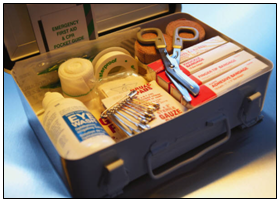
- First aid supplies must be kept in a weatherproof container and maintained in a dry, sterile, and serviceable condition. See ANSI/ISEA Z308.1-2009, "Minimum Requirements for Workplace First Aid Kits and Supplies" for minimal contents of first aid kits for workplace settings.
- Inspection and replenishment of first aid supplies and equipment should be conducted, as necessary, to ensure that adequate and serviceable supplies and equipment are available when needed.
- If basket stretchers (or the equivalent) are not provided by emergency response services, they must be made available by employers when work is being performed on vessels and vessel sections. Basket stretchers or the equivalent must be equipped with bridles capable of being hoisted, restraints to secure the injured or ill employee, and a blanket or other covering.
- Stretchers and related equipment (i.e., restraints, blankets) must be stored in a clearly marked location and in a way that protects them from damage and environmental conditions.
Quick-drenching and Flushing Facilities
- If the potential exists for an employee to be splashed with a substance that could seriously harm him or her, the employer needs to provide facilities for quick-drenching the body or flushing the eyes.
- Quick-drenching and flushing facilities must be located close enough to operations where such substances are used so that the facilities are available for immediate emergency use.
Automatic External Defibrillators (AEDs)
Approximately 300,000 individuals die from cardiac arrest each year, with most of these events occurring outside hospitals. AEDs restore normal heart rhythm with electrical shock (defibrillation) and have been shown to significantly increase survival rates. Employers that provide AEDs at their worksites should store them so they can be used within three to five minutes. Employers should also train employees to use AEDs. AEDs should also be inspected, tested, and maintained in accordance with the manufacturer's specification.