Section VII: Chapter 1
Section VII: Chapter 1
Back Disorders and Injuries
Table of Contents:
- Introduction
- Back Disorders
- Reports of Back Injuries
- Investigation Guidelines
- Prevention and Control
- Bibliography
List of Appendices:
- Appendix VII:1-1. In-Depth Analysis
- Appendix VII:1-2. Evaluation of Lifting Tasks
- Appendix VII:1-3. Videotape Guidelines and Analysis
- Appendix VII:1-4. Supplemental Factors For Ergonomic Tape Evaluation
- Appendix VII:1-5. NIOSH Lifting Analysis Worksheet
I. Introduction
- General. Back disorders can develop gradually as a result of microtrauma brought about by repetitive activity over time or can be the product of a single traumatic event. Because of the slow and progressive onset of this internal injury, the condition is often ignored until the symptoms become acute, often resulting in disabling injury. Acute back injuries can be the immediate result of improper lifting techniques and/or lifting loads that are too heavy for the back to support. While the acute injury may seem to be caused by a single well-defined incident, the real cause is often a combined interaction of the observed stressor coupled with years of weakening of the musculoskeletal support mechanism by repetitive micro-trauma. Injuries can arise in muscle, ligament, vertebrae, and discs, either singly or in combination.
- Incidence. Although back injuries account for no work-related deaths, they do account for a significant amount of human suffering, loss of productivity, and economic burden on compensation systems. Back disorders are one of the leading causes of disability for people in their working years and afflict over 600,000 employees each year with a cost of about $50 billion annually in 1991 according to NIOSH. The frequency and economic impact of back injuries and disorders on the work force are expected to increase over the next several decades as the average age of the work force increases and medical costs go up.
II. Back Disorders
- Factors Associated With Back Disorders. Back disorders result from exceeding the capability of the muscles, tendons, discs, or the cumulative effect of several contributors:
- Reaching while lifting.
- Poor posture--how one sits or stands.
- Stressful living and working activities--staying in one position for too long.
- Bad body mechanics--how one lifts, pushes, pulls, or carries objects.
- Poor physical condition-losing the strength and endurance to perform physical tasks without strain.
- Poor design of job or work station.
- Repetitive lifting of awkward items, equipment, or (in health-care facilities) patients.
- Twisting while lifting.
- Bending while lifting.
- Maintaining bent postures.
- Heavy lifting.
- Fatigue.
- Poor footing such as slippery floors, or constrained posture.
- Lifting with forceful movement.
- Vibration, such as with lift truck drivers, delivery drivers, etc.
- Signs and Symptoms. Signs and symptoms include pain when attempting to assume normal posture, decreased mobility, and pain when standing or rising from a seated position.
III. Reports of Back Injuries
- Contributing Factors. These factors usually account for very few work-related back injuries.
- Congenital defects of the spine.
- Increase in static standing or sitting tasks.
- An aging work force.
- Decreases in physical conditioning and exercise.
- Increased awareness of workplace hazards.
- Job dissatisfaction.
- Manual Materials Handling. Manual materials handling is the principal source of compensable injuries in the American work force, and four out of five of these injuries will affect the lower back.
IV. Investigation Guidelines
- Records Review: OSHA 200 Log
Note when back or other musculoskeletal disorders appear excessive from Lost Work Day Injury and Illness (LWDII) rate calculations. Understand that excessiveness is relative, since there is no firm figure established that delineates safe from unsafe. A better measure is to look for trends of escalating number of injuries or of increasing severity of injuries. Comparing your target population with BLS data, other company rates, other lines, departments, wings, or occupational titles can yield a meaningful measuring point to gauge excessiveness.
Back injuries should be treated as an injury on the OSHA 200 log regardless of whether the injury was the result of an acute or chronic exposure.
- To determine if trends exist, at least several years of the OSHA 200 log will be needed for review.
- Record or copy information, including occupational titles, departments, dates of injury or illness, from the OSHA 200 log and pertinent OSHA 101 (or equivalent). This information can be used to calculate the LWDII and Severity rates (see Appendix VII:1-1).
- If you determine that there is a need for a more in-depth analysis of the extent and magnitude of the back disorders, see Appendix VII:1-1.
- Employer, Employee Interviews
- Walkaround
- Ask employees about their opinion on the difficulty of the task as well as personal experiences of back pain.
- Observe worker postures and lifting.
- Determine weight of objects lifted.
- Determine the frequency and duration of lifting tasks.
- Measure the dimensions of the workplace and lift.
- Evaluation
- Videotapes should be taken of the work task for later review and for evidence of recognized musculoskeletal hazards (see Appendix VII:1-3).
- Manual lifting:
- Repetitive material handling increases the likelihood of a disorder.
- Principal variables in evaluating manual lifting tasks to determine how heavy a load can be lifted are: the horizontal distance from the load to the employee's spine, the vertical distance through which the load is handled, the amount of trunk twisting the employee utilized during the lifting, the ability of the hand to grasp the load, and the frequency with which the load is handled.
- Additional variables include floor and shoe traction, space constraints, two-handed lifts, size and stability of the load.
- The NIOSH Lifting Formula uses the principal variables to compute a theoretically safe lift.
- Walkaround
V. Prevention and Control
- Engineering Controls
- General. Alter the task to eliminate the hazardous motion and/or change the position of the object in relation to the employee's body -- such as adjusting the height of a pallet or shelf.
- Manual Handling Tasks
- Material handling tasks should be designed to minimize the weight, range of motion, and frequency of the activity.
- Work methods and stations should be designed to minimize the distance between the person and the object being handled.
- Platforms and conveyors should be built at about waist height to minimize awkward postures. Conveyors or carts should be used for horizontal motion whenever possible. Reduce the size or weight of the object(s) lifted.
- High-strength push-pull requirements are undesirable, but pushing is better than pulling. Material handling equipment should be easy to move, with handles that can be easily grasped in an upright posture.
- Workbench or workstation configurations can force people to bend over. Corrections should emphasize adjustments necessary for the employee to remain in a relaxed upright stance or fully supported, seated posture. Bending the upper body and spine to reach into a bin or container is highly undesirable. The bins should be elevated, tilted or equipped with collapsible sides to improve access.
- Repetitive or sustained twisting, stretching, or leaning to one side are undesirable. Corrections could include repositioning bins and moving employees closer to parts and conveyors.
- Store heavy objects at waist level.
- Provide lift-assist devices, and lift tables.
- Controls and Work Practices
- Engineering controls are preferred.
- Worker training and education:
- Training should include general principles of ergonomics, recognition of hazards and injuries, procedures for reporting hazardous conditions, and methods and procedures for early reporting of injuries. Additionally, job specific training should be given on safe work practices, hazards, and controls.
- Strength and fitness training can reduce compensation costs.
- Rotating of employees, providing a short break every hour, or using a two-person lift may be helpful.
- Rotation is not simply a different job, but must be a job that utilizes a completely different muscle group from the ones that have been over-exerted.
- Other
- Standing for extended periods places excessive stress on the back and legs. Solutions include a footrest or rail, resilient floor mats, height-adjustable chairs or stools, and opportunities for the employee to change position.
- Where employees are seated the chairs or stools must be properly chosen.
- Proper adjustable lumbar support may be provided.
- Static seated postures with bending or reaching should be avoided.
VI. Bibliography
Cailliet, R. 1968. Low Back Pain Syndrome. 2nd. ed. Philadelphia: F.A. Davis Co.
Eastman Kodak Company. 1983. Ergonomic Design for People at Work. Vol. 1 & 2. Belmont California: Lifetime Learning Publications.
National Institute for Occupational Safety and Health (NIOSH), DHHS, Work Practices Guide for Manual Lifting. 1981 & 1991.
Singleton, W.T. ed. 1982. The Body at Work: Biological Ergonomics. 1st. ed. New York: Cambridge University Press.
Chaffin and Andersson, 1984. Occupational Biomechanics. John Wiley & Sons, New York/Chichester/Brisbane/Toronto/Singapore
Mital, A.; Nicholson, A.S.; Ayoub, M.M., 1993. A Guide to Manual Materials Handling 1993. Taylor and Francis, London/Washington, D.C.
Appendix VII:1-1. In-Depth Analysis
The usefulness of the information gained from the review of the OSHA 200 log is limited by internal practices of recording injuries and illnesses. Some plants record everything and some record only those cases that are sent to see a physician. With back disorders, these cases are not always recognized as being work-related and therefore are not recorded. Thus, the Compliance Officer must determine the internal procedure for recording on the OSHA 200, i.e., who records, what cases are recorded, and when cases are recorded (see Field Operations Manual (FOM)).
The following is a systematic approach to identifying the extent and magnitude of a disease or injury and is based on epidemiological principles. The approach consists of records review, worker surveys, and job analysis respectively. This information may be used to determine which jobs pose a risk to workers.
Workers' Compensation Records
Advantages:
Identify additional cases, departments, and job titles.
Limitations:
Does not include cases where treatment is paid for directly by the employee or comprehensive health insurance.
Describes only most severe and advanced problems. May fail to identity problems in early stage of development.
Plant Medical Records
In larger plants that employ health care providers, individual employee medical folders, or records, will be maintained and every visit to the health office may be recorded in the record. Such records should be accessed through a medical access order.
There may also be a first-aid log or health office sign-in log. Entries in these records often include:
- Date of visit;
- Department or location where employee works;
- Description of injury or illness;
- Treatment given, including medications; and
- Work restrictions recommended.
Monthly summaries of employee visits to the health office are often compiled by health office personnel. If there are too many records, review a random sample of records to identify cases of back disorders.
Safety and Accident Reports
Internal reports that may be available in the health, safety or personnel office. These cases may not be noted on the OSHA 200 Log or in worker compensation records. Employee may just want to report the injury or disorder and not seek treatment.
Payroll Records (If available)
Used to obtain information on number of hours worked.
Serves as crude measure of exposure potential and can be used to compare jobs in terms of incidence rates of all forms of back disorders.
Useful in identifying job titles or departments with high absentee or turnover rates.
Available Information From Records Review
- Total number of back injuries reported to the company;
- Date each case reported;
- Department or specific job of those who are injured or ill; and
- Number of workers on the same job or in the same department.
What You Can Do With the Information
The incidence rate can be calculated for the entire establishment and for each department. This procedure allows comparison between and within the same departments from year to year.
Lost Work Day Injury and Illness rate (LWDII) = (Number of cases)*(200,000)/Total population at risk in a given period
- Numerator: Number of lost or restricted time incidents (cases) in specified group or department that experiences a disorder in a specified time period multiplied by 200,000. Multiplying the number of employees by 200,000 normalizes the observed work population to a standard work population of 100 employees working a 50-week year.
- Denominator: Total number of hours worked in a specified group or department within the same time period. If these numbers are not available an approximation can be made by multiplying the observed number of employees by 2000.
Severity Rate (SR) = This is the same calculation as was performed to produce the LWDII except that the days away from work or restricted days are substituted into the numerator for the number of incidents. This calculation provides a measure of the severity of the cases and is used in conjunction with the LWDII to determine the magnitude of the case.
NOTE: If counting system recognized only lost-time or Workers Compensation cases, relatively low incidence rates may be computed. If the company has instituted an ergonomics program the LWDII may rise dramatically, but there should be a corresponding drop in the SR.
Survey the Workers
Purpose:
Assist in identifying new or early cases of back injury and disorders in the work force. Useful in smaller facilities where data gathered from records review may be limited or in facilities where reporting disincentives limit the number of reported cases. The major reason for this is to collect data on the number of workers that may be experiencing some form of back injury or disorder. This is also a good method for identifying departments or jobs where potential back problems exist.
Factors to be considered in designing a questionnaire or symptom survey:
- Reading level and primary language of workers if the questionnaire or survey is self-administrated. Wording is very important and must be geared to particular respondents.
- Length of the questionnaire (usually should not exceed 20 minutes).
- Instructions: Are they clear?
- Important questions should be asked first.
- Sensitive or personal questions should be asked later in the survey.
- Multiple-choice questions are easier to evaluate but limit the potential responses of the person being questioned.
Mass Medical Screening:
Mass medical screening could be useful but must be performed by trained medical staff -- so the process can be costly in both personnel and resources. The Office of Occupational Medicine should be consulted prior to attempting mass medical screenings.
Job Analysis and Observation
Each job in which workers have a greater incidence of back disorders might be subject to a job analysis after an appropriate records review and worker survey.
Work-Methods Analysis:
- Observe employees at work:
- Notice what employees are doing to make themselves more comfortable in the workplace. For example, look for improvised foot rests, padding, or homemade tools and devices.
- Watch for repeated motions and the position of the arms, wrist and trunk (e.g. over-stretching or unusual posture).
- Record the movements used to perform the task. Use a video camera for subsequent slow-motion analysis. See Appendix VII:1-3 for instructions on videotaping techniques.
- Describe the positions seen. Ask questions to determine if staffing levels and production pace is truly representative of the normal operation. Obtain production data if at all possible.
- An ergonomic check-list can be helpful on inspections to record information which is not readily identifiable from the videotape. A sample checklist is shown in Appendix VII:1-4.
- Work station and tool evaluation may be necessary.
Appendix VII:1-2. Evaluation of Lifting Tasks [Completely Revised]
NIOSH Work Practice Guide for Manual Lifting
In 1981, NIOSH developed an equation to assess lifting conditions. In 1991, NIOSH issued a revised equation for the design and evaluation of manual lifting tasks. The 1991 equation uses six factors that have been determined to influence lifting difficulty the most, combining the factors into one equation. Two of the factors which are new to the revised equation include twisting (asymmetry) and the quality of the worker's grip on the load (coupling). Using the equation involves calculating values for the six factors in the equation for a particular lifting and lowering task, thereby generating a Recommended Weight Limit (RWL) for the task. The RWL is the load that nearly all healthy employees (90% of the adult population, 99% of the male and 75% of the female workforce) can lift over a substantial period of time (i.e., up to 8 hours) without placing an excessive load on the back.
The revised equation also incorporated a term called the Lifting Index, which is defined as a relative estimate of the level of physical stress associated with a particular manual lifting task. The estimate of the level of physical stress is defined by the relationship of the weight of the load lifted divided by the recommended weight limit. A level greater than one indicates that the lifted weight exceeded the RWL and should be addressed using either administrative or engineering controls. A level greater than three indicates that the lifted weight exceeds the capacity to safely lift for most of the population, is likely to cause injury, and should be modified by implementation of engineering controls.
The 1991 equation still maintains the 1981 biomechanical criteria for establishing the maximum lower back compression force of 770 lbs. For the revised equation, the load constant was reduced from 90 pounds to 51 pounds. This reduction was driven by the need to increase the minimum horizontal distance from 6 inches to 10 inches (which is believed to be the minimum attainable horizontal distance as measured from the spine during lifting) in the 1991 equation. Aside from this reduction the 1991 revised equation represents only a two-pound reduction from the 1981 version when adjusted for revised horizontal distance.
Application of the NIOSH lifting tasks assumes the following:
- Lifting task is two-handed, smooth, in front of the body, hands are at the same height or level, moderate-width loads (i.e., they do not substantially exceed the body width of the lifter), and the load is evenly distributed between both hands.
- Manual handling activities other than lifting are minimal and do not require significant energy expenditure, especially when repetitive lifting tasks are performed (i.e., holding, pushing, pulling, carrying, walking or climbing).
- Temperatures (66-79°F) or humidity (35-50%) outside of the ranges may increase the risk of injury.
- One-handed lifts, lifting while seated or kneeling, lifting in a constrained or restricted work space, lifting unstable loads, wheelbarrows and shovels are not tasks designed to be covered by the lifting equation.
- The shoe sole to floor surface coupling should provide for firm footing.
- Lifting and lowering assumes the same level of risk for low back injuries.
- Using the Guidelines in situations that do not conform to these ideal assumptions will typically underestimate the hazard of the lifting task under investigation.
The computed values of the Recommended Weight Limit are used by the CSHO as a guide to estimate risk. The numbers by themselves do not identify a hazardous activity. The employer's incidence of injuries and lack of programs for training, work practice controls, and engineering controls related to lifting are elements used to determine the seriousness of the hazard.
Calculations
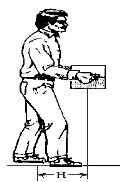
Figure VII:1-1. Horizontal Measurement
The revised lifting equation for calculating the Recommended Weight Limit (RWL) is based on a multiplicative model that provides a weighting for each of six variables:
RWL = LC x HM x VM x DM x AM x FM x CM
where:
LC = Load Constant (51 pounds)
HM = Horizontal Multiplier (10/H)
Horizontal location of the hands (H): The horizontal location of the hands at both the start (origin) and end (destination) of the lift must be measured. The horizontal location is measured as the distance from the mid-point between the employee's ankles to a point projected on the floor directly below the mid-point of the hands grasping the object (the middle knuckle can be used to define the mid-point). The horizontal distance should be measured when the object is lifted (when the object leaves the surface).
VM = Vertical Multiplier (1 - (0.0075|V-30|))
Vertical location of the hands (V):The vertical location is measured from the floor to the vertical mid-point between the two hands (the middle knuckle can be used to define the mid-point).
DM = Distance Multiplier (0.82 + (1.8 / D)
Travel Distance of the load (D): The total vertical travel distance of the load during the lift is determined by subtracting the vertical location of the hands (V) at the start of the lift from the vertical location of the hands (V) at the end of the lift. For lowering, the total vertical travel distance of the load is determined by subtracting the vertical location of the hands (V) at the end of the lower from the vertical location of the hands (V) at the start of the lower.
AM = Asymmetric Multiplier (1 - (0.0032A))
Figure VII:1-2. Measure of Asymmetry Angle A
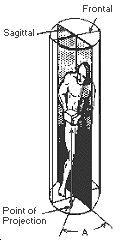
Asymmetry Angle(A): The angular measure of the perpendicular line that intersects the horizontal line connecting the mid-point of the shoulders and the perpendicular line that intersects the horizontal line connecting the outer mid-point of the hips.
FM = Frequency Multiplier (See Frequency Table Below (Table VII:1-1))
Lifting Frequency (F): The average lifting frequency rate, expressed in terms of lifts per minute, must be determined. The frequency rate can be determined by observing a typical 15 minute work period, and documenting the number of lifts performed during this time frame. The number of lifts observed is divided by 15 to determine the average lifts per minute. Duration is measured using the following categories: Short (Less than one hour); Moderate (1 to 2 hours); Long (2 to 8 hours).
| Frequency Lifts/min(F) ‡ | Work Duration | |||||
|---|---|---|---|---|---|---|
| < 1 Hour | > 1 but < 2 Hours | > 2 but < 8 Hours | ||||
| V < 30 † | V > 30 | V < 30 | V > 30 | V < 30 | V > 30 | |
| < 0.2 | 1.00 | 1.00 | .95 | .95 | .85 | .85 |
| 0.5 | .97 | .97 | .92 | .92 | .81 | .81 |
| 1 | .94 | .94 | .88 | .88 | .75 | .75 |
| 2 | .91 | .91 | .84 | .84 | .65 | .65 |
| 3 | .88 | .88 | .79 | .79 | .55 | .55 |
| 4 | .84 | .84 | .72 | .72 | .45 | .45 |
| 5 | .80 | .80 | .60 | .60 | .35 | .35 |
| 6 | .75 | .75 | .50 | .50 | .27 | .27 |
| 7 | .70 | .70 | .42 | .42 | .22 | .22 |
| 8 | .60 | .60 | .35 | .35 | .18 | .18 |
| 9 | .52 | .52 | .30 | .30 | .00 | .15 |
| 10 | .45 | .45 | .26 | .26 | .00 | .13 |
| 11 | .41 | .41 | .00 | .23 | .00 | .00 |
| 12 | .37 | .37 | .00 | .21 | .00 | .00 |
| 13 | .00 | .34 | .00 | .00 | .00 | .00 |
| 14 | .00 | .31 | .00 | .00 | .00 | .00 |
| 15 | .00 | .28 | .00 | .00 | .00 | .00 |
| > 15 | .00 | .00 | .00 | .00 | .00 | .00 |
† Values of V are in inches.
‡ For lifting less frequently than once per 5 minutes, set F = 2 lifts/minute.
CM = Coupling Multiplier (See Coupling Table Below (Table VII:1-2))
Object coupling (C): The classification of the quality of the hand-to-object coupling (rated as Good, Fair, or Poor).
| GOOD | FAIR | POOR |
|---|---|---|
| CM = 1.00 | V < 30" then CM = 0.95 | CM = 0.90 |
| V > or = to 30" then CM = 1.00 | ||
|
|
|
|
|
|
Help using the lifting formula is available through the Directorate of Technical Support and Emergency Management.
Lifting Analysis Worksheet Table
The actual worksheet can be found in Appendix VII:1-5. The lifting analysis should be performed using both the average and maximum weights.
Appendix VII:1-3. Videotape Guidelines and Analysis [Completely Revised]
Video Guidelines for Ergonomic Evaluations
Obtaining good video documentation for ergonomic evaluations can be difficult -- as the tasks are often performed in inaccessible areas with poor lighting conditions and a lot of extraneous movement taking place. This guide presents suggestions for capturing effective video documentation of potential ergonomic hazards.
Preparation
Use the OSHA Form 200 logs and 101's, complaint information, and interviews to help prioritize areas for taping. It is desirable to have at least a two-person team when performing an evaluation. One person can operate the video camera while the other can record task and employee information.
The equipment needed for an ergonomic inspection will generally include:
- Video Camera with extra tapes and charged batteries
- Tape measure
- Small Notebook
- Fanny pack
- Small scale (Chattillon or fish scale that can measure pull forces)
- Bungee cord or small piece of rope
- Questionnaires for employee interviews concerning ergonomic factors.
Other useful items may include:
- Stop watch
- Lens cleaning paper
- Extra batteries for internal clock
- Skylight UV filter. This is a must in a dirty environment if you do not have a protective case.
The following are general suggestions on camera usage which, if reviewed prior to going on-site, will provide the best video documentation for the analyst and ensure that all pertinent information is obtained and documented.
- Become familiar with the camera and read the operators manual. Shoot some test footage so you are familiar with all the functions of the camera.
- Always activate the date and time mechanism on the camera so that this information is displayed on the video during the entire taping series. This will provide additional reference points with which to correlate written information with the videotape footage. Be aware of the position of the date and time printout on the video footage to make sure that it is not superimposed over the top of important features of the video documentation.
- For operations with extraneous movement it may be necessary to use the manual focus to avoid the camera refocusing on irrelevant moving objects. Determine where the focus point is for the camera you are using. It may not be in the center of the viewfinder. To make this determination place the camera on auto focus and try to focus on a small item such as a hanging pendant that has nothing else in the same plane. Hang the item from a doorway and try to focus by moving the item back and forth in the field of the viewfinder. You have found the focus point when the camera focuses on the item.
- If the camera has a high speed shutter, turn it off and use the auto shutter. high speed requires too much light for most industrial tasks. If you are taping a worker with dark clothes against a light background (such as a window, or a white wall), activate the "back lit" capability on the camera.
- Practice visual slating of information. This should be done by filming a piece of paper with information clearly written on it just prior to or directly after videotaping the task. Use a marker or dark pen that can be clearly seen. The macro-zoom on your camera will permit use of a small notebook or journal to be used as a slate. A small notebook is easy to carry and any pertinent notes can be recorded on the slate sheet for easy correlation and future reference. Macro-zoom is also helpful for documentation of small informational areas such as labels.
- If visual slating is absolutely not possible, cover the lens with your hand and record the information verbally before the actual job taping begins. Be aware that you will need to speak directly into the camera microphone to be clearly understood. Use of an external microphone can be helpful in audio slating.
- Hold the camera as still as possible or use a tripod if available. Don't walk with the camera unless absolutely necessary to record the task. When you change location, move slowly and minimize camera movement. Use the zoom instead of walking whenever possible. Use the manual focus whenever there is extraneous movement in the frame of action to ensure the focus will be on the items of interest.
Videotaping Tasks
The following items outline the procedures used for obtaining useful video documentation.
- If possible tape the operation in the order of production. Do the beginning of the production process first and proceed through all tasks of interest.
- Visually SLATE at least the name of the task just prior to or directly after videotaping the task.
- Tape 5-10 minutes for all jobs including approximately 10 cycles. A cycle is considered to be a set of repeated motions during which one part or assembly is processed. Jobs that have relatively long cycle times in excess of 30-60 seconds may require fewer than 10 cycles if all aspects of the job are recorded at least 3-4 times.
- Begin each task with a whole-body view of the worker from the side including the chair and/or the floor. Hold this view for 2-3 cycles and then zoom the camera in for a closer view of the area of principal interest. Tape from a variety of angles to allow a determination of wrist deviation, arm postures, back angles, etc. Tape from both sides and the front if possible. The total footage may be distributed between these different angles.
- Videotape the operation from a distance to give perspective to the analyst about workstation layout.
- Find an entity of known dimension in the frame of the picture and measure it for reference purposes. The employee's forearm from the wrist to the elbow is a convenient landmark since it is in most frames and is measurable on the television screen. If possible place a piece of contrasting tape on the reference points to provide a more distinct and identifiable location point. Record the reference dimensions either by visually slating the information or verbally recording the data. If using a ruler or tape measure as your reference point, ensure that the increments are clearly visible.
- Obtain video footage of tools or machinery that are used on the job. Videotape labels from hand tools, machinery, weight from boxes, etc.
Analysis of Videotapes
It is usually best to contact the Salt Lake Technical Center before you submit a videotape for analysis. This will allow us to provide you with a time frame for analysis completion and to make any pertinent inquiries concerning the nature of the request. Send a copy of the tape rather than the original, since we keep all materials for our files, and any written documentation which was obtained about the inspection. Allow plenty of time for analysis as there is generally significant backlog.
There is information that cannot be readily obtained by visual inspection of the video documentation. The following information should be recorded on the videotape slate at the beginning of the taping sequence or provided in the written "Request For Tape Evaluation" accompanying the tape (example attached):
- Name, SIC code, and location of the facility being inspected.
- Date of inspection.
- Name of Compliance Officer(s), and OSHA office performing the inspection.
Additionally, the following information should be visually slated at the beginning of each individual task or recorded in a written Supplemental Factors Checklist (example attached). Written information should be referenced to the video documentation and must accompany the videotape when submitted for analysis.
- The name of the task and employee.
- Anthropometry (height) of the employee.
- Ambient conditions when working in extreme areas (freezers, furnaces, etc.).
- Clothing and PPE (materials, etc.).
- The period of time in which the task is performed including work-rest schedules.
- The nature of injuries as determined from the 200's, 101's, or interviews.
- Weight and dimension of loads lifted.
- Dimensions of the work items seen in the shot (i.e., pallets, tables, shelving units, etc.).
- Vertical distance between origin and destination of lift. Horizontal distance the load is held from the body at the beginning and end of the lift. These distances can be estimated directly from the video documentation if measuring will significantly interfere with the operation. To do this there must be a clear view of the entire body and the work space, preferably in profile. Provide dimensional information on as many work items seen in the footage as possible.
- Distance loads must be carried.
- Production data to aid in determining if the video segment is representative of normal activity.
- Conditions that might affect grip or traction (ie., sand on the floor, ice on boxes being lifted, etc.).
Appendix VII:1-4. Supplemental Factors For Ergonomic Tape Evaluation [New]
Worker Information:
- Worker's Name:
- Worker's Height:
- Distance from wrist to elbow or between contrast markers:
- Past medical or CTD problems (prior to this task):
- Current medical or CTD problems:
- Non-occupational activities:
Job Information:
- Job Name:
- Location:
- Time of videotape sequence:
- Job Description (task frequency, cycle time, time on job; is the job always performed in this manner?):
- Number of employees on job (now and normally):
- Line speed; Self or machine-paced; (pieces/min):
- Break schedule (micro-rest breaks possible):
- Rotation schedule:
- Jobs in rotation:
Job and Ergonomic Training:
- Given by Whom:
- Hands-on or theoretical:
- Time spent in training:
- Updates:
- How often:
- Last update:
- Update given by whom:
Workstation Information:
*Make a sketch of the workstation layout on separate sheet of paper or reference to area of tape that shows the entire work layout.
- Is the workstation adjustable, can it be tilted or rotated (mechanism and range of motion, heights, dimensions):
- Table:
- Chair:
- What is the worker standing on (concrete, wood):
- Is it slippery:
- Can work positions be changed (sit/stand):
- Reach distances:
- Horizontal:
- Vertical:
Tool Information:
*Answer these questions and make a sketch or identify the tool on the video segment for each tool used. Use other sheets of paper if needed.
- Name of tool:
- Type of tool and Power Source:
- Torque:
- Reciprocating or vibrating:
- Other:
- Weight of tool:
- Handle:
- Span and Length:
- Material:
- If air-powered, is the exhaust away from the hand:
Miscellaneous Information:
- What objects or materials are handled and their weight (for patients estimate the amount of help they can provide):
- Name & Weight:
- Temperature of work environment:
- Personal protective equipment:
- Are gloves worn, what material:
- Estimate of task exertion level:
- Estimate of hand and finger exertion level:
- (1 = Low; hold coffee cup; to 5 = high; open large "Bulldog" paper clip)
- Does the employee have an opinion concerning the nature of the problem, management commitment, and possible corrective measures?
- Employee Signature (optional, but desirable) ___________________________________________________________
Appendix VII:1-5. NIOSH Lifting Analysis Worksheet [New]
Lifting Analysis Worksheet
Department _________________________________
Job Title ____________________________________
Analyst's Name ______________________________
Date _______________________________________
Job Description
____________________________________________
____________________________________________
Step 1. Measure and record task variables
| Object Weight (lbs) | Hand Location | Vertical Distance | Asymmetric Angle (deg.) | Frequency Rate | Duration | Object Coupling | |||||
|---|---|---|---|---|---|---|---|---|---|---|---|
| Origin | Dest | Origin | Destination | lifts/min | Hrs | ||||||
| L(AVG) | L(MAX) | H | V | H | V | D | A | A | F | C | |
Step 2. Determine the multipliers and compute the RWLs
| RWL | = | LC | x | HM | x | VM | x | DM | x | AM | x | FM | x | CM | |||
|---|---|---|---|---|---|---|---|---|---|---|---|---|---|---|---|---|---|
| ORIGIN | RWL | = | 51 | x | x | x | x | x | x | = | |||||||
| DEST. | RWL | = | 51 | x | x | x | x | x | x | = |
Step 3. Compute the Lifting Index
ORIGIN
LIFT INDEX
OBJECT WEIGHT/RWL = ____________________ = ____________________
DESTINATION
LIFT INDEX
OBJECT WEIGHT/RWL = ____________________ = ____________________