- Safety and Health Information Bulletins
- /
- Preventing Fire and/or Explosion Injury from Small and Wearable Lithium Battery Powered Devices


Preventing Fire and/or Explosion Injury from
Small and Wearable Lithium Battery Powered Devices
Safety and Health Information Bulletin
SHIB 06-20-2019
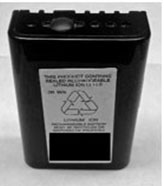
Image 1. Example of a lithium battery
Source/Copyright: OSHA
Introduction
Small and wearable electronic devices used in workplaces (e.g., body cameras) rely on a power source that stores a high amount of energy in a small space (i.e., high energy density). Lithium cells provide sustained power and often have the capability to recharge. When designed, manufactured, and used properly, lithium batteries are a safe, high energy density power source for devices in the workplace.
While lithium batteries are normally safe, they may cause injury if they have design defects, are made of low quality materials, are assembled incorrectly, are used or recharged improperly, or are damaged. In February 2018, the U.S. Consumer Product Safety Commission’s Status Report on High Energy Density Batteries Project reported over 25,000 overheating or fire incidents involving more than 400 types of lithium battery- powered consumer products that occurred over a five-year period.
Many consumer products have practical applications in small and large businesses. Ensuring these products will operate safely in workplaces begins with using batteries, chargers, and associated equipment that are tested in accordance with an appropriate test standard (e.g., UL 2054) and, where applicable, certified by a Nationally Recognized Testing Laboratory (NRTL) i. Manufacturer’s instructions provide procedures for use, charging, and maintenance that is specific to each device and necessary to prevent damage to the lithium batteries (See Image 1). For example, some batteries will overcharge if a charger is used that does not turn off when the battery is fully charged.
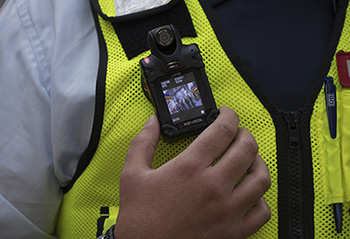
Image 2. Small wearable camera
Source/Copyright: Andreas Arnold/picture-alliance/dpa/AP Images
Workers who wear or frequently handle lithium-powered devices or batteries are particularly at risk if a lithium battery catches fire or explodes since the device or battery is close to the body. For example, small cameras worn by workers (e.g., police and security personnel), as shown in Image 2, can cause burns or other serious injury if the lithium battery catches fire or explodes while worn. To prevent injury, it is important for employers and workers to understand a lithium-powered device’s basic function, hazards, and safe use.
How Lithium Batteries Work
The term “lithium battery” refers to one or more lithium cells that are electrically connected. Like all batteries, lithium battery cells contain a positive electrode, a negative electrode, a separator, and an electrolyte solution. Atoms or molecules with a net electric charge (i.e., ions) are transferred from a positive electrode to a negative electrode through an electrolyte solution. Lithium cells store and release power by converting chemical potential energy into electrical energy using lithium ions or lithium metal. Electrolyte solutions allow ions to flow freely between the electrodes.
Lithium-ion batteries use lithium in ionic form instead of lithium in solid metallic form (See Image 3). They are also usually rechargeable, often without the need to remove them from the device. Lithium-ion batteries power devices such as mobile telephones, laptop computers, tablets, cameras, and power tools.
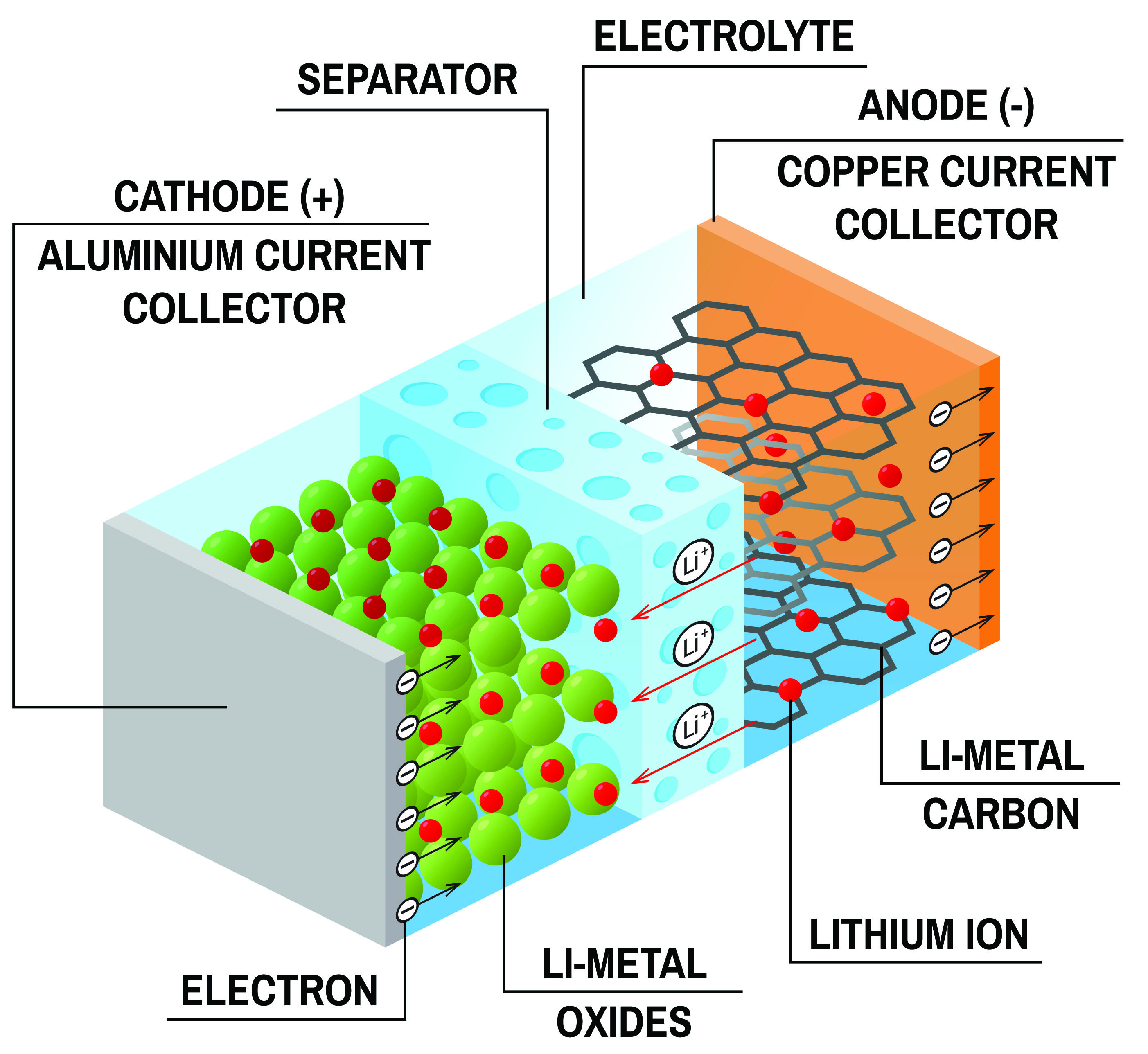
Image 3. Lithium-Ion Cell Discharging
Source/Copyright: iStock
Lithium-metal batteries are generally non-rechargeable and have lithium-metal electrodes. Lithium-metal batteries are generally used to power devices such as watches, calculators, temperature data loggers, car key fobs, flashlights, and defibrillators.
Hazards
Lithium batteries are generally safe and unlikely to fail, but only so long as there are no defects and the batteries are not damaged. When lithium batteries fail to operate safely or are damaged, they may present a fire and/or explosion hazard. Damage from improper use, storage, or charging may also cause lithium batteries to fail. Testing batteries, chargers, and associated equipment in accordance with an appropriate test standard (e.g., UL 2054). NRTL certification (where applicable), and product recalls, help identify defects in design, manufacturing, and material quality.
Damage to lithium batteries can occur immediately or over a period of time, from physical impact, exposure to certain temperatures, and/or improper charging.
- Physical impacts that can damage lithium batteries include dropping, crushing, and puncturing.
- Damage to all types of lithium batteries can occur when temperatures are too high (e.g., above 130°F). External heat sources (e.g., open flames, heaters, etc.) can also accelerate failure in cells with defects or damage from other causes.
- Damage to lithium-ion batteries can occur when the batteries themselves or the environment around the batteries is below freezing (32°F) during charging. Charging in temperatures below freezing can lead to permanent metallic lithium buildup (i.e., plating) on the anode, increasing the risk for failure.
- Charging a device or battery without following manufacturer’s instructions may cause damage to rechargeable lithium-ion batteries. For example, some manufacturer-authorized chargers will cycle the power to the battery on and off before it is fully charged to avoid overcharging. Since ultra-fast chargers may not cycle power, do not use them unless the manufacturer’s instructions include them as an option.
Heat released during cell failure can damage nearby cells, releasing more heat in a chain reaction known as a thermal runaway. The high energy density in lithium batteries makes them more susceptible to these reactions. Depending on the battery chemistry, size, design, component types, and amount of energy stored in the lithium cell, lithium cell failures can result in chemical and/or combustion reactions, which can also result in heat releases and/or over-pressurization.
- In chemical reactions, by-products from the electrolyte solution and electrodes can increase the pressure in the cell to the point where the cell walls expand and by-products leak out. Chemical by-products usually include carbon monoxide, carbon dioxide, hydrogen, and hydrocarbons. In many cases, the by-products are also combustible and could ignite.
- In combustion reactions, a thermal runaway releases byproducts that may ignite to cause smoke, heat, fire, and/or explosion. The by-products from a lithium battery combustion reaction are usually carbon dioxide and water vapor. In some lithium batteries, combustion can separate fluorine from lithium salts in the battery. If mixed with water vapors, fluorine may produce hydrofluoric acid, which is particularly hazardous because workers may not feel its effects until hours after skin exposure.
Prevention
Workplace injuries from lithium battery defects or damage are preventable and the following guidelines will assist in incorporating lithium battery safety into an employer’s Safety and Health Program:
- Ensure lithium batteries, chargers, and associated equipment are tested in accordance with an appropriate test standard (e.g., UL 2054) and, where applicable, and certified by a Nationally Recognized Testing Laboratory (NRTL), and are rated for their intended uses.
- Follow manufacturer’s instructions for storage, use, charging, and maintenance.
- When replacing batteries and chargers for an electronic device, ensure they are specifically designed and approved for use with the device and they are purchased from the device’s manufacturer or a manufacturer authorized reseller.
- Remove lithium-powered devices and batteries from the charger once they are fully charged.
- Store lithium batteries and devices in dry, cool locations.
- Avoid damaging lithium batteries and devices. Inspect them for signs of damage, such as bulging/cracking, hissing, leaking, rising temperature, and smoking before use, especially if they are wearable. Immediately remove a device or battery from service and place it in an area away from flammable materials if any of these signs are present.
- If batteries are damaged, remove them from service, place in fire resistant container (e.g., metal drum) with sand or other extinguishing agent and dispose in accordance with local, state, and federal regulations. Contact a local battery recycling center for disposal instructions.
- Follow manufacturer’s guidance on how to extinguish small battery fires, which could include using ABC dry chemical extinguishers, Class D fire extinguishers (for lithium-metal), dirt, or sand.
Training
Ensure that workers who use or handle lithium-powered devices, cells, or batteries in the workplace receive training associated with these products, including training on how to:
- Verify NRTL certification for batteries, chargers, and associated equipment, where applicable.
- Identify defective, damaged, or failing lithium-powered devices and batteries.
- Remove defective devices or batteries from the workplace.
- Quickly remove a lithium-powered device from clothing if it feels hot or if the device is leaking, releasing gas, hissing, bulging/cracking, or on fire.
Ensure that an emergency action plan (EAP) for a workplace with lithium-powered devices or batteries includes lithium-related incident response procedures based on manufacturer’s instructions for responding to battery failures including fires and/or explosions.
Ensure that appropriate information about the hazards of lithium-powered devices and lithium batteries is communicated to exposed workers (e.g., during repair of lithium-powered devices or during recycling activities) and that workers receive training on the physical and health hazards associated with lithium-ion and/or lithium-metal cells or batteries.
Resources
OSHA Fire Safety and Health Topics Page
OSHA Hazard Communication Safety and Health Topics Page
OSHA Evacuation Plans and Procedures eTool
OSHA Recommended Practices for Safety and Health Programs
OSHA Nationally Recognized Testing Laboratory Program
Consumer Product Safety Commission Batteries Topic Page
Status Report on High Energy Density Batteries Project, February 12, 2018
Department of Energy, "How Does a Lithium-ion Battery Work?"
NFPA Lithium Ion Batteries Hazard and Use Assessment
NFPA Safety Tip Sheet: Lithium Ion Batteries
Pipeline and Hazardous Materials Safety Administration – Safe Travel, Batteries
2019 Lithium Battery Guidance Document - IATA
Additional Information
OSHA provides compliance assistance through a variety of programs. OSHA On-Site Consultation Program offers no-cost and confidential occupational safety and health services to small and medium-sized businesses. On-Site consultation services are separate from OSHA enforcement efforts and do not result in penalties or citations. However, employers must agree to correct any serious and imminent danger hazards identified in a timely manner. To locate the OSHA On-Site Consultation Program nearest you, call 1-800-321-OSHA (6742) or visit www.osha.gov/consultation.
Workers' Rights
Workers have the right to:
- Working conditions that do not pose a risk of serious harm.
- Receive information and training (in a language and vocabulary the worker understands) about workplace hazards, methods to prevent them, and the OSHA standards that apply to their workplace.
- Review records of work-related injuries and illnesses.
- File a complaint asking OSHA to inspect their workplace if they believe there is a serious hazard or that their employer is not following OSHA's rules. OSHA will keep all identities confidential to the extent permitted by law.
- Exercise their rights under the Occupational Safety and Health Act (OSH Act) without retaliation, including reporting an injury or raising health and safety concerns with their employer or OSHA. To preserve a claim for unlawful retaliation under the OSH Act, a worker must file a complaint with OSHA no later than 30 days after the alleged unfavorable action occurs.
- Exercise their rights under the Consumer Product Safety Improvement Act (CPSIA) without retaliation, including reporting a potentially unsafe or defective product to their employer, the Federal Government (such as the Consumer Product Safety Commission (CPSC)), or a State attorney general. To preserve a claim for unlawful retaliation under the CPSIA, a worker must file a whistleblower complaint with OSHA no later than 180 days after an alleged violation of the CPSIA whistleblower provision occurs.
For additional information, see OSHA's Workers page.
Contact OSHA
Under the OSH Act, employers are responsible for providing safe and healthful workplaces for their employees. OSHA's role is to help ensure these conditions for America's working men and women by setting and enforcing standards, and providing training, education and assistance. For more information, visit www.osha.gov/ or call OSHA at 1-800-321- OSHA (6742), TTY 1-877-889-5627.
i Many of OSHA’s safety standards for Construction and General Industry (e.g., OSHA’s Electrical Standard for General Industry, 29 CFR Part 1910 Subpart S) require that equipment and products be tested and certified to help ensure their safe use in the workplace. To implement these requirements, OSHA established the Nationally Recognized Testing Laboratory (NRTL) Program and the Agency generally requires independent organizations recognized by OSHA (i.e., NRTLs) to perform this testing and certification. For more information on the NRTL Program and the OSHA requirements for NRTL testing and certification, please see https://www.osha.gov/dts/otpca/nrtl/index.html.
This Safety and Health Information Bulletin is not a standard or regulation, and it creates no new legal obligations. The Bulletin is advisory in nature, informational in content, and is intended to assist employers in providing a safe and healthful workplace. Pursuant to the Occupational Safety and Health Act (OSH Act), employers must comply with hazard-specific safety and health standards and regulations promulgated by OSHA or by a state with an OSHA-approved state plan. In addition, pursuant to Section 5(a)(1), the General Duty Clause of the Act, employers must provide their employees with a workplace free from recognized hazards likely to cause death or serious physical harm. Employers can be cited for violating the General Duty Clause if there is a recognized hazard and they do not take reasonable steps to prevent or abate the hazard. However, failure to implement any recommendations in this Safety and Health Information Bulletin is not, in itself, a violation of the General Duty Clause. Citations can only be based on standards, regulations, and the General Duty Clause.
Twenty-eight states and territories operate their own occupational safety and health State Plans approved by OSHA. State Plans may have different or additional requirements. A list of State Plans is available at: https://www.osha.gov/dcsp/osp/.