
- U.S. Department of Labor
- Occupational Safety and Health Administration
- Directorate of Technical Support and Emergency Management
- Office of Science and Technology Assessment
Hazards Associated with the "Unintended (Double) Cycling" of Mechanical Power Presses
Safety and Health Information Bulletin
SHIB 02-02-2010
Preface
The most common type of injury associated with mechanical power presses is amputation. Such injuries are often the result of point of operation hazards. The point of operation is the area on a press where material is processed. Amputations may occur when the required point of operation guards and devices are not in place or are not properly installed and the operator is able to place a hand, finger or any other body part in the working area of the press while it is cycling. Press operators may also be injured if one of the safety components of the press fails and the clutch/brake control electrical circuit has not been constructed to provide for control reliability. Control reliability means the system's components are integrated and function together as a unit; if one system component fails, the press will not initiate a successive stroke until the failure is corrected.
This Safety and Health Information Bulletin (SHIB) describes an accident involving an amputation that occurred when the press double cycled. The operator was injured when he placed his hand in the point of operation area and the presence sensing device (PSD) failed. Had the system been control reliable, this failure should have stopped the machine from operating.
This SHIB also highlights safety measures in OSHA's Mechanical Power Presses standard, 29 CFR 1910.217, that address this situation.
Purpose
The purpose of this SHIB is to:
- Inform employers and workers that unless a press control circuit is control reliable, unintended cycling may occur when a safety device and/or control component is improperly installed or fails.
- Raise awareness that it is important to verify that the safety systems of mechanical power presses are functioning properly.
- Stress that it is important to train operators and maintenance personnel on safe operating procedures.
- Identify the requirements in OSHA's mechanical power presses standard that address safeguarding the point of operation, component failure and safety system reliability.
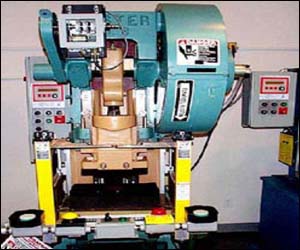
Part revolution mechanical power press
Background
A mechanical power press is a machine that shears, punches, forms or assembles metal or other materials by means of tools or dies mounted on slides or rams. It operates in a controlled, reciprocating motion toward and away from the stationary bed containing the lower die.
When the upper and lower dies press together, the desired workpiece is produced. Once the downstroke is completed, the formed workpiece is removed, a new workpiece is fed into the die and the process is repeated. These presses are characterized by the type of clutch they use: full revolution or part revolution. See OSHA's Machinery and Machine Guarding Definitions standard, 29 CFR 1910.211(d)(5) and (d)(6), for a definition of these two types of clutches. Point of operation safeguarding devices required on part revolution clutch presses may include, but are not limited to, two hand controls, presence sensing devices, type A and type B gates, pull outs, and movable barriers. See 29 CFR 1910.217(c)(3).
Accident Description
OSHA's Omaha, Nebraska Area Office investigated an amputation accident involving a guarded 60 ton, part revolution, mechanical power press. The press on which the amputation occurred incorporated a two hand control point of operation device and a PSD. The two hand controls were located 22 inches from the die area. The safety distance met the requirements in 29 CFR 1910.217(c)(3)(vii)(c).
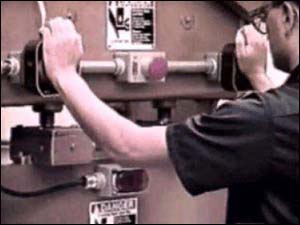
Mechanical power press operation using two hand controls
The PSD on this press was installed by the employer who followed the manufacturer's wiring schematic. A PSD signals the machine to stop operating when any part of the operator's body is within the sensing field.
On the day of the accident, a worker, without using hand tools, reached into the die area to clear jammed material and the press double cycled. This resulted in the amputation of three fingers on his left hand. The press was immediately locked-out and removed from service.
This press had double cycled four days before the accident. At that time, the double cycling did not cause an injury. After that initial incident, the employer's maintenance personnel inspected the press and concluded that a faulty timer caused the press to double cycle. Maintenance personnel replaced the timer and the employer returned the press to service.
After the accident, the employer contacted the press manufacturer to determine what was causing the press to double cycle. The manufacturer's electrician evaluated the press and concluded that the PSD was not wired correctly. The schematic that came with the PSD was incorrect which led to improper installation of the device. The manufacturer's electrician rewired the PSD and corrected the schematic.
The employer's electrician conducted a follow-up test of the press's electrical circuit (the timer contacts, limit switches and control relays) and validated that these components were functioning properly. The press was then put back into service.
OSHA's Standard Requirements
OSHA's Mechanical Power Presses standard, 29 CFR 1910.217, contains requirements to protect workers from point of operation hazards. Requirements that apply to the press involved in this specific accident, include:
- Hand Controls. Controls must be arranged so that both hands are used at the same time to trip the press (29 CFR 1910.217(b)(7)(v)(a)).
- Anti-repeat. This feature must be part of the control system so that the press is limited to a single stroke (29 CFR 1910.217(b)(7)(v)(c)).
- Electrical Clutch/Brake Control Circuits. Circuitry must incorporate features such as relays, limit switches, and static output circuits to minimize the possibility of an unintended stroke if a control component fails to function properly (29 CFR 1910.217(b)(8)(vi)).
- Control Reliability. The control system must be designed to allow the brake to stop the press when a control component fails, while at the same time not allowing the next stroke to occur until the failure is fixed (29 CFR 1910.217(b)(13). For more information see the definition of safety system under 29 CFR 1910.211(d)(62)).
- Safeguarding the Point of Operation. Employers shall provide and ensure the use of point of operation guards or properly applied and adjusted point of operation devices on every operation performed on a mechanical power press (29 CFR 1910.217(c)(1)(i)).
- Point of operation guards. A barrier that prevents the operator's hand or fingers from entering the point of operation of the press by reaching through, over, under or around the guard (29 CFR 1910.217(c)(2)).
- Point of operation devices. A control or attachment that prevents the operator from inadvertently reaching into the point of operation (29 CFR 1910.217(c)(3)(i)(a-g)).
- Hand Feeding Tools. Used for placing and removing material in and from the point of operation area. These can only be used with other point of operation guards or devices, not in place of them (29 CFR 1910.217(c)(4)).
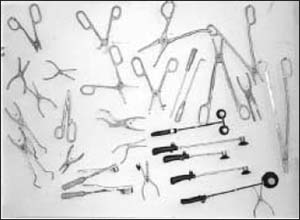
Typical Hand Feeding Tools
- Design, Construction, Setting and Feeding of Dies. Dies and operating methods must be designed to control or eliminate hazards to operators. By providing and enforcing the use of hand tools for clearing jams in the die, workers will not need to reach into the point of operation with their hands (29 CFR 1910.217(d)(1)(i)) and (29 CFR 1910.217(d)(1)(ii)).
- Inspection, Maintenance and Modification of Presses. Employers must develop an inspection program that ensures that all press parts, point of operation guards and devices are in safe working condition. A certification record of these inspections is required and all repair or maintenance must be performed and completed before the press is operated (29 CFR 1910.217(e)). If a press is modified, it must be accompanied by instructions that indicate new or changed guidelines for use and care of the press (29 CFR 1910.217(e)(2)).
- Training and Instruction. Maintenance personnel who care for, inspect and maintain power presses must be competent (29 CFR 1910.217(e)(3)) and operators must be trained and instructed on safe work methods before starting work (29 CFR 1910.217(f)(2)).
Recommendations
Following the recommendations below will further reduce the risk of amputation hazards to part revolution clutch press operators.
- Adhering to a safety practice that does not allow operators to place their hands in the hazardous zone of the machinery will further reduce the risk of point of operation amputations. This approach should be practiced even when point of operation safeguarding features are present and function properly.
- Power press manufacturers, presence sensing device manufacturers, and other equipment manufacturers, as well as third-party integrators and refurbishment companies who retrofit equipment, should verify that their equipment and installations are control reliable.
Conclusion
The purpose of this SHIB is to minimize the potential for fatal or serious amputation injuries. The underlying cause of the highlighted accident was an improperly installed PSD that caused a failure of the safety control system's ability to detect a fault and prevent the unintended next stroke.
The accident might have been prevented if these requirements were followed: ensuring control reliability prior to putting the machine in service, conducting regular inspections, training operators and using point of operation guarding and other safety devices in conjunction with the use of hand tools.
Additionally, implementation of a safe work practice that does not allow operators to place their hands in the hazardous zone of the machinery would have resulted in a near miss rather than an amputation injury. Enforcing this policy will serve as a front line defense in preventing mechanical power press-related injuries.
References
The references listed below provide more detailed information on machine guarding, controlling amputation hazards and definitions of terms used in the standard.
- 29 CFR 1910.217, Mechanical Power Presses.
- 29 CFR 1910.211, Definitions. (Note that section 1910.211(d) defines power press terms that are used in 1910.217, and should be referenced to assist in understanding their application.)
- Machine Guarding. OSHA e-Tool.
- MIOSHA. Michigan Occupational Safety and Health Administration's Consultation, Education & Training Division.
- U.S. Department of Health and Human Services. Centers for Disease Control and Prevention. National Institute for Occupational Safety and Health. Current Intelligence Bulletin 49, Injuries and Amputations Resulting from Work with Mechanical Power Presses. Cincinatti, 1987. Print.
- U.S. Department of Labor. Occupational Safety and Health Administration. Safeguarding Equipment and Protecting Employees from Amputations. Small Business Safety and Health Management Series, 11 Sept. 2007. Web. 27 July 2009.
- Kentucky Labor Cabinet. Division of Education and Training. Mechanical Power Press Safety. Frankfort, KY. Print.
- Michigan Department of Energy, Labor & Economic Growth. Michigan Office of Safety & Health Administration. General Industry Safety Standard, Part 24. Mechanical Power Presses. 1993. Print.
- PMA Mechanical Power Presses Checklist.