
- U.S. Department of Labor
- Occupational Safety and Health Administration
- Directorate of Technical Support and Emergency Management
- Office of Science and Technology Assessment
Using Dolly-Type Devices to Spread Flammable Liquid Adhesives on a Roof Can Cause Fires
Safety and Health Information Bulletin
SHIB 03-13-2014
Introduction
Throughout the roofing industry, adhesives are used to glue membranes in place on a roof. Adhesives are spread onto the roofing deck using devices, such as sprayers or rollers. During an inspection, the Occupational Safety and Health Administration’s (OSHA) area office in Concord, New Hampshire, identified a dolly-type roller device that must not be used for spreading flammable liquid adhesives (Figure 1). The device (or equipment) does not meet the agency’s requirements for dispensing a flammable liquid and it was used in a way that creates a fire hazard to workers.
The dolly-type roller device and the adhesive are manufactured by different companies and are sold separately. The device is designed to spread the liquid adhesive directly onto the roof from its 5-gallon metal container (Figure 2). The manufacturer of the device instructs users to lay the adhesive container on its side (horizontally), punch a row of holes along the center, clamp the container to the dolly, and turn it over, so that the adhesive flows through the holes to the roller to be spread onto the roof.
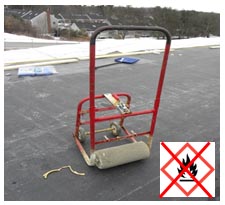
Figure 1: The dolly-type roller device used in a way that does not meet OSHA’s requirements for spreading flammable adhesives.
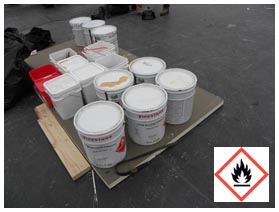
Figure 2: Metal containers of flammable adhesive.
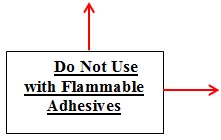
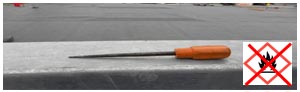
Figure 3: Using a metal punch to create holes in containers of flammable adhesives increases the risk of starting a fire.
This dolly-type roller must not be used to dispense flammable adhesives as currently designed because:
- Flammable liquids must be dispensed from a closed system or an approved container – punching holes in the adhesive container nullifies its approval.
- Punching holes in the adhesive container can introduce sparks and cause ignition of the flammable adhesive.
- Neither the storage container nor the roller has an approved shut-off or self-closing latch or valve, so if a fire starts there would be no way to stop the flow of the adhesive.
"Approved" means listed or approved by a Nationally Recognized Testing Laboratory (29 CFR 1910.106(a)(35)) such as:
- FM Approvals, LLC,
- Underwriters Laboratories, Inc.,
- or a federal agency, like the Department of Transportation that issues approvals for such equipment (29 CFR 1926.152(a)(1); 29 CFR 1910.106(d)(2)(i)).
OSHA does not approve containers or equipment.
What are the fire hazards?
The adhesive used at this roofing job site was a toluene-based liquid. The Material Safety Data Sheet (MSDS) or Safety Data Sheet (SDS)1 for the adhesive states that it is flammable and warns users not to cut, drill, grind, or weld near full, partially full or empty adhesive containers. The product information instructs users to apply the adhesive using a nine-inch, medium-nap roller (back rolling of the adhesive is required) or with an approved spraying equipment or power roller equipment.
Punching holes in the storage container using an electric drill or hand tools such as drills, screwdrivers, or punches can create sparks and heat, introducing sources of ignition. Sparks or heat can ignite the flammable adhesive and start a fire. The dolly-type device does not have an approved self-closing or shutoff system. As a result, the flammable adhesive will continue to flow from the holes in the container and add fuel to the fire, putting workers at risk of being trapped on the rooftop with only a limited number of exits.
Static electricity can also create sparks. Static electricity is common when the humidity is low, such as during the winter. A spark can be created under some conditions, for example, just by shuffling the feet across the rooftop and then touching a metal screw or plate. Static electricity can also build-up as a flammable liquid flows from its container and by the movement (rubbing together and separation) of certain types of clothing. For example, clothing made of one hundred percent silk, polyester, wool or nylon is highly static producing.
Are there other hazards with using roofing adhesives?
While the risk of starting a fire (physical hazard2) is the focus of this Safety and Health Information Bulletin (SHIB), roofers should also be aware that roofing adhesives may contain chemicals with health hazards, for example, toluene. Workers may be exposed if they breathe the vapors into their lungs, or if the adhesive gets into their eyes or on their skin. A worker may be accidentally exposed by touching their face, or eating, or drinking after handling adhesives without first washing his or her hands. In addition, there is always a risk of falling when working at a height. Increasing this risk is the fact that surfaces coated with adhesives can be slippery.
Precautions
- Use non-flammable adhesives to install roofing membranes when possible.
- Use only non-flammable liquid adhesives with the type of roller device described in this SHIB (Figure 1). Do not use the type of roller device described and pictured (Figure 1) in this SHIB to dispense flammable adhesives.
- If a flammable liquid adhesive is used, ensure that it is drawn from containers and spread onto the rooftop with an approved closed system/device (no leaks of flammable liquid or vapor). Such a device would draw flammable liquids from containers or portable tanks by gravity or by using an approved pump. The device must have an approved self-closing latch or valve and a means for safely removing static electricity (29 CFR 1926.152(a)(1); 29 CFR 1926.152(e)(3) & (5); 29 CFR 1910.106(a)(9)).
- Provide workers with effective information and training on hazardous chemicals in their work area (29 CFR 1926.59; 29 CFR 1910.1200 (h)(1),(2) & (3) (h)(1),(2) & (3)).
- Carefully review the label on the adhesive container, MSDS or Safety Data Sheet (SDS), and the manufacturer’s product information to find out if the adhesive you plan to use contains hazardous chemicals3, and follow the precautions recommended in these documents for using the product safely (29 CFR 1926.59; 29 CFR 1910.1200(b),(f)(10) & (g)).
- Take steps to eliminate sources of ignition, for example, safely discharge any static electricity, by using properly connected bonding and grounding methods. Avoid clothing that generates static electricity, for example, wear clothing made of cotton. Use non-sparking tools and intrinsically safe equipment.
- Make sure that there are no open flames or other sources of ignition (for example, generators, smoking, hot surfaces, etc.) in the area where a flammable adhesive is being applied (29 CFR 1926.152(f)(3)). As it dries, the adhesive will give off flammable vapors that can be ignited.
- Keep to a minimum the total area of the roof that is coated with a flammable adhesive and not covered with a roofing membrane; for example, cover the adhesive with the roofing membrane as soon as possible. This will help to reduce the chance of starting a fire and workers’ exposure to any hazardous chemicals.
- Make sure that approved portable fire extinguishers of the appropriate type are readily accessible to workers and that workers have been trained on how to use them (29 CFR 1926.150(a)(2),(3) & (4); 29 CFR 1926.150(c)(1)(vi) and (ix); 29 CFR 1910.157(c)(1) and (c)(2).
- Do not store containers of flammable adhesives near the exit route(s). If a fire starts and spreads to the containers, it may block the roof exit, trapping workers on the rooftop (29 CFR 1926.152(a)(2)).
- Monitor the air to determine if the levels of hazardous chemicals released from an adhesive when coating a rooftop are above OSHA’s permissible exposure limits (PELs) for workers; (29 CFR 1926.55; 29 CFR 1910.1000).
- Use adhesives with less hazardous or non-hazardous chemicals when possible.
- Use the natural ventilation on a rooftop to help reduce the levels of any hazardous chemicals released from an adhesive. Make sure that workers, including those who are performing other tasks, are working upwind of the area where the adhesive is being applied. Use other measures, such as local exhaust ventilation, to move hazardous vapors away from workers when natural ventilation is not adequate to do so. Fans and other ventilation equipment must be selected carefully if the vapors are flammable.
- Ensure that workers receive the appropriate training before using any required protective clothing and equipment such as, respirators (if necessary) (29 CFR 1926.28; 29 CFR 1926.103; 29 CFR 1910.132; 29 CFR 1910.134).
- Protect workers from falls when working on roofs that have unprotected sides and edges, and that are 6 feet or more above lower levels (29 CFR 1926.501(b)(10) & (11)).
- Train workers on how to recognize fall hazards, ways of reducing the hazards, and how to properly use the right type of fall protection equipment provided by the employer (29 CFR 1926.503(a)(1) & (2), 29 CFR 1926.21(b)(2)).
Conclusion
Do not use a dolly-type roller device like the one described in this SHIB to dispense flammable liquid adhesives, due to the risk of starting a fire. If a flammable liquid adhesive is used, the employer must ensure that it is drawn from containers and spread onto the rooftop with an approved closed system/device. In addition to the risk of starting a fire, roofing adhesives may also contain chemicals with health hazards. Workers must be trained on all the hazards of the chemicals they use and the correct safety measures that will protect them. Workers must also be protected from the hazard of falling from a height when working on a rooftop (as applicable).
References
The resources listed below provide additional information on flammable liquids, fire prevention and control, air contaminants, hazard communication, and the use of PPE.
- 29 CFR 1910.106: Flammable liquids.
- 29 CFR 1910.132: General requirements for personal protective equipment for general industry.
- 29 CFR 1910.134: Respiratory protection.
- 29 CFR 1910.157: Portable fire extinguishers.
- 29 CFR 1910.1000: Air contaminants.
- 29 CFR 1910.1200: Hazard communication.
- 29 CFR 1926.21: Safety training and education.
- 29 CFR 1926.28: Personal protective equipment.
- 29 CFR 1926.55: Gases, vapors, fumes, dusts, and mists.
- 29 CFR 1926.59: Hazard communication.
- 29 CFR 1926.103: Respiratory protection.
- 29 CFR 1926.150: Fire protection.
- 29 CFR 1926.152: Flammable liquids.
- 29 CFR 1926.501: Duty to have fall protection.
- 29 CFR 1926.503: Training requirements.
How OSHA Can Help
OSHA's On-site Consultation Program offers free and confidential advice to small and medium-sized businesses in all states across the country, with priority given to high-hazard worksites. On-site Consultation services are independent of OSHA enforcement and do not result in penalties or citations. Consultants from state agencies or universities work with employers to identify workplace hazards, provide advice on compliance with OSHA standards, and assist in establishing safety and health management systems. To locate the OSHA On-site Consultation office in your state, call 1-800-321-OSHA (6742) or visit OSHA's Consultation web page.
OSHA Approved State Plans: Twenty-seven states and U.S. territories operate their own occupational safety and health state plan approved by OSHA. State plans have Hazard Communication standards that are at least as effective as OSHA's standards in providing protection to workers. A list of state plans and more information about each state plan's Hazard Communication standard is available.
OSHA Compliance Assistance: OSHA’s compliance assistance specialists throughout the nation provide information to employers and workers about OSHA standards, rights and responsibilities under the Occupational Safety and Health Act, present short educational programs on special hazards and help with other compliance assistance resources. Contact your local OSHA office for more information by calling 1-800-321-OSHA (6742) or visit OSHA's web page at www.osha.gov.
Workers' Rights
Workers have the right to:
- Working conditions that do not pose a risk of serious harm.
- Receive information and training (in a language and vocabulary they can understand) about workplace hazards, methods to prevent harm, and the OSHA standards that apply to their workplace.
- Review records of work-related injuries and illnesses.
- Get copies of test results that find and measure hazards.
- File a complaint asking OSHA to inspect their workplace if they believe there is a serious hazard or that their employer is not following OSHA's rules. OSHA will keep all identities confidential.
- Exercise their rights under the law without retaliation or discrimination
For more information, see OSHA's web page for workers.
Contact OSHA
For questions or to get information or advice, to report an emergency, report a fatality or catastrophe, file a confidential complaint, order publications, or to request OSHA's free On-site Consultation service, contact your nearest OSHA office, visit www.osha.gov, or call OSHA at 1-800-321-OSHA (6742), TTY 1-877-889-5627.
Footnotes
1 OSHA’s Hazard Communication standard was revised in 2012. Safety Data Sheets (SDSs) will replace MSDSs. SDSs have a standardized 16-section format with specific information required in each section. Manufacturers and importers have until June 1, 2015, to replace MSDSs with SDSs; until then either MSDSs or SDSs may be received by employers.
2 A physical hazard means a chemical that is classified as posing one of the following hazardous effects: explosive; flammable (gases, aerosols, liquids, or solids); oxidizer (liquid, solid or gas); self-reactive; pyrophoric (liquid or solid); self-heating; organic peroxide; corrosive to metal; gas under pressure; or in contact with water emits flammable gas. See Appendix B to 1910.1200 — Physical Hazard Criteria (29 CFR 1910.1200).
3 A hazardous chemical means any chemical which is classified as a physical hazard or a health hazard, a simple asphyxiant, combustible dust, pyrophoric gas, or hazard not otherwise classified (29 CFR 1910.1200).