
- U.S. Department of Labor
- Occupational Safety and Health Administration
- Directorate of Technical Support and Emergency Management
- (formerly Directorate of Science, Technology & Medicine)
- Office of Science and Technology Assessment
Potential Flammability Hazard Associated with Bulk Transportation
of Oilfield Exploration and Production (E&P) Waste Liquids
Safety and Health Information Bulletin
SHIB 03-24-2008
Incident
On January 13, 2003, a vapor cloud ignited, leading to a fire at an oilfield waste disposal facility (hereafter, disposal facility) near Rosharon, Texas, south of Houston. The fire occurred as two vacuum trucks were off-loading liquid wastes from oil and gas production wells.
The trucks arrived at the disposal facility within a few minutes of each other and were parked approximately 16 feet apart. The two drivers got out of their trucks, left the engines running, and told the disposal facility employees that the trucks were to be drained and rinsed out. Both drivers then went to the drivers' shed to complete paperwork and to wait for the washout to be completed. (1)
The fire was caused by the ignition of hydrocarbon vapor released during the off-loading of basic sediment and water (BS&W) from the two vacuum trucks into an open area collection pit. BS&W is an oil/gas exploration and production (E&P) waste liquid. The BS&W was contaminated with highly flammable condensate. During the off-loading, vapor off-gassed from the BS&W and was drawn into the air intakes of the vacuum trucks' running diesel engines. As a result, the engines began to race and backfire. The flammable vapor cloud ignited. (1)
The post-incident investigation documented five possible vapor cloud ignition sources - the vacuum trucks' diesel engines, vacuum truck electrical systems, static electricity discharge from the off-loading liquid, (although equipped with a grounding cable, the trucks were not grounded during the off-loading), personnel smoking, and facility electrical wiring. The investigation determined that the diesel truck engines were most likely the ignition source based on physical evidence and the supporting eyewitness testimony. (1)
Two disposal facility employees and one tank driver, employed by the transport company, were killed in the fire. Three other disposal facility employees and one truck driver suffered severe burns. The fire destroyed the two 50-barrel vacuum trucks (each tank truck = 2,100 gallon capacity) owned by the transport company and heavily damaged waste liquid off-loading equipment and structures at the facility (See Figure 1). (1)
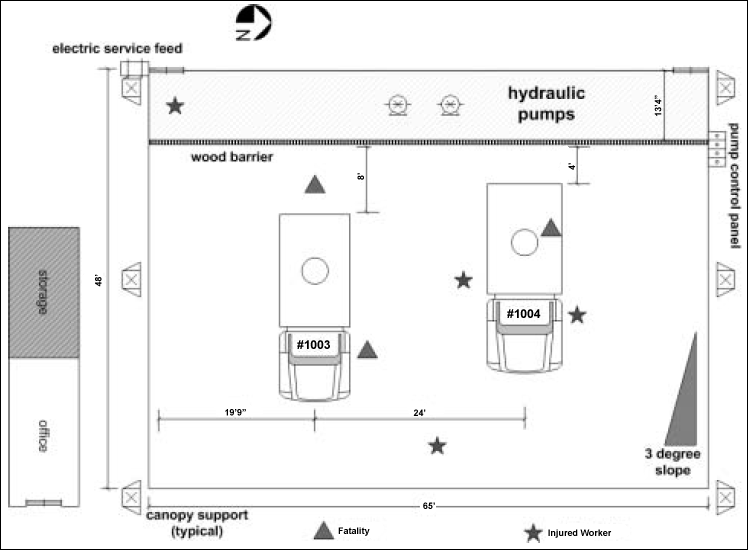
Figure 1. Layout of Open Area, Gravity Feed, Disposal Pad, with Vacuum Trucks
Positioned as on January 13, 2003, When the Fire and Deflagration Occurred. (1)
Purpose of SHIB
The purpose of this Safety and Health Information Bulletin is to alert other facilities in the oil and gas industry about:
- The potential flammability hazard associated with BS&W and other E&P waste liquids,
- The safe work practices operators should follow when handling and transporting potentially flammable waste liquids, and the necessary precautions to take to minimize the generation of flammable vapor and to control ignition sources,
- The importance for companies to obtain the necessary material safety data sheets (MSDSs) before transporting waste or disposing of it,
- Employers' obligations regarding hazard communication and the safe handling of oilfield and gasfield waste, and
- The responsibility of all employers to properly train their employees in a manner clearly understood by the recipients (all affected personnel).
CSB Investigation
Because of the deaths and injuries caused by this incident, OSHA and the U.S. Chemical Safety and Hazard Investigation Board (CSB) conducted investigations. CSB's investigation sought to determine the root and contributing causes, and to issue recommendations to interested parties in an effort to prevent similar occurrences. (1)
In its investigation report, the CSB pointed out that "the oil and gas industry disposes of many thousands of barrels of E&P waste liquids annually, including potentially flammable BS&W." (1) "E&P wastes can have flammability characteristics that meet the definition of a flammable liquid in both OSHA and DOT regulations, thus posing a significant physical hazard to personnel." (1) The CSB found inconsistency within the oil and gas industry in managing the potential flammability hazard of BS&W. In some cases, the flammability hazard is not identified or recognized, and work practices are inadequate for safe handling of the potentially flammable liquid.
Root Causes
The CSB investigation revealed the following root causes of this incident:
- The producer/shipper of the waste failed to identify the flammability hazard of BS&W generated at its gas well production facility and also failed to communicate the hazard to employees and contractors who were required to handle the flammable liquid (1),
- The transport company did not ensure that the producer provided vacuum truck drivers with a material safety data sheet or other document listing the potential flammability hazard of BS&W, nor did it identify the flammability hazard of the mixture in the vacuum trucks' tanks (1), and
- Management at the disposal facility did not have effective hazard communication practices in place to recognize the potential flammability hazard of each shipment of BS&W, nor did it implement safe handling practices for off-loading flammable liquid into the mud disposal and washout pad area. (1)
Contributing Causes
Contributing causes of the incident reported by the CSB are summarized below:
- The transport company did not understand the potential flammability hazard of BS&W in the product storage tanks, nor did they understand that inadvertent mixing of hydrocarbon product with waste liquid when filling the vacuum trucks' tanks most likely increased the flammability hazard of the trucks' contents (1),
- The transport company and disposal facility management did not implement safe work practices to minimize the generation of flammable vapor and to control ignition sources (1), and
- Neither the transport company nor the disposal facility management and employees recognized that the trucks' diesel engines presented multiple vapor ignition sources. (1)
Discussion of Standards
Based on the listed root causes of this incident, the following aspects of the incident and their associated OSHA standards are identified below.
Hazard Determination and MSDSs
- Drillers and producers must evaluate chemicals they produce to determine if they are hazardous, i.e., determine the potential flammability hazard associated with BS&W and other E&P waste liquids
- 1910.1200(d). - Drillers and producers must obtain or develop appropriate MSDSs for the hazardous materials they produce, i.e., BS&W - 1910.1200(g)(1).
- Drillers and producers must ensure that appropriate MSDSs are provided to downstream employers, e.g., the transport company, with their first shipments - 1910.1200(g)(6)(i).
- The transport company did not conduct a hazard determination or obtain an MSDS from the producer. The transport company is responsible for a hazard determination of the hazardous chemicals they deliver to downstream customers/ employers - 1910.1200(d)(1).
Training Information and Labeling
- Procedures implemented by employers at workplaces to protect employees from hazardous chemicals must be included in the employer's hazard communication training for their employees and contract employees. For example, in this case, the producer was required to include appropriate elements of hazard communication training to the transport company driver (contract employee), who used the specified tank off-loading procedure to drain the BS&W from the producer's tank. One basis for this procedure was to prevent the draining of lighter, presumably flammable hydrocarbons into the transport company's vacuum truck, thereby reducing the risk of a fire/explosion incident. This same concept was applicable at the disposal facility. The specific procedures utilized at this facility to protect employees from chemical hazard exposures needed to be included in the hazard communication training for employees and contract employees - 1910.1200(h)(3)(iii). In this case, safe practices were not implemented at this disposal facility when the mixture in the vacuum truck was by gravity drop off-loaded to a concrete pad. As a result, off-gassing from the condensate/BS&W mixture formed a vapor cloud which ignited and ultimately caused the employee deaths and injuries as well as property damage.
- All employee safety information must be in languages and presented in a manner that can be clearly understood by all affected personnel - 1910.1200(h)(1). If the employees receive job instructions in a language other than English, then the training and information provided needs to be presented in that language.
- Storage tanks must be properly labeled to clearly identify the hazard of the tanks' contents to all employees and contractors working at the wellsite and disposal facility - 1910.1200(f)(5) and 1910.1200(f)(6).
Work Procedures and Emergency Planning
- At the disposal site, management needs to develop and implement written procedures and provide training to employees on off-loading all flammable or potentially flammable BS&W and other E&P waste liquids. Safe procedures need to be followed when off-loading flammable or potentially flammable liquids from tank trucks, including methods to minimize generation of flammable vapor.
- Ignition sources from vehicle-mounted equipment and facility equipment need to be controlled - 1910.106(e)(6)(i). Ignition sources include those related to vehicular and electrical equipment located in hazardous classified areas.
- Emergency procedures must be developed [1910.120(q)(1) or 1910.38(a)]** and training provided [1910.120(q)(6) or 1910.38(e)] to employees on responding to abnormal or emergency situations, including uncontrolled flammable vapor releases that can result in a fire or explosion hazard. Emergency procedures need to address the safe response to abnormal diesel engine operation (e.g., diesel engine overspeed - "racing") due to a flammable vapor atmosphere being drawn into the air intake system of the truck. It should be noted that the normal engine shut-off method will not suffice as long as flammable vapor continues to enter the intake system.
Vacuum Truck Operations
Vacuum truck owners must ensure that vacuum truck operators are trained and qualified for their work assignment. The following Standards address the issues necessary to provide appropriate training.
- 29 CFR 1910.1200, Hazard Communication,
- 29 CFR 1910.106, Flammable and Combustible Liquids,
- 29 CFR 1910.120, Hazardous Waste Operations and Emergency Response,
- 29 CFR 1910.307, Hazardous (classified) Locations,
- 29 CFR 1910.1000, Air Contaminants, and
- 49 CFR, Parts 171, 172, 173, 178, 179, 382, 383 and 390-397, U.S. DOT "Motor Carrier Safety requirements for proper hazard classification and manifesting of flammable liquids, approved container design, and periodic testing.
Recommendations
Hazard Materials Awareness
Vacuum truck owners must ensure that vacuum truck operators are aware of the physical and chemical characteristics of flammable, combustible, toxic and corrosive materials. Trace amounts of flammable and combustible liquids and gases, hydrogen sulfide gas, acids, caustics, spent acids, sour water and other liquids, materials and gases present in the petroleum industry may cause serious injury, illness or death if not properly handled. (2)
MSDSs need to provide correct information on hazardous materials in tanks or vessels, but occasionally, for various reasons, they do not accurately reflect the hazards associated with co-mingled and waste products, tank bottoms, contaminated catalysts, spent acids or other materials that are being transferred. (2) Therefore, employers should be aware that in these cases a flammable or toxic hazard could exist even though its MSDS does not identify this hazard.
CSB found that the majority of those industry personnel questioned during the investigation did not believe that BS&W poses a flammability hazard, even though it can contain highly flammable condensate. "CSB analysis of nine tank BS&W samples from six production wells, including one of the wells involved in the BLSR incident, indicated flashpoints below 30°F in eight of the samples. For comparison, the flashpoint of condensate is about -36°F, and the flashpoint of gasoline is about -45°F. OSHA classifies any liquid with a flashpoint below 100°F as a flammable liquid." (1)
"Care must be taken to ensure that the materials being loaded into the cargo tank are compatible with materials previously loaded and that the mixing of these materials will not create hazards such as fire, explosion, heat, toxic gases or vapors. Unless the vacuum truck has been thoroughly cleaned and inspected, it should not be used to load materials which are not compatible with those previously handled." (2) The same principles apply when the cargo tank contents are off-loaded - the contents must be compatible with the materials presently or previously contained in the receiving container. (2)
Safe Vacuum Truck Operations
Vacuum truck owners and operators, as well as facility personnel, should be aware of numerous potential hazards associated with operating vacuum trucks in petroleum facilities, including, but not limited to the following:
- sources of ignition,
- potential hazards including spills, flammable atmosphere within and around vacuum trucks, cargo tanks or source containers, hose failures, and discharges of flammable vapors to the atmosphere,
- potential hazards associated with the surrounding area and atmospheric conditions during vacuum truck operations, and
- toxic vapor build up at or near the vacuum pump discharge port.
Note: An industry recognized good practice, American Petroleum Institute (API) Publication No. 2219, provides safe vacuum truck operating guidelines and a comprehensive checklist in an appendix. (2)
Atmospheric Testing
"The areas where vacuum trucks operate must be free of hydrocarbon vapor concentrations in the flammable range." (2) "If there is any question of whether the area is free of flammable vapor or toxic gas, atmospheric testing must be performed by a qualified person using properly calibrated and adjusted combustible gas indicators, appropriate toxic gas testers, or hydrocarbon analyzers. Testing should be conducted anytime there is uncertainty about the safety of the surrounding atmosphere, including prior to starting any operation, and during operations." (2)
Bonding and Grounding
"The complete vacuum transfer system should be bonded to ensure a continuous conductive path from the vacuum truck through the hose and nozzle to the tank or source container." (2) Bonding ensures that there is no difference in electrostatic potential between vacuum trucks and pumps and the source or receiving tank, container or vessel. (2) "This reduces the likelihood of a spark being created in the vicinity of flammable vapors when the suction nozzle or discharge hose is removed from the source or discharge container and/or is disconnected from the vacuum trucks, or when any conductive connectors are disconnected." (2)
Grounding is also a must. Prior to starting transfer operations, vacuum trucks need to be grounded directly to the earth or bonded to another object that is inherently grounded (due to proper contact with the earth), such as a properly grounded large storage tank or underground piping. Grounding ensures that any electrostatic charges that might be generated can be "bled off" to the earth, bringing all parts of the system to zero electrical potential. (2)
Personnel Safety
As stated earlier, vacuum truck personnel working in petroleum facilities must be trained in the safe operation of the vacuum equipment; be familiar with the hazards of the petroleum products, byproducts, wastes, materials being transferred, as well as any co-mingled wastes; and be aware of relevant government and facility safety procedures and emergency response requirements. (2)
MSDSs for the products being transferred must be available to vacuum truck operators, and a qualified person must be able to assess the potential exposure to unsafe air contaminant levels as well as any potential or existing flammable atmospheres. (2)
When loading and off-loading, all personnel must leave the truck cab and shut off the engine if flammable vapors are generated at or above 25% of the Lower Explosive Limit (LEL). However, when transferring flammable liquids or hazardous materials, vacuum truck operators should stay within 25 feet of the vacuum truck (between the truck and the source or receiving tank, vessel, or container) throughout the operation. (2) In practice, the vacuum truck operators will be positioned upwind and to one side of the truck within the line of sight of the operation.
Vacuum truck operators must monitor the transfer operation and be ready to quickly close the product valve and stop the pump in the event of a blocked line or release of material through a broken hose or connection. (2) Vacuum truck owners must develop emergency procedures that conform with OSHA requirements found in 29 CFR 1910.120(q) and 29 CFR 1910.38(a), and must train all vacuum truck operators in the use of those procedures. In the event of a fire, spill, release, or other emergency, operators must be knowledgeable about emergency reporting and appropriate emergency response actions.
During loading and off-loading, position the vacuum truck on level ground, at least 25 feet away from (50 feet if in a diked area) and preferably upwind or crosswind of the source or receiving tank, vessel, or container. (2) Smoking must not be permitted within at least 100 feet (depending on local procedures and atmospheric conditions) of the truck, the discharge of the vacuum pump, or any other vapor source. (2)
Conclusion
To prevent future accidents like this, the hazard of exploration and production (E&P) waste liquids must be recognized, communicated, and controlled by employers in the oil and gas production industry. Oil and gas waste liquids can be highly flammable and need to be handled appropriately.
OSHA recommends that employers engaged in the production, transport, and disposal of waste liquids take the following action:
- Ensure that MSDSs on BS&W waste material are provided to all haulers and disposal facility operators so that end-users know what is being delivered,
- Ensure proper hazard classification and manifesting of flammable liquids that are being shipped,
- Develop written procedures for safe unloading and handling practices of all potentially flammable waste liquids, designed to minimize vapor formation and prevent static discharges that could ignite vapors,
- Provide adequate training for all personnel,
- Operate vacuum trucks in a safe manner (refer to API Publication No. 2219),
- Perform atmospheric testing in accordance with API Publication 2219, Section 5.2, and
- Develop emergency procedures, particularly when diesel engines overspeed due to the presence of highly flammable vapors.
References
- Vapor Cloud Deflagration and Fire. U.S. Chemical Safety and Hazard Investigation Board, Investigation Report, (2003).
- "Safe Operations of Vacuum Trucks in Petroleum Service," American Petroleum Institute, API Publication No. 2219, (2005).
- Edwin G. Foulke, Jr.
- Assistant Secretary
- Occupational Safety and Health Administration
**OSHA requires written emergency procedures [1910.120(q) or 1910.38(a)] except in the case where employers have ten or fewer employees and chose to comply with the emergency action plan requirements of 1910.38.