
- U.S. Department of Labor
- Occupational Safety and Health Administration
- Directorate of Technical Support and Emergency Management
- Salt Lake Technical Center
Operating Hazards of Baler Discharge-Door Locks
Safety and Health Information Bulletin
SHIB 08-13-2013
This Safety and Health Information Bulletin is not a standard or regulation, and it creates no new legal obligations. The Bulletin is advisory in nature, informational in content, and is intended to assist employers in providing a safe and healthful workplace. Pursuant to the Occupational Safety and Health Act, employers must comply with safety and health standards and regulations promulgated by OSHA or by a state with an OSHA-approved state plan. In addition, pursuant to Section 5(a)(1), the General Duty Clause of the Act, employers must provide their employees with a workplace free from recognized hazards likely to cause death or serious physical harm. Employers can be cited for violating the General Duty Clause if there is a recognized hazard and they do not take reasonable steps to prevent or abate the hazard. However, failure to implement any recommendations in this Safety and Health Information Bulletin is not, in itself, a violation of the General Duty Clause. Citations can only be based on standards, regulations, and the General Duty Clause.
Glossary
The key terms used in this Safety and Health Information Bulletin (SHIB) and their definitions are:
Baling and compacting equipment means: Equipment used for compacting large volumes of low density material into smaller volumes of high density for more efficient handling and transport.
Discharge-door locking mechanism means: The mechanism designed to hold the baler or compactor discharge door in the closed position.
Preface
Many industries across the nation use hydraulic baling and compacting equipment. Maryland Occupational Safety and Health (MOSH) identified a serious hazard, failure of the discharge-door locking mechanism, in multiple units of hydraulic baling and compacting equipment produced by one manufacturer, Waste Processing Equipment, Inc. An engineering assessment of this hazard suggests that competent engineering professionals should evaluate all hydraulic baling equipment for this hazard.
The hazard described in this SHIB constitutes a potentially fatal hazard to any workers that may be in the area of the baler or compactor discharge door. Standards for proper design of the discharge-door locking mechanism, discussed in this bulletin, exist both nationally and internationally. Noncompliant designs of balers or compactors and a lack of awareness of this potential hazard can result in fatal injury. This SHIB is a result of a fatality-related case involving this hazard investigated by MOSH.
Purpose
The purpose of this SHIB is to:
- Inform employers and workers of the potential for fatal injury associated with failure of the discharge-door locking mechanism on baling and compacting equipment, and measures they can take to mitigate this hazard.
- Raise awareness of the importance of conducting periodic inspections of the discharge-door locking mechanism under the direction of competent engineering and materials analysis professionals.
- Encourage compliance with established guidance for baling and compacting equipment published in existing consensus standards such as ANSI Z245.2, Z245.21, Z245.5, and Z245.51.
Background
Balers and compactors are machines that use high compression force to compact scrap and refuse material into bales or bundles for efficient handling. In many designs, these machines utilize large cylinders or rams to compress the materials against a heavy, reinforced discharge door. Following the compression cycle, the discharge door moves out of the way to discharge the bale of compacted material. The force imposed on the discharge door is often well over 100,000 lbs. The baler or compactor housing and discharge door must, therefore, withstand the high loads from the compaction ram. These loads result in significant cyclic stresses on the discharge-door locking mechanism. With each compression cycle of the baler or compactor, fatigue cracks can form and propagate through the discharge-door locking bars until the discharge-door locking mechanism ultimately fails. (See Figure 1 below.)
This cyclic stress caused fatigue cracking in the discharge-door locking mechanism in six of nine Max-Pak hydraulic paper balers owned by the employer in the MOSH case. The complete separation of the discharge-door locking bars from the locking mechanism resulted in a worker fatality in the MOSH case. In this case, all four discharge-door locking bars separated from the discharge-door locking mechanism, allowing the discharge door to swing open with deadly force.
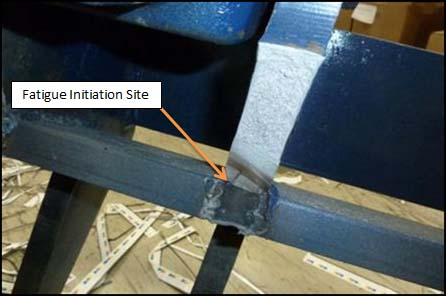
Figure 1 – Discharge-Door Locking Bar Failure Site
Incident Description
MOSH investigated the failure of a Max-Pak Model HCE60FE 8 full-eject, horizontal, closed-end paper baler that resulted in a fatality. MOSH requested an analysis of the failure by OSHA’s Health Response Team (HRT) based at the Salt Lake Technical Center in Salt Lake City, Utah. The HRT found that the failure of the discharge-door locking bars resulted from classic metal fatigue associated with excessive cyclic loading of the locking bars.
The fatality occurred as the paper baler was compressing a load of scrap paper. With fatigue cracks already in advanced stages, the discharge-door locking bars failed catastrophically. Complete failure of the discharge-door locking bars allowed the heavy discharge door to swing open, fatally injuring a worker located near the end of the baler. The failed locking bars are part of the 1st generation (original) design of this equipment. (See Figure 2 below.)
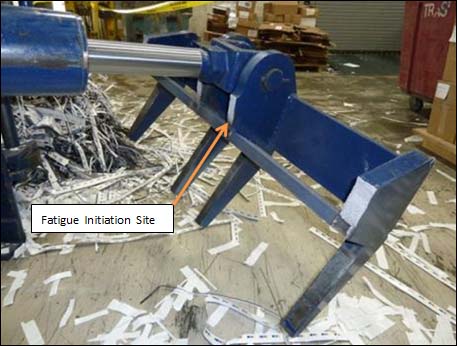
Figure 2 - Failed Discharge-Door Locking Mechanism
Following the original purchase of the balers in 2005, the employer found a discharge-door locking mechanism on a different baler to be defective and replaced it under warranty; the replacement of this 1st generation discharge-door locking mechanism occurred after approximately three years in service. The employer noticed that a new (2nd generation) design provided by the manufacturer was considerably heavier than the original design. The manufacturer provided no information regarding any inherent operating hazards of the original equipment.
Following the recent fatality in Maryland involving a second baler with a 1st generation discharge-door locking mechanism, the employer began an inspection program for all of its nine balers at various corporate locations across the country. Of these nine balers, six had fatigue cracking in the discharge-door locking mechanism. Upon receiving replacement discharge-door locking mechanisms, the employer found that the manufacturer again redesigned the discharge-door locking mechanism, resulting in a 3rd generation design. (See Figure 3, below - Max-Pak Baler and Sub-Assemblies.)
OSHA is advising owners and operators of all baling and compacting equipment to contact the equipment manufacturer regarding preventive maintenance requirements. If owners or operators are unable to obtain adequate guidance from the manufacturer on these requirements, they should obtain competent engineering support to develop, at a minimum, appropriate procedures to assess the potential for fatigue failure, and then complete proper periodic inspection and testing of the discharge-door locking mechanism.
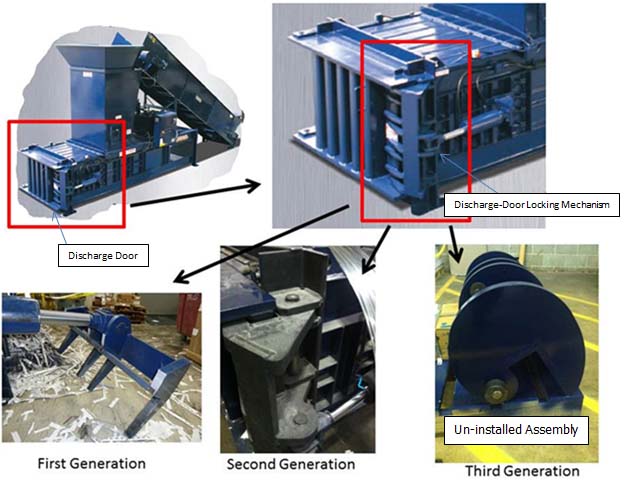
Figure 3–Max-Pak Baler Showing 1st, 2nd, and 3rd Generation Discharge-Door Locking Mechanisms
OSHA Standard Requirements
Guidance on how to safely design, operate, and maintain baling and compacting equipment is readily available from established industry consensus standards (see References section below). Specific OSHA standards that apply to baling and compacting equipment include:
- 29 CFR Part 1910.146, Permit-Required Confined Spaces
- 29 CFR Part 1910.147, Lockout/Tagout of Energy Sources
- 29 CFR Part 1910.212, Machine Guarding
Recommendations
OSHA is providing the following recommendations as general guidance in identifying and addressing potential fatigue failures involving baling and compacting equipment:
- Contact the original equipment manufacturer for detailed guidance regarding component locations and methods for periodic inspection of baling or compacting equipment to identify any fatigue cracking. The manufacturer should provide guidance on the degree of actual stress vs. allowable stress at critical locations on the equipment so that owners have a clear understanding of how quickly fatigue cracking can begin and advance to failure. Employers should comply with manufacturers’ loading methods and limitations for bailing and compacting equipment.
- Obtain the services of a competent inspection firm to methodically inspect, at a minimum, the inner surfaces of the discharge-door locking mechanism. Any edges, welds, or discontinuities on the inner surfaces of the locking bars may be fatigue-crack initiation sites. Professional engineers experienced in materials analysis, fatigue failure, and component remediation should direct the diagnosis and correction of component failure, including fatigue cracking.
- Comply with the recommendations contained in American National Standards Institute (ANSI) Z245 governing installation, maintenance, and operation of baling or compacting equipment. These standards provide direction for using a safety device, such as a hook or chain, to prevent discharge doors from flying open if the discharge-door locking mechanism should fail. The safety device must be designed to absorb the substantial kinetic energy of the heavy discharge door under the high loads of the compaction ram. Employers should modify operating procedures accordingly to include specific procedures and precautions employees must use when working with balers or compactors, including the use of safety devices.
- Periodically inspect the baling or compacting equipment to identify any cracks in welds or base metal. Employers should pay particular attention to the discharge-door locking mechanism and associated housing attachments. These components receive high, cyclic loading during normal baler or compactor operation.
- Provide thorough employee training in safe work methods before assigning them to operate, clean, service, maintain, modify, or repair any stationary hydraulic baling or compacting equipment. The applicable sections of ANSI Z245 provide information on developing safe work practices.
Conclusion
The purpose of this SHIB is to minimize the potential for injuries and fatalities caused by baling or compacting equipment fatigue failures. Industry standards provide specific procedures to reduce worker exposures to these operational hazards.
Employers should immediately investigate the potential for failure of their baling or compacting equipment. Guidance from the equipment designer or manufacturer is essential in identifying the location, and the maximum operating loads, of equipment components. Employers should inspect on a periodic basis all components that may experience high cyclic-load conditions to identify incipient cracks or flaws before they progress to failure. Employers also should fit all equipment with appropriately designed safety devices, as noted in recommendation #3 above, to minimize worker exposure to equipment-failure hazards.
References
- American National Standards Institute Z245.2-2008, Stationary Compactors—Safety Requirements for Installation, Maintenance and Operation.
- American National Standards Institute Z245.21-2008, Stationary Compactors—Safety Requirements.
- American National Standards Institute Z245.30-2008, Equipment Technology and Operations for Wastes and Recyclable Materials—Waste Containers—Safety Requirements.
- American National Standards Institute Z245.5-2008, Baling Equipment.
- American National Standards Institute Z245.51-2008, Baling Equipment, Safety Requirements.
- American National Standards Institute Z245.60-2008, Equipment Technology and Operations for Wastes and Recyclable Materials—Waste Containers—Compatibility Dimensions.
- National Electrical Manufacturers Association Z535.1-2006 (R2011), Safety Colors.
- National Electrical Manufacturers Association Z535.2-2011, Environmental and Facility Safety Signs.
- National Electrical Manufacturers Association Z535.3-2011, Criteria for Safety Symbols.
- National Electrical Manufacturers Association Z535.4-2011, Product Safety Signs and Labels.
- National Electrical Manufacturers Association Z535.5-2011, Safety Tags and Barricade Tapes (for Temporary Hazards); incorporates errata: November 3, 2011.
How OSHA Can Help
OSHA has compliance assistance specialists located in most OSHA offices throughout the nation who can provide information to employers and workers about OSHA standards, short educational programs on specific hazards, or OSHA rights and responsibilities, as well as information on additional compliance assistance resources. Contact your local OSHA office for more information.
OSHA's Consultation Service offers free and confidential advice to private-sector employers to help them identify and correct hazards, with priority given to small employers with the most hazardous operations, or in the most high-hazard industries. Consultation services are separate from enforcement activities. To locate the OSHA Consultation program nearest you, call 1-800-321-6742 (OSHA) or visit OSHA's Small Business web page.
Workers have the right to:
- Working conditions that do not pose a risk of serious harm.
- Receive information and training (in a language and vocabulary they understand) about workplace hazards, methods to prevent them, and the OSHA standards that apply to their workplace.
- Review records of work-related injuries and illnesses.
- Receive copies of results from tests and monitoring done to find and measure hazards in their workplace.
- File a confidential complaint with OSHA to have their workplace inspected if they believe there is a serious hazard or that their employer is not following OSHA's rules.
- File a complaint with OSHA if they have been retaliated or discriminated against by their employer as the result of requesting an inspection or using any of their other rights under the OSH Act.
Contact OSHA
- For questions or to get information or advice, or to report an emergency, report a fatality or catastrophe, order publications, sign up for OSHA's e-newsletter QuickTakes, or to file a confidential complaint, contact your nearest OSHA office, visit www.osha.gov, or call OSHA at 1-800-321-OSHA (6742), TTY 1-877-889-5627.
Twenty-seven states operate their own occupational safety and health state plans approved by OSHA. State plans enforce similar standards that may have different or additional requirements. A list of state plans is available at web page.