
- U.S. Department of Labor
- Occupational Safety and Health Administration
- Directorate of Technical Support and Emergency Management
- (formerly Directorate of Science, Technology & Medicine)
- Office of Science and Technology Assessment
Hazards of Improper Elevator Controller Wiring
Safety and Health Information Bulletin
SHIB 08-16-2004
Preface
An employee was fatally injured when the elevator he was entering continued to move while the elevator doors were open. An investigation revealed that the interlock, which would have prevented movement of the elevator car with the doors in the open position, had been bypassed due to improper wiring. This incident highlights the importance of elevator maintenance and repair adhering to manufacturer design codes and applicable industry safety procedures and standards.
Purpose
The purpose of this Safety and Health Information Bulletin (SHIB) is to:
- identify potential hazards of an incorrectly wired elevator controller;
- identify consensus standards applicable to elevators;
- provide information to employers regarding the importance of complying with consensus safety and maintenance standards for elevators; and
- notify employers of required testing and verification of proper elevator operation before releasing elevators into service.
Background
The Occupational Safety and Health Administration (OSHA) Houston South Area Office investigated a fatality in Houston, Texas that involved improper elevator wiring. As a result of improper wiring of the elevator's controller, the hoistway door interlock circuit was bypassed, permitting the elevator car to travel at full-speed with the doors open. This condition resulted in fatal injuries to an employee entering the elevator while the elevator was moving.
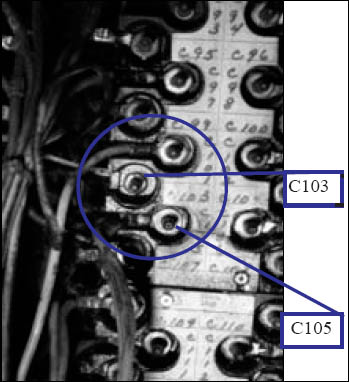
Figure 1: Controller Panel
Note two wires connected to Terminal C105 and
no wires connected to Terminal C103.
Accident Description
Mechanics employed by a contracted maintenance company were assigned to install a new generator for an elevator at a hospital. In addition to installing the generator, the mechanics also reportedly found and repaired a short circuit in the system. The mechanics then tested the elevator and returned it to service. The fatal accident occurred about 25 hours later. There were no reports of malfunctioning between the time the elevator was returned to service and the time of the fatal accident.
The victim was trying to board the elevator. As he approached the elevator, the elevator doors were closing, and he extended his arms in an attempt to hold the doors open. The victim then put his leg up and tried to get into the elevator, which was moving up. The victim became pinned between the elevator doors. He was caught between the elevator car and the hoistway as the elevator continued to move up, and he died immediately..
The investigation of this accident was comprehensive and systematic. The investigation concluded that at some point wiring was removed and subsequently reattached incorrectly to an adjacent electrical terminal of the elevator car controller (see Figure 1), bypassing the hoistway-door interlocks and resulting in the elevator's ability to move with the doors in an open position. A review of the elevator's wiring diagram substantiated the improper wiring.
Other Information
While there are no specific OSHA standards addressing the pattern of electrical wiring for elevator control panels, the Occupational Safety and Health Act requires employers to provide a workplace that is "free from recognized hazards that are causing or are likely to cause death or serious physical harm to his employees." To this end, employers need to take reasonable steps to assure that employees who perform work on elevators are adequately trained in, and knowledgeable of, elevator design specifications and proper maintenance procedures. Further, equipment must be maintained in accordance with manufacturer design specifications and operating procedures.
State governments also regulate the installation, maintenance, repair, and operation of elevators. Typically, the state Department of Labor and Industry or similar state agency oversees elevator installation and operation. Many of these agencies require compliance with industry standards and guidance for elevators, as discussed in the following paragraph. A directory of state elevator code authorities can be accessed through http://www.neii.org/. In some cases, local authorities regulate the installation, repair, maintenance, and operation of elevators; and employers need to ensure compliance with these local requirements.
The safe work procedures and equipment necessary to assure the safety of elevator passengers and maintenance workers have been developed over time by the elevator industry. Industry standards and guidance documents related to this subject are provided by the American Society of Mechanical Engineers (ASME), the National Elevator Manufacturing Industry, Inc. (NEMI, also known as the National Elevator Industry, Inc. (NEII)), and the National Elevator Industry Educational Program (NEIEP).
Specific safety procedures and equipment that are necessary to prevent incidents similar to the fatality in Houston are included in the following:
- ASME A17.1 - Safety Code for Elevators and Escalators, 2000
- ASME A17.2 - Guide for Inspection of Elevator, Escalators, and Moving Walks, 2001, (consolidation of A 17.2.1, A17.2.2, and A 17.2.3)
- ASME A17.3 - Safety Code For Existing Elevators and Escalators, 2002
- NEII - Elevator Industry Field Employees Safety Handbook - 2000
Conclusions
The Houston, Texas accident illustrates the importance of assuring that elevator components are properly wired and procedures followed to assure that the elevator will operate properly before it is returned to service. Elevator maintenance companies and employers should take steps to ensure the integrity of elevator wiring performed during maintenance activities and adhere to the wiring diagrams specified by the elevator manufacturer. In addition, employees performing maintenance and repair work on elevators must be trained in, and knowledgeable of, applicable standards, including proper testing and verification mechanisms required before returning elevators to service.
Recommendations
To ensure the safe operation of elevators and the protection of employees, employers need to assure that employees who install and maintain elevators are adequately trained and knowledgeable about proper installation, wiring, and maintenance procedures. The following guidelines will help reduce the risk of employee injury from malfunctioning elevators:
- Integrity of electrical wiring. Maintenance personnel should review the controller and advancer wiring. Wiring diagrams should be kept on site and reviewed to ensure that the controller and advancer panel wiring is correct, to make certain the door interlocks are operating properly, and to prevent operation of the elevator driving mechanism when either the hoistway door or elevator cab door is not properly closed.
- Employee training. Maintenance technicians, elevator inspectors, safety compliance personnel and consultation personnel should be familiar with the consensus safety standards applicable to elevators. Employers need to ensure that their personnel are knowledgeable of the safe procedures to positively control hazards and the recommended fail-safe measures to "test and verify" proper operation of an elevator following maintenance activities and prior to releasing an elevator into service.
- Adherence to industry standards. The referenced industry standards address proper elevator maintenance and post-maintenance procedures. Service personnel need to be knowledgeable of proper procedures, and employers need to take reasonable steps to ensure that their personnel adhere to these procedures. Employers should implement effective maintenance control programs for elevator systems and ensure that methods are used to detect and correct any defects affecting safe operation of an elevator system following maintenance activities and before the elevator is returned to service.
References
- American Society of Mechanical Engineers (ASME). Safety Code for Elevators and Escalators, 2000. ASME A17.1.
- American Society of Mechanical Engineers (ASME). Guide for Inspection of Elevator, Escalators, and Moving Walks, 2001 (consolidation of A 17.2.1, A17.2.2, and A 17.2.3). ASME A17.2.
- American Society of Mechanical Engineers (ASME). Safety Code for Existing Elevators and Escalators, 2002. ASME A17.3
- National Elevator Industry, Inc. (NEII). Elevator Industry Field Employees Safety Handbook - 2000. http://www.neii.org
Links/Citations to the websites listed above are offered for the reader's convenience. Since OSHA does not control the information contained in the websites, OSHA cannot assure the accuracy, relevance, timeliness, or completeness of all of this information. Moreover, providing links/citations to such websites does not constitute an endorsement of the websites, or their content, nor does it suggest that these websites are the exclusive or most useful sources of relevant information.