
- U.S. Department of Labor
- Occupational Safety and Health Administration
- Directorate of Technical Support and Emergency Management
- (formerly Directorate of Science, Technology and Medicine)
- Office of Science and Technology Assessment

- U. S. Environmental Protection Agency
- EPA 550-F-03-001
- August 2003
- Chemical Emergency Preparedness and Prevention Office
- (5104A)
Hazards of Delayed Coker Unit (DCU) Operations
Safety and Health Information Bulletin
Chemical Safety Alert
SHIB 08-29-03 (C)
NOTICE:
The statements in this document are intended solely as guidance. This document does not substitute for EPA's or other agency regulations, nor is it a regulation itself. Site-specific application of the guidance may vary depending on process activities, and may not apply to a given situation. EPA may revoke, modify, or suspend this guidance in the future, as appropriate.
The Environmental Protection Agency (EPA) and the Occupational Safety and Health Administration (OSHA) are jointly issuing this Chemical Safety Alert/Safety and Health Information Bulletin (CSA/SHIB) as part of ongoing efforts to protect human health and the environment by preventing chemical accidents. We are striving to better understand the causes and contributing factors associated with chemical accidents, to prevent their recurrence, and to provide information about occupational hazards and noteworthy, innovative, or specialized procedures, practices, and research that relate to occupational safety and health and environmental protection. Major chemical accidents cannot be prevented solely through regulatory requirements. Rather, understanding the fundamental root causes, widely disseminating the lessons learned, and integrating these lessons into safe operations are also required. EPA and OSHA jointly publish this CSA/SHIB to increase awareness of possible hazards. This joint document supplements active industry efforts to exchange fire and safety technology and to increase awareness of environmental and occupational hazards associated with DCU operations. It is important that facilities, State Emergency Response Commissions (SERCs), Local Emergency Planning Committees (LEPCs), emergency responders, and others review this information and take appropriate steps to minimize risk. This document does not substitute for EPA or OSHA regulations, nor is it a regulation itself. It cannot and does not impose legally binding requirements on EPA, OSHA, states, or the regulated community, and the measures it describes may not apply to a particular situation based upon the circumstances. This guidance does not represent final agency action and may change in the future, as appropriate.
Problem
The batch portion of DCU operations (drum switching and coke cutting) creates unique hazards, resulting in relatively frequent and serious accidents.
The increasingly limited supply of higher quality crude oils has resulted in greater reliance on more intensive refining techniques. Current crude oils tend to have more long chain molecules, known as "heavy ends" or "bottom of the barrel" than the lighter crude oils that were more readily available in the past. These heavy ends can be extracted and sold as a relatively low value industrial fuel or as a feedstock for asphalt-based products, such as roofing tile, or they may be further processed to yield higher value products. One of the most popular processes for upgrading heavy ends is the DCU, a severe form of thermal cracking requiring high temperatures for an extended period of time.
This process yields higher value liquid products and creates a solid carbonaceous residue called "coke." As the supply of lighter crude oils has diminished, refiners have relied increasingly on DCUs.
Unlike other petroleum refinery operations, the DCU is a semi-batch operation, involving both batch and continuous stages. The batch stage of the operation (drum switching and coke cutting) presents unique hazards and is responsible for most of the serious accidents attributed to DCUs. The continuous stage (drum charge, heating, and fractionation) is generally similar to other refinery operations and is not further discussed in this document. About 53 DCUs were in operation in the United States in 2003, in about one third of the refineries.
In recent years, DCU operations have resulted in a number of serious accidents despite efforts among many refiners to share information regarding best practices for DCU safety and reliability. EPA and OSHA believe that addressing the hazards of DCU operations is necessary given the increasing importance of DCUs in meeting energy demands, the array of hazards associated with DCU operations, and the frequency and severity of serious incidents involving DCUs.
Understanding the Hazards
Safe DCU operations require an understanding of the situations and conditions that are most prone to frequent or serious accidents.
Process Description
Each DCU module contains a fired heater, two (in some cases three) coking drums, and a fractionation tower.
This document focuses on the coke drums, which are large cylindrical metal vessels that can be up to 120 feet tall and 29 feet in diameter.
In delayed coking, the feed material is typically the residuum from vacuum distillation towers and frequently includes other heavy oils. The feed is heated by a fired heater (furnace) as it is sent to one of the coke drums. The feed arrives at the coke drum with a temperature ranging from 870 to 910°F. Typical drum overhead pressure ranges from 15 to 35 psig. Under these conditions, cracking proceeds and lighter fractions produced are sent to a fractionation tower where they are separated into gas, gasoline, and other higher value liquid products. A solid residuum of coke is also produced and remains within the drum.
After the coke has reached a predetermined level within the "on oil" drum, the feed is diverted to the second coke drum. This use of multiple coke drums enables the refinery to operate the fired heater and fractionation tower continuously. Once the feed has been diverted, the original drum is isolated from the process flow and is referred to as the "off oil" drum. Steam is introduced to strip out any remaining oil, and the drum is cooled (quenched) with water, drained, and opened (unheaded) in preparation for decoking. Decoking involves using high pressure water jets from a rotating cutter to fracture the coke bed and allow it to fall into the receiving area below. Once it is decoked, the "off oil" drum is closed (re-headed), purged of air, leak tested, warmed-up, and placed on stand-by, ready to repeat the cycle. Drum switching frequency ranges from 10 to 24 hours. DCU filling and decoking operations are illustrated in Figure 1. Equipment used in coke cutting (hydroblasting) operations is illustrated in Figure 2.
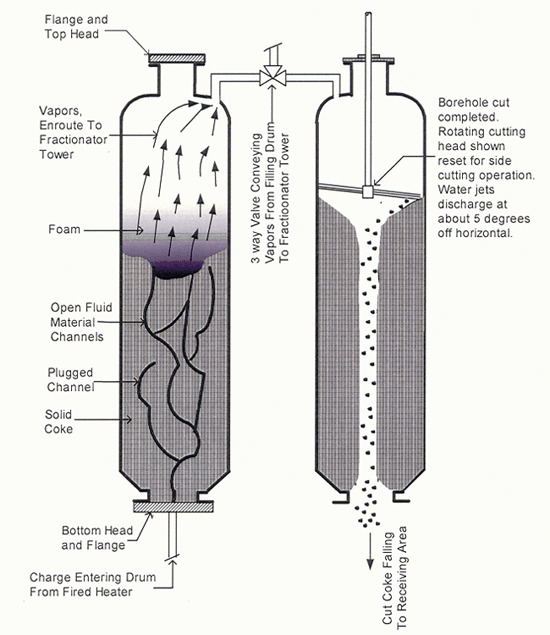
Figure 1. Delayed Coker Unit
Cutaway to Depict Drum In Filling and Migration Mode (Left)
and Drum In Cutting Mode (Right).
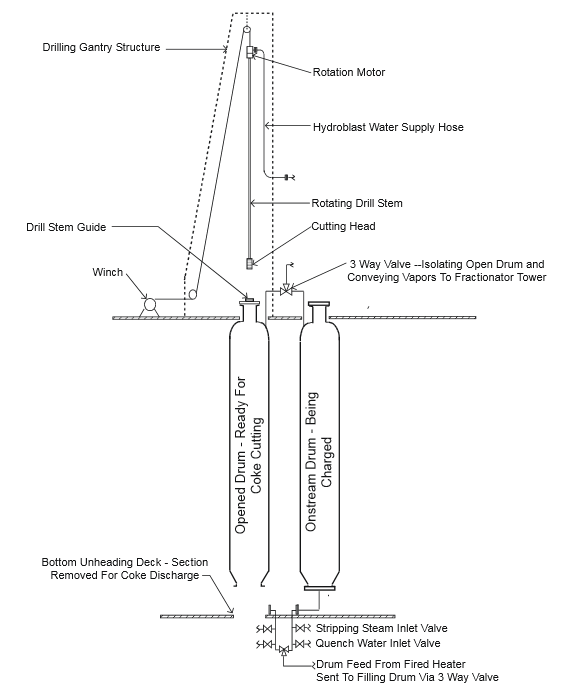
Figure 2. Delayed Coker Unit
Coke Drums and Hydroblast Systems.
Once removed from the coke drums, the coke is transported away from the receiving area. From here, the coke is either exported from the refinery or crushed, washed, and stored prior to export.
The following specific operations and more general situations and conditions contribute most significantly to the hazards associated with DCU operations:
Specific operation hazards
- Coke drum switching
- Coke drum head removal
- Coke cutting (hydroblasting operation)
Emergency and general operational hazards
- Coke transfer, processing, and storage
- Emergency evacuation
- Toxic exposures, dust irritants, and burn trauma
The hazards associated with these specific operations and DCU operations, in general, are explained below to share lessons learned and increase awareness of the situations and conditions that are most prone to serious accidents. Following this section, the joint CSA/SHIB describes actions that can be taken to help minimize the risks associated with these situations and conditions.
Specific Operation Hazards
Coke Drum Switching
Most DCU operations consist of several DCU modules, each typically alternating between two coke drums in the coking/decoking sequence. Some DCU modules include a third drum in this sequence. Each drum includes a set of valving, and each module includes a separate set of valving. Differences in valving among drums and among modules may be difficult to distinguish and can lead to unintended drum inlet or outlet stream routing. Similarly, valve control stations, for remotely activated valves, may not always clearly identify the operating status of different drums and modules. Activating the wrong valve because of mistakes in identifying the operational status of different drums and modules has led to serious incidents.
Coke Drum Head Removal
Conditions within the drum, during and after charging, can be unpredictable. Under abnormal conditions, workers can be exposed to the release of hot water, steam and coke, toxic fumes, and physical hazards during removal of the top and bottom drum heads. The most frequent and/or severe hazards associated with this operation are described below:
- Geysers/eruptions - Under abnormal situations, such as feed interruption or anomalous shortcircuiting during steaming or quenching, hot spots can persist in the drum. Steam, followed by water, introduced to the coke drum in preparation for head removal can follow established channels rather than permeate throughout the coke mass. Because coke is an excellent insulator, this can leave isolated hot areas within the coke. Although infrequent, if the coke within the drum is improperly drained and the coke bed shifts or partially collapses, residual water can contact the isolated pockets of hot coke, resulting in a geyser of steam, hot water, coke particles, and hydrocarbon from either or both drum openings after the heads have been removed.
- Hot tar ball ejection - Feed interruption and steam or quenching water short-circuiting can also cause "hot tar balls," a mass of hot (over 800°F) tar-like material, to form in the drum. Under certain circumstances, these tar balls can be rapidly ejected from the bottom head opening.
- Undrained water release - Undrained hot water can be released during bottom head removal, creating a scalding hazard.
- Shot coke avalanche - Sometimes, the coke forms into a multitude of individual, various sized, spherical shaped chunks known as "shot coke," rather than a single large mass. In this situation, the drum contents are flowable and may dump from the drum when the bottom head is removed, creating an avalanche of shot coke.
- Platform removal/falling hazard - Some DCUs require the removal of platform sections to accommodate unheading the bottom of the drum. This can introduce a falling hazard.
Coke Cutting (Hydroblasting Operation)
Coke-cutting or -hydroblasting involves lowering from an overhead gantry a rotating cutter that uses high pressure (2000 to 5000 psig) water jets. The cutter is first set to drill a bore hole through the coke bed. It is then reset to cut the coke away from the drum interior walls. Workers around the gantry and top head can be exposed to serious physical hazards, and serious incidents have occurred in connection with hydroblasting operations. Some of the most frequent and/or severe hazards are described below:
- If the system is not shut off before the cutting nozzle is raised out of the top drum opening, a high pressure water jet can be exposed and seriously injure, even dismember a nearby worker.
- Fugitive mists and vapors from the cutting and the quench water can contain contaminants that pose a health hazard (see section on Toxic Exposures, Dust Irritants and Burn Trauma, below).
- The water hose can burst while under high pressure, resulting in whipping action that can seriously injure nearby workers.
- The wire rope supporting the drill stem and water hose can fail (part), allowing the drill stem, water hose, and wire rope to fall onto work areas.
- Gantry damage can occur, exposing workers to falling structural members and equipment.
Emergency and General Operational Hazards
Coke Transfer, Processing, and Storage
The following coke conveyance, processing, and storage operations have presented safety and health hazards for DCU workers:
- The repositioning of rail cars by small locomotives or cable tuggers to receive coke being cut from a drum can create physical hazards for workers in the rail car movement area.
- Mechanical conveyors and coke crushers may contain exposed moving parts that can cause fracture or crush type injuries at pinch points.
- Fires are common in coke piles and rail cars. Large chunks of coke can contain pockets of unquenched material at temperatures well above the ignition point. When fractured and exposed to air, this material can ignite. Fires have also been attributed, although less frequently, to reactions that lead to spontaneous combustion.
- Combustion products and/or oxygen depletion resulting from spontaneous fires can create hazardous conditions for workers in confined spaces.
- Wet coke in an enclosed area has been reported to have absorbed oxygen from the surrounding air under certain circumstances. This can make the area oxygen deficient and cause asphyxiation.
Emergency Evacuation
The delayed coking process is very labor intensive. Each batch process cycle requires 25 or more manual operations (valve, winch operation, drum heading, etc.), and many DCUs operate with three or more sets of drums. Tasks are performed at several levels on the coke drum structure. The upper working platform (frequently called the "cutting deck") is generally well over 120 feet above ground. During an emergency, evacuation from the structure can be difficult.
In addition, moisture escaping from drum openings during cold weather can produce fog. This can obscure vision and make walkways, and hand rails wet and slippery, creating additional difficulties during emergency evacuation.
Toxic Exposures, Dust Irritants, and Burn Trauma
DCU workers can be exposed to coke dust and toxic substances in gases and process water around DCU operations. Workers can also be exposed to physical stress and other hazardous conditions. The following exposures to toxic substances, irritants, and hazardous conditions have been associated with DCU operations, in general:
- Hot water, steam, and liquid hydrocarbon (black oil) can escape from a coke drum and cause serious burn trauma. Contact with black oil can cause second or third degree burns. In addition, liquid hydrocarbon escaped from a coke drum can be well above its ignition temperature, presenting a fire hazard.
- Heat stress can be a health hazard during warm weather, particularly for those required to wear protective clothing while performing tasks on the coke drum structure.
- Hazardous gases associated with coking operations, such as hydrogen sulfide, carbon monoxide, and trace amounts of polynuclear aromatics (PNAs), can be emitted from the coke through an opened drum or during processing operations.
- If allowed to accumulate and become airborne, dust around a DCU may exceed acceptable exposure limits and become a hazard.
Controlling the Hazards
Evaluating hazardous conditions, modifying operations to control hazards, actively maintaining an effective emergency response program, and familiarizing workers about risks and emergency procedures will help reduce the frequency and severity of serious incidents associated with DCU operations.
Specific Operation Hazards
Coke Drum Switching
No one system has proven effective in eliminating all incidents associated with incorrect valve activation due to mistaken coke drum or module identification; however, the following actions have been reported as beneficial:
- Conduct human factors analyses to identify, evaluate, and address potential operator actions that could compromise the safe operation of the coke drum system.
- Provide interlocks for automated or remotely activated valve switching systems.
- Provide interlocks for valves that are manually operated as part of the switching/decoking cycle to avoid unanticipated valve movement.
- Color code and clearly label valves and control points to guard against incorrect identification.
- Provide indicator lights at valve and valve control stations to help the operator determine which is the correct valve station for the intended operator action.
- Use the "buddy system" (employees working in pairs) to help verify accurate valve or switch identification.
- Conduct periodic and documented training focusing on the importance of activating the correct valve or switch and the consequence of incorrect activation.
Coke Drum Head Removal
It can be difficult to anticipate the presence of either a hot spot or a hot tar ball in the coke drum prior to drum head removal. In light of this possibility and the potential for serious incidents, it is prudent to:
- Be alert to any operating abnormalities or variations during charging, steaming, or quenching that may forewarn a hot spot or tar ball. Have a contingency plan to deal with such issues before proceeding with coke drum head removal and coke cutting.
- Always assume the possibility of a hot-spot induced geyser or the release of hot tar balls or undrained hot water, and incorporate protective operational measures in drum unheading operations. Further control the hazard by establishing restricted areas; minimizing the number of workers in restricted areas; minimizing the time spent by essential workers in restricted areas; and maintaining readiness for a rapid evacuation.
- Consider equipment upgrades to further control the hazards associated with geysers and release of hot tar balls and undrained hot water during drum head removal, such as installing protective shrouds and automating both top and bottom head removal operations to keep workers away from these unprotected areas.
- Consider emergency steam/cooling water sources in the event of loss of primary steam/cooling water supply or because of drum inlet flow path obstruction.
- Provide temporary guardrails to prevent employees from falling while platform plating is removed for bottom head removal.
- Consider installation of vapor ejectors to draw vapors away from the open top head area.
Coke Cutting (Hydroblasting Operation)
The following actions could help control hazards associated with coke cutting operations:
- Install an enclosed cutter's shack for worker protection--preferably supplied with air from a remote source to maintain slight positive pressure.
- Ensure that personnel who must be on the coke drum structure when a drum is open wear prescribed personal protective equipment.
- Conduct training in recognition and prevention of worker heat stress.
- Make sure the interlocks will work to shut off and prevent restart of the cutting water pump any time that the cutting head is raised above a predetermined point within the coke drum. Consider installing redundant switches to provide an additional level of protection against extracting a cutting head that is under pressure.
- Verify the adequacy of the inspection and maintenance program for cutting water hoses, wire ropes, and hoists.
- Establish a gantry structure inspection and maintenance program. Periodically verify that gantry structures have not been weakened due to corrosive conditions, such as mist exiting from the top nozzle, that could lead to gantry collapse.
- Install drill stem free fall arresters.
Emergency and General Operational Hazards
Coke Transfer, Processing, and Storage
The following actions could help control hazards associated with coke conveyance, processing, and storage operations:
- Establish and enforce restricted areas (e.g., areas where heavy equipment movement and possible lash path of a wire rope from failed equipment may occur) to prevent personnel entry and, ultimately, injury.
- Establish and periodically verify the operability of an alarm system that activates immediately before and during heavy equipment (rail car, bridge crane, or conveyor) movement.
- Verify conformance with a safe entry permit system to ensure that appropriate measures are taken prior to and during entry into any enclosed area or vessel where coke may be present.
- Establish personnel protective measures to protect against inhalation or personal contact with coke dust or potentially contaminated mists from water used for cutting, quench, or coke conveyance (see section on Toxic Exposures, Dust Irritants, and Burn Trauma, below).
Emergency Evacuation - Preparations and Procedures
Despite best efforts to prevent incidents, DCU operators should anticipate the need for emergency evacuation and other response measures, operate in a manner that will minimize the severity of an incident, and prepare for and implement emergency procedures to protect worker safety.
The following specific actions are recommended:
- Review and address weaknesses associated with the location and suitability of emergency escape routes. Protected stairways, preferably detached from the coke drum structure, are the most effective conventional means of emergency escape route (egress) from tall structures, such as those serving the coke drums. Consider installing horizontal walkways to adjacent structures. Some refineries are exploring the use of commercially available escape chutes. Also, slip resistant walking surfaces will help prevent falling during an emergency evacuation.
- Establish or verify the operability of an evacuation signal (Scram Alarm) to expedite personnel clearing the structure in the event of an emergency. Alarm signal actuation (triggering) stations should be deployed at work areas and along the escape routes.
- Install water sprays to protect work stations and emergency escape routes. Include activation stations at work stations and along the escape route.
- Provide heat shields to protect work stations and escape routes. Ensure that the shield will not interfere with evacuation and will not entrap fugitive vapors.
- Conduct regular emergency exercises to test the plan as well as to ensure familiarity with emergency signals, evacuation routes, and procedures.
Toxic Exposures, Dust Irritants, and Burn Trauma
The following actions could help control exposures to toxic substances, irritants, physical stress, and hazardous conditions associated with DCU operations, in general:
- Configure coke drum inlets and outlets with doubleblock valve and steam seal isolation to reduce the likelihood of unanticipated leakage.
- Establish burn trauma response procedures, including procedures for interacting with emergency medical service providers and the burn trauma center that would be used in the event of a burn incident.
- Conduct burn trauma simulation exercises to ensure appropriate use of the emergency response procedures and the training level of relevant personnel.
- Evaluate health exposure potential and establish appropriate protective measures based on an industrial hygiene survey plan that anticipates variations in the range of DCU feed stocks and operating conditions.
- Shovel, sweep, vacuum, and provide proper ventilation to keep exposures to dust around a DCU to within acceptable limits.
Information Resources
Internet resources - The search entry, "Delayed Coker Unit," yields many sources of information that are believed to be useful. However, neither EPA nor OSHA control this information and cannot guarantee the accuracy, relevance, timeliness or completeness of all facets of the information.
Further, the citation to these resources is not intended to endorse any views expressed, or services offered by the author of the reference or the organization operating the service identified by the reference. The following are examples of informative additional reading.
- http://www.coking.com - focuses on coking best practices, safety, reliability, and communications within the DCU industry.
- http://www.fireworld.com/magazine/coker.html - describes a May 1999 coking unit fire and offers recommendations on fire protection.
For More Information:
- Contact EPA's RCRA Superfund & EPCRA Call Center
- (800) 424-9346 or (703) 412-9810
- TDD (800) 553-7672
- Monday-Friday, 9 AM to 5 PM, Eastern Time
- Visit the OEPPR Home Page.
- To report an emergency, file a complaint, or seek OSHA advice, assistance, or products, call:
- 1-800-321-OSHA (6742)
- TTY 1-877-889-5627
- 24-hours
- Visit the OSHA Home Page.