
- U.S. Department of Labor
- Occupational Safety and Health Administration
- Directorate of Technical Support and Emergency Management
- (formerly Directorate of Science, Technology & Medicine)
- Office of Science and Technology Assessment
Hazards Associated with Transporting Granite and Marble Slabs
Safety and Health Information Bulletin
SHIB 09-08-2005
Purpose
The purpose of this Safety and Health Information Bulletin is to:
- Alert employers and employees who handle and transport granite and marble rock slabs to the hazards associated with handling and transporting of slabs;
- Remind employers that transportation devices need to be properly designed and maintained; and,
- Emphasize the importance of training employees in rock slab handling procedures.
Background
The Seattle OSHA Regional Office has been alerted to the hazards associated with handling and transporting granite and marble slab . During loading, transport, and unloading of the slabs, the loads can shift and tip over. Workers can either be caught in between slabs or can be struck by shifting or falling slabs. A review of OSHA's Integrated Management Information System (IMIS) data confirmed that there have been a number of worker injuries and fatalities associated with the handling and transporting of granite and marble slabs.
A number of companies use flatbed truck to transport the slabs. Rock slabs can vary in weight from hundreds to a few thousand pounds. An average individual truck load can weigh between 20,000 to 40,000 pounds.
The slabs are transported vertically on storage racks strapped to the bed of the truck. These racks can be made of metal and/or wood. Often, these racks are an A-frame structure (see pictures below), and the slabs are strapped to these A-frames. The slabs are loaded on the truck by the distributor and then transported to their destination. The employees at the other end off-load the slabs from the racks. Often, the truck driver may assist in the unloading process.
During transport, the loads can shift or the tracks can become deformed or fail. As a result, the slabs may shift or fall while they are being unloaded.
In many cases, the A-frames have not been designed to take into account the weight of the slabs. The A-frames also have not been designed to prevent shifting of other slabs if one of the slabs either shifts or is removed.
Often, the slabs are secured using restraining devices and/or tie-downs. When these restraining devices or tie-downs are removed, the loads can shift if the frame is not designed to prevent shifting. The slabs can also shift or fall due to failure or to improper placement of these restraining devices.
Conclusion
The following procedures will minimize the potential hazards associated with handling and transporting granite and marble slabs:
- Design rock slab transportation devices to withstand the loads and forces imposed on them. If storage racks, other than A-frames are used, they should be designed so that if one or more slabs shift or are moved, the other slabs will not be affected. This could be accomplished by designing individual compartments for each slab.
- Effectively secure the storage racks to the truck.
- Periodically inspect and properly maintain the storage racks.
- Restraining devices and tie-downs, if used, should be properly applied and removed. The restraining devices and tie-downs should be inspected before being applied and prior to being removed. Restraining devices and tie-downs that do not pass inspection should be removed from service.
- Implement correct loading and loading procedures and follow all the safety-related work practices.
- Train employees in the correct loading and unloading procedures and to identify fallen or shifted slabs that may present a hazard.
- If employees use forklifts or other equipment to load/unload slabs, employers must comply with relevant OSHA provisions.
- Truck drivers should visually check the racks for any damage during transit.
- Visitors/customers should be kept away from the area while slabs are being loaded or unloaded.
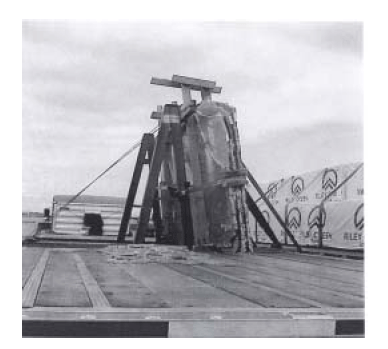
A-frame rack used to transport rock slabs
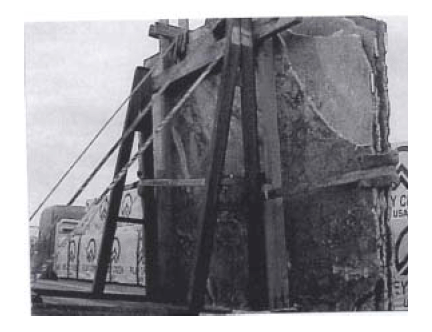
Close-up of A-frame rack used to transport rock slabs