
- U.S. Department of Labor
- Occupational Safety and Health Administration
- Directorate of Technical Support and Emergency Management
- (formerly Directorate of Science, Technology and Medicine)
- Office of Science and Technology Assessment
Compactor Rollover Hazard
Safety and Health Information Bulletin
SHIB 09-29-2008
Preface
Between 2000 and 2006, OSHA investigated over 50 rollover incidents that involved a variety of roller/compactor makes and models. Of the rollover accidents investigated:
- 5 involved roller/compactors with rollover protective structures (ROPS) where operators used the seatbelts provided. None of these accidents resulted in a fatality.
- 19 involved roller/compactors with ROPS, but seatbelts were not used. In some cases, seatbelts were not provided. In other cases, the seatbelts provided were not used by the operators. Fourteen of these accidents resulted in fatalities. In a number of these cases, the operator was either ejected or jumped from the equipment, and was pinned under or crushed by the ROPS.
- 1 case involved a pneumatic rubber-tired roller/compactor where the ROPS and seatbelt had been removed prior to the accident. The operator involved was fatally injured in the accident. This accident is described below (Accident #1).
- 6 cases involved pneumatic rubber-tired roller/compactors without ROPS. In all of these cases, the accident resulted in a fatality. One such accident is described below (Accident #2).
The fatal accidents in the last two bullets above are the focus of this Safety and Health Information Bulletin (SHIB), and are described in detail below.
Purpose
The purpose of this Safety and Health Information Bulletin is to:
- to remind employers and employees of the rollover hazard when operating roller/compactor machines, and that ROPS and seatbelts can reduce the risk;
- to alert users and operators that, when they operate roller/compactors on uneven surfaces, the likelihood of a rollover is significantly increased; and
- to encourage employers to carefully evaluate roadways and work surfaces where roller/compactors are operated for dangerous inclines/declines.
Background
The OSHA Englewood Area Office investigated two fatal accidents in 2005 in southern Colorado involving the rollover of pneumatic rubber-tired roller/compactors. The machines involved in these fatal accidents were produced by different manufacturers, but they were very similar in nature. Each machine had pneumatic rubber tires and a low center of gravity. These machines are often used in the compacting process during road construction and paving operations.
In both cases, OSHA concluded that if the machine had been equipped with a ROPS system, and if the operator had been wearing a seatbelt, the likelihood of the operator's survival would have increased significantly.
Roller/Compactor Involved in Accident #1
(ROPS and seatbelts were removed prior to the accident)
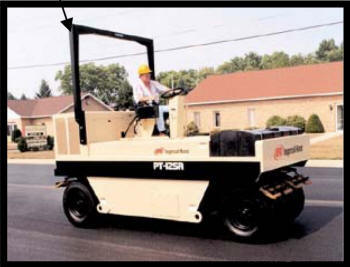
Pneumatic Tired Roller/Compactor
Figure 1
Roller/Compactor Involved in Accident #2
(ROPS was not provided and the operator was not wearing a seatbelt)
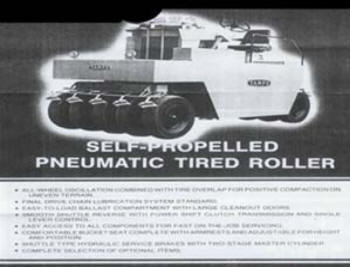
Self-Propelled Pneumatic Tired Roller/Compactor
Figure 2
Accident Description
- Accident #1 - In May 2005, an employee was fatally injured while operating a pneumatic rubber- tired roller/compactor on a roadway during asphalt compacting. The roller/compactor ran off the road and traveled down a 22-degree sloping embankment. It rolled over 1½ times, coming to a stop on its top. The operator was thrown from the machine and was fatally crushed between the machine and the ground. Although the roller/compactor was originally equipped and sold with a ROPS and a seatbelt, the ROPS and seatbelt had been removed prior to the accident.
- Accident #2 - In August 2005, an employee was operating a pneumatic rubber-tired roller/compactor on a gravel road, rolling magnesium chloride into the gravel. The roller/compactor ran off the road and traveled down a 28-degree sloping embankment. It rolled onto its side and came to a stop. As the machine traveled down the embankment, the operator was thrown from the machine and fatally crushed. The roller/compactor was not provided with a ROPS and the operator was not wearing a seatbelt.
Other Information
A ROPS is a protective frame that is mounted on the machine and extends above the operator's seat (see Figure 1). In addition to bearing the weight of the machine during a rollover event, ROPS are designed to minimize the likelihood that the machine will overturn completely, thereby reducing the possibility that the operator will be crushed as a result of rollover or upset. A principle applied in ROPS design is to restrict the overturn to no more than 90 degrees. [1] A ROPS may be designed with one, two, or four posts, and it may have a canopy overhead; the canopy may be designed as part of the ROPS. Some machines have a single-post ROPS with a canopy that extends to the sides which is designed to absorb the impact of a rollover.
ROPS need to be used in combination with a seatbelt. As discussed in the Preface, operators who do not use seatbelts may be ejected from the machine and then crushed between the machine and the ground. The operator can even strike the ROPS as the operator is thrown from the equipment. A ROPS only provides protection if the operator remains in the seat. In some investigations, OSHA noted that operators had removed their seatbelts and jumped from the equipment, negating the protection offered by a ROPS.
During the investigation of Accidents #1 and #2, it was determined that ROPS were available for both machines. In Accident #1, the ROPS had been removed by the employer for convenience during a previous project and had not been replaced. In Accident #2, the machine had initially been sold without ROPS, but an aftermarket ROPS had been developed, tested and was available.
The Center to Protect Workers Rights (CPWR), through a cooperative agreement with the National Institute for Occupational Safety and Health (NIOSH), evaluated 58 roller/compactor overturn accidents and summarized the results in a report titled Compactor Overturns and Rollover Protective Structures (M. Meyers, April 2004). This report highlighted a number of hazards associated with rollovers, including:
- Working near the edge of a road or an embankment was the most hazardous situation in the 58 rollover accidents studied. The second most significant factors were steep slopes and roadway curves, where problems with gear-shifting and brakes resulted in runaways.
- Compacting soil appeared to be more hazardous than other operations. Hazards included the soil edges and soft soil pockets that could drop under the weight of the unit.
- Loading and unloading roller/compactors onto and off of trailers posed a potential overturn hazard. Hazards were caused by skidding on the ramps, using wood blocks or planks as ramps, or loading/unloading a machine that was too narrow to span both units of the ramp.
Conclusions
During the course of OSHA's investigations, it was determined that if the machines involved in these accidents had been equipped with ROPS, and if the operators had been wearing seatbelts, the likelihood of the operator's survival would have increased significantly.
OSHA Requirements
While OSHA does not have a standard requiring employers to use ROPS or seatbelts for this type of roller/compactor equipment, it is important for employers to understand that under the General Duty Clause of the OSH Act (section 5(a)(1) of the Act), employers must provide their employees with a workplace that is free from recognized hazards likely to cause death or serious physical harm. It is OSHA's position that the hazard of equipment rollover is a "recognized hazard" within the meaning of the General Duty Clause of the OSH Act. [3, 4]
In cases where the employer chooses to operate these types of machines in areas where the potential for rollover is present (e.g., loading or unloading, operating on slopes or near slope edges, etc.) and the equipment is not equipped with ROPS and seatbelts, a General Duty Clause violation may exist.
In addition, OSHA's Construction Standard "General safety and health provisions," 29 CFR 1926.20(b)(4), states "the employer shall permit only those employees qualified by training or experience to operate equipment and machinery." Section 1926.21(b)(2), "Safety training and education," states further that "the employer shall instruct each employee in the recognition and avoidance of unsafe conditions…."
Therefore, employers performing construction work are required to ensure that roller/compactor operators are trained to use the equipment properly and to understand how to recognize those situations and conditions that pose a rollover hazard. For example, operators need to understand that:
- soft edges can cause one side of the equipment to sink and therefore may pose a risk of rollover;
- turning away from a slope with articulated steering can destabilize the compactor;
- improperly inflated tires can destabilize roller/compactors; and
- rain or wet conditions can pose a hazard during unloading and can increase the possibility of rollovers near embankments as soil conditions become unstable.
Although OSHA does not have a standard that requires ROPS for roller/compactor equipment, OSHA does have construction and agriculture standards that have requirements for ROPS involving other types of equipment. Specifically, OSHA's Construction Standard 29 CFR 1926.1001 sets minimum performance criteria for ROPS for certain scrapers, loaders, dozers and graders, and crawler tractors, and 29 CFR 1926.1002 sets requirements for ROPS frames for the protection of operators of wheel-type agricultural and industrial tractors used in construction. OSHA's Agriculture Standard 29 CFR 1928.51(b)(2)(i)(A) requires ROPS for tractors used in agricultural operations, as well as seatbelts where ROPS are required. 29 CFR 1928.52 and 1928.53 establishes test and performance requirements for protective frames and protective enclosures designed for wheel-type agricultural tractors to minimize the frequency and severity of operator injury. These standards are beyond the scope of this SHIB, but noted for informational purposes. However, to ensure that ROPS used by the construction industry will protect roller/compactor operators, OSHA recommends that construction employers use ROPS on these machines that comply with the testing requirements specified by these standards.
Recommendations
Employers using roller/compactors should evaluate their worksites and operations to identify potential rollover hazards. Although the conditions that cause such hazards may not be present at one construction site, they may be present at the next one. Therefore, OSHA recommends that as a matter of practice in all cases, employers should institute the following measures:
- equip roller/compactors with a ROPS and seatbelt;
- instruct operators to always wear seatbelts whenever operating the equipment;
- consider using a warning system such as barricades, hand or mechanical signals, or stop logs when the equipment is operated near sloped edges, such as an embankment and roadway edges, to alert equipment operators of their proximity to the hazard; and
- conduct pre-shift inspections to make sure all equipment systems, including the braking system, the tires, and operator controls, are in proper working condition.
References
- CPWR. Compactor Overturns andRollover Protective Structures, 2004. Available online at: http://www.cdc.gov/eLCOSH/docs/d0600/d000656/d000656.html
- NIOSH. Preventing Injuries WhenWorking with Ride-onRoller/Compactors, 2005. http://www.cdc.gov/elcosh/docs/d0600/d000678/d000678.html
- OSHA. ROPS/seatbelts for roller compactors; lockout/tagout in construction. Letter of Interpretation dated March 16, 1998 and addressed to Mr. Brian McQuade.
- OSHA. Guidelines for ROPS on pneumatic compactors and "skid steer" equipment. Letter of Interpretation dated March 16, 1998 and addressed to Mr. Robert S. Beisel.
- Edwin G. Foulke, Jr.
- Assistant Secretary
- Occupational Safety and Health Administration