
- U.S. Department of Labor
- Occupational Safety and Health Administration
- Directorate of Technical Support and Emergency Management
- (formerly Directorate of Science, Technology & Medicine)
- Office of Science and Technology Assessment
Hazards of Manually Lifting Balloon Framed Walls
Safety and Health Information Bulletin
SHIB 11-17-2005
Purpose
This Safety and Health Information Bulletin alerts employers and employees that manually raised balloon framed walls could become too heavy for employees to hold and could collapse back onto the employees. From July 1999 through July 2004, 22 balloon framed wall collapses were reported. Four of these accidents occurred in the Chicago area. In one of these accidents, in August 2003, eight employees were sent to local hospitals; two of them suffered broken feet and vertebrae. Six other employees suffered back, shoulder and neck strains. This bulletin will summarize:
- How balloon framed walls can collapse onto the employees raising them; and
- Methods to prevent accidental collapse of balloon framed walls while they are being raised.
Background
The Occupational Safety and Health Administration's (OSHA's) Calumet City Area Office investigated an accident where the weight of a balloon framed wall became too heavy for the employees raising the wall, and the wall collapsed back onto the employees. OSHA's Integrated Management Information System (IMIS) data from July 1999 through July 2004 recorded 21 additional incidents involving the collapse of balloon framed walls. As a result of these 22 incidents, five employees died and 28 employees were injured, 16 of whom required hospitalization.
Balloon Framing
Balloon framing involves the placement of framed walls (generally over 10 feet in height) that run the entire vertical length from the structure's floor sill plate to the roof. Balloon framed walls have been raised for years using manual labor. However, over the years framed walls have become heavier due to contemporary construction designs. Many contractors have developed guidelines for employees raising such walls. However, these guidelines are not consistent and often rely heavily on the foreman guessing the weight of the wall and estimating the number of employees necessary to perform the lift.
Accident Description
The accident near the Calumet City Area Office occurred on a site where a contractor was building new homes. The wall involved in the incident was 22 feet, 10 inches in width and 18 feet in height, with a 30-foot chimney chase attached. The wall weighed approximately 2,300 pounds, and 15 employees were raising it by hand.
The wall was built on the deck (first floor) of the house. Fifteen carpenters spread out along the top plate of the wall and began to lift it. The carpenters lifted the wall to approximately waist height, placed it on saw horses, and then attached braces. The carpenters then continued to lift the wall. Three carpenters dropped back to help push up the wall using the braces. The additional weight distributed to the remaining carpenters overwhelmed the 12 carpenters who remained at the top plate.
The carpenters interviewed stated that the wall was at an angle of approximately 30 degrees when it fell back onto the workers. The carpenters attempted to "back down" the wall, but it fell onto them. Several employees were able to step into window openings, avoiding the falling wall, while several others were unable to avoid the falling wall, including two employees who were pinned under the wall. These two employees were freed by the other carpenters, but they suffered broken feet and vertebrae. Six other carpenters were treated at local hospitals and released with strains and sprains of their backs, shoulders and necks.
Safe Lifting Methods
Employers may use a combination of the following methods to protect employees from the potential collapse of balloon framed walls:
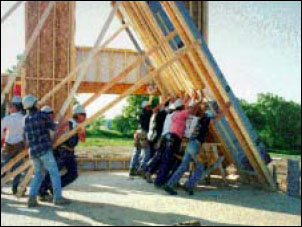
Example of carpenters manually raising a balloon framed wall with a chimney chase attached. As the photo depicts, more than 10 workers are exposed to being struck by the wall if it collapses onto them.
- Pre-plan the job;
- Determine the weight of the walls;
- Conduct "pre-lift" meetings to discuss the safest methods for raising these walls;
- Use a competent person to consider and supervise all aspects of the lifting operation;
- Use cranes with appropriate and approved attachments to assist in raising and placing balloon framed walls;
- Use either forklifts of adequate size and capacity for lifting balloon framed walls or rough terrain forklifts (Figure 1) with appropriate and approved attachments in placing balloon framed walls;
- Prior to the lifting of the wall, establish a limited access zone whenever a balloon framed wall is being raised;
- Secure bottom plates with adequate sized metal bands (at least a one-inch band nailed to the floor joists) located at each end of the wall and spaced not more than 6 feet apart (Figure 2) or other adequate feasible means of securing the bottom plate.
- Use either manual or mechanical/electrical wall jacks (Figures 3 & 4) to assist with the lifting and placing balloon framed walls;
- If the manual lifting method is chosen and a determination is made that a method exists to safely lift these walls, assure that a sufficient number of workers are continually assisting while each wall is being raised to prevent the wall from falling back onto them and to prevent overexertion by workers lifting each wall; and
- Require employees to use the proper procedures for engaging load-handling attachments onto forklifts or cranes. Make these safe lifting procedures part of the company's safety and health program.
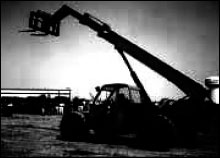
Figure 1
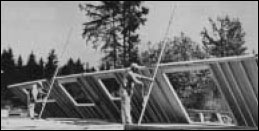
Figure 3
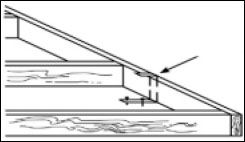
Figure 2
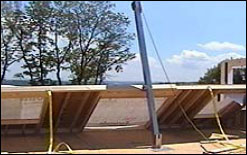
Figure 4
The limited access zone should be equal to the height of the wall plus four feet and should run the entire length of the wall;
The limited access zone should be restricted to entry by employees actively engaged in lifting the wall and no other workers be allowed to enter the zone;
The limited access zone should remain in place until the wall is adequately supported and braced to prevent accidental collapse;