Chapter 1 - Basics of Machine Safeguarding
Basics of Machine Safeguarding
Crushed hands and arms, severed fingers, blindness -- the list of possible
machinery-related injuries is as long as it is horrifying. There seem to
be as many hazards created by moving machine parts as there are types of
machines. Safeguards are essential for protecting workers from needless
and preventable injuries.
A good rule to remember is: Any machine part, function, or process which
many cause injury must be safeguarded. When the operation of a machine or
accidental contact with it can injure the operator or others in the
vicinity, the hazards must be either controlled or eliminated.
This manual describes the various hazards of mechanical motion and
presents some techniques for protecting workers from these hazards.
General information covered in this chapter includes -- where mechanical
hazards occur, the hazards created by different kinds of motions and the
requirements for effective safeguards, as well as a brief discussion of
nonmechanical hazards.
Where Mechanical Hazards Occur
Dangerous moving parts in three basic areas require safeguarding:
The point of operation: that point where work is performed on the
material, such as cutting, shaping, boring, or forming of stock.
Power transmission apparatus: all components of the mechanical system
which transmit energy to the part of the machine performing the work.
These components include flywheels, pulleys, belts, connecting rods,
couplings, cams, spindles, chains, cranks, and gears.
Other moving parts: all parts of the machine which move while the machine
is working. These can include reciprocating, rotating, and transverse
moving parts, as well as feed mechanisms and auxiliary parts of the
machine.
Hazardous Mechanical Motions and Actions
A wide variety of mechanical motions and actions may present hazards to
the worker. These can include the movement of rotating members,
reciprocating arms, moving belts, meshing gears, cutting teeth, and any
parts that impact or shear. These different types of hazardous mechanical
motions and actions are basic in varying combinations to nearly all
machines, and recognizing them is the first step toward protecting workers
from the danger they present.
The basic types of hazardous mechanical motions and actions are:
Motions
- rotating (including in-running nip points)
- reciprocating
- transversing
Actions
- cutting
- punching
- shearing
- bending
Motions
Rotating motion can be dangerous; even smooth, slowly rotating shafts can
grip clothing, and through mere skin contact force an arm or hand into a
dangerous position. Injuries due to contact with rotating parts can be
severe.
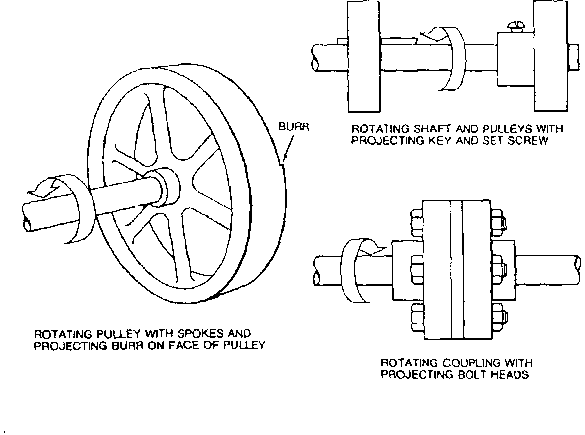
Collars, couplings, cams, clutches, flywheels, shaft ends, spindles,
meshing gears, and horizontal or vertical shafting are some examples of
common rotating mechanisms which may be hazardous. The danger increases
when projections such as set screws, bolts, nicks, abrasions, and
projecting keys or set screws are exposed on rotating parts, as shown in
Figure 1.
Figure 1. Examples of hazardous projections on rotating parts
In-running nip point hazards are caused by the rotating parts on
machinery. There are three main types of in-running nips.
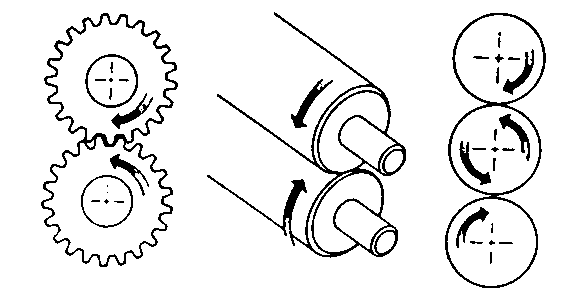
Parts can rotate in opposite directions while their axes are parallel to
each other. These parts may be in contact (producing a nip point) or in
close proximity. In the latter case the stock fed between the rolls
produces the nip points. This danger is common on machines with
intermeshing gears, rolling mills, and calenders. See Figure 2.
Figure 2. Common nip points on rotating parts
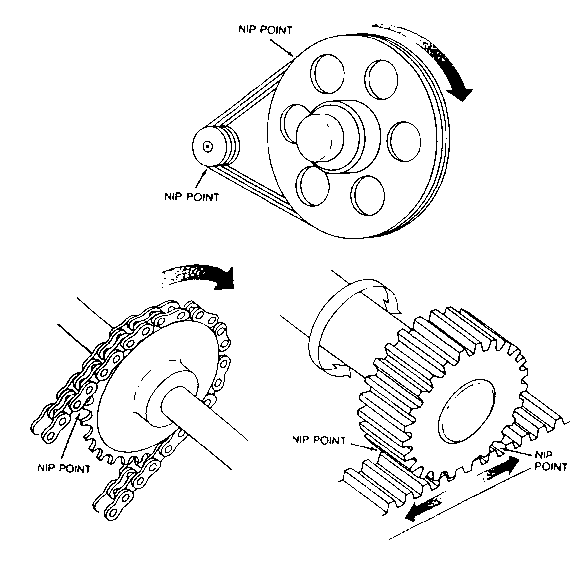
Nip points are also created between rotating and tangentially moving
parts. Some examples would be: the point of contact between a power
transmission belt and its pulley, a chain and a sprocket, and a rack and
pinion. See Figure 3.
Figure 3. Nip points between rotating elements and parts with
longitudinal motions.
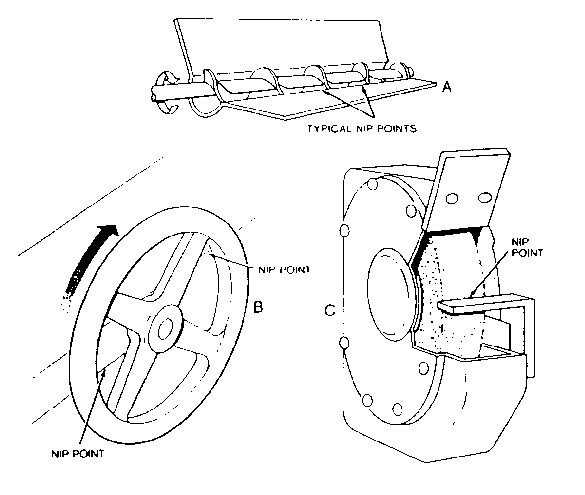
Nip points can occur between rotating and fixed parts which create a
shearing, crushing, or abrading action. Examples are: spoked handwheels
or flywheels, screw conveyors, or the periphery of an abrasive wheel and
an incorrectly adjusted work rest. See Figure 4.
Figure 4. Nip points between rotating machine components;
(A - cover removed for clarity.)
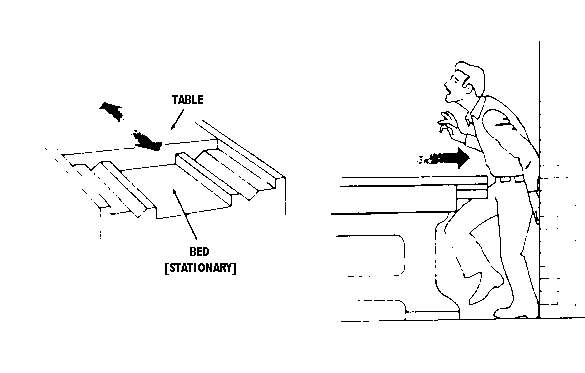
Reciprocating motions may be hazardous because, during the back-and-forth
or up-and-down motion, a worker may be struck by or caught between a
moving and a stationary part. See Figure 5 for an example of a
reciprocating motion.
Figure 5. Hazardous reciprocating motion.
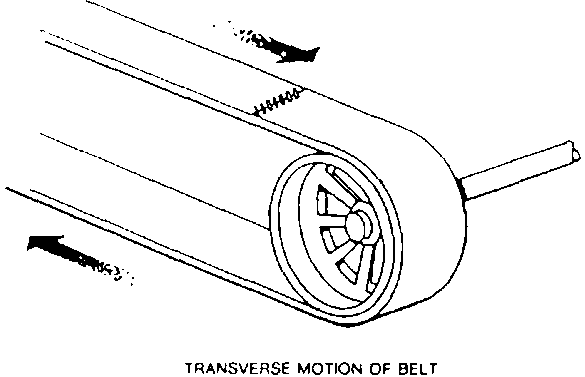
Transverse motion (movement in a straight, continuous line) creates a
hazard because a worker may be struck or caught in a pinch or shear point
by the moving part. See Figure 6.
Figure 6. Example of transverse motion.
Actions
Cutting action may involve rotating, reciprocating, or transverse motion.
The danger of cutting action exists at the point of operation where
finger, arm and body injuries can occur and where flying chips or scrap
material can strike the head, particularly in the area of the eyes or
face. Such hazards are present at the point of operation in cutting wood,
metal, or other materials.
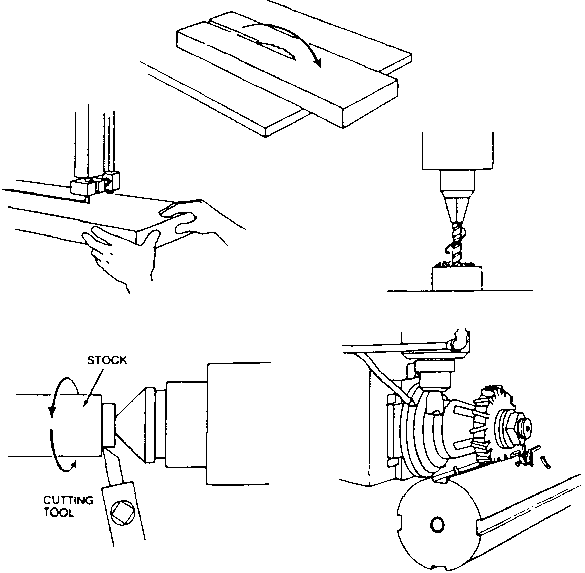
Examples of mechanisms involving cutting hazards include bandsaws,
circular saws, boring or drilling machines, turning machines (lathes), or
milling machines. See Figure 7.
Figure 7. Examples of dangerous cutting hazards.
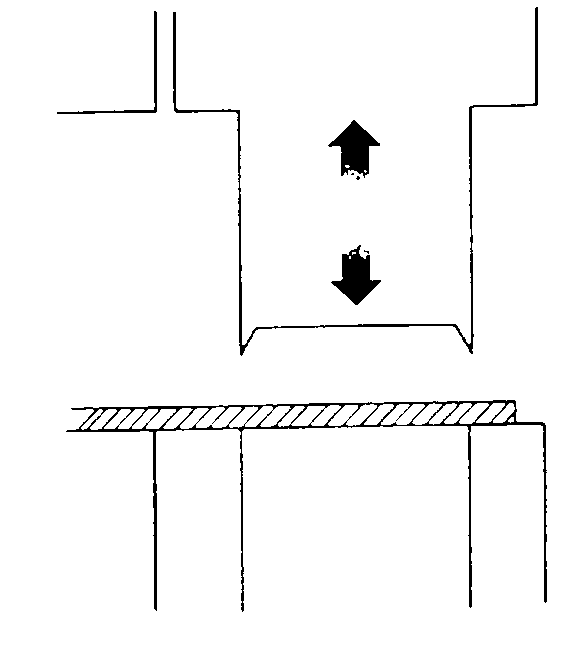
Punching action results when power is applied to a slide (ram) for the
purpose of blanking, drawing, or stamping metal or other materials. The
danger of this type of action occurs at the point of operation where stock
is inserted, held, and withdrawn by hand.
Typical machines used for punching operations are power presses and iron
workers. See Figure 8.
Figure 8. Typical punching operation.
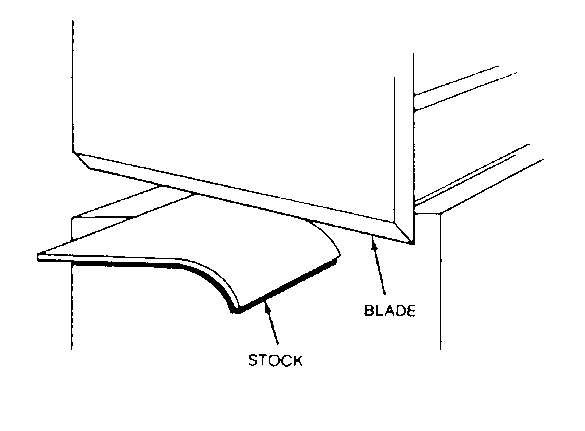
Shearing action involves applying power to a slide or knife in order to
trim or shear metal or other materials. A hazard occurs at the point of
operation where stock is actually inserted, held, and withdrawn.
Examples of machines used for shearing operations are mechanically,
hydraulically, or pneumatically powered shears. See Figure 9.
Figure 9. Shearing
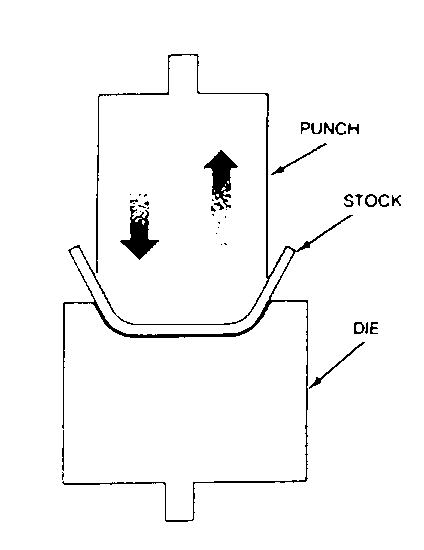
Bending action results when power is applied to a slide in order to draw
or stamp metal or other materials. A hazard occurs at the point of
operation where stock is inserted, held, and withdrawn.
Equipment that uses bending action includes power presses, press brakes,
and tubing benders. See Figure 10.
Figure 10. Bending
Requirements for Safeguards
What must a safeguard do to protect workers against mechanical hazards?
Safeguards must meet these minimum general requirements:
Prevent contact: The safeguard must prevent hands, arms, and any other
part of a worker's body from making contact with dangerous moving parts.
A good safeguarding system eliminates the possibility of the operator or
another worker placing parts of their bodies near hazardous moving parts.
Secure: Workers should not be able to easily remove or tamper with the
safeguard, because a safeguard that can easily be made ineffective is no
safeguard at all. Guards and safety devices should be made of durable
material that will withstand the conditions of normal use. They must be
firmly secured to the machine.
Protect from falling objects: The safeguard should ensure that no objects
can fall into moving parts. A small tool which is dropped into a cycling
machine could easily become a projectile that could strike and injure
someone.
Create no new hazards: A safeguard defeats its own purpose if it creates
a hazard of its own such as a shear point, a jagged edge, or an unfinished
surface which can cause a laceration. The edges of guards, for instance,
should be rolled or bolted in such a way that they eliminate sharp edges.
Create no interference: Any safeguard which impedes a worker from
performing the job quickly and comfortably might soon be overridden or
disregarded. Proper safeguarding can actually enhance efficiency since it
can relieve the worker's apprehensions about injury.
Allow safe lubrication: If possible, one should be able to lubricate the
machine without removing the safeguards. Locating oil reservoirs outside
the guard, with a line leading to the lubrication point, will reduce the
need for the operator or maintenance worker to enter the hazardous area.
Nonmechanical Hazards
While this manual concentrates attention on concepts and techniques for
safeguarding mechanical motion, machines obviously present a variety of
other hazards which cannot be ignored. Full discussion of these matters
is beyond the scope of this publication, but some nonmechanical hazards
are briefly mentioned below to remind the reader of things other than
safeguarding moving parts that can affect the safe operation of machines.
All power sources for machines are potential sources of danger. When
using electrically powered or controlled machines, for instance, the
equipment as well as the electrical system itself must be properly
grounded. Replacing frayed, exposed, or old wiring will also help to
protect the operator and others from electrical shocks or electrocution.
High pressure systems, too, need careful inspection and maintenance to
prevent possible failure from pulsation, vibration, or leaks. Such a
failure could cause, among other things, explosions or flying objects.
Machines often produce noise (unwanted sound) which can result in a number
of hazards to workers. Noise can startle and disrupt concentration, and
can interfere with communications, thus hindering the worker's safe job
performance. Research has linked noise to a whole range of harmful health
effects, from hearing loss and aural pain to nausea, fatigue, reduced
muscle control, and emotional disturbance. Engineering controls such as
the use of sound-dampening materials, and personal protective equipment,
such as ear plugs and muffs, can help control the harmful effects of
noise. Also, administrative controls that involve removing the worker
from the noise source can be an effective measure when feasible.
Because some machines require the use of cutting fluids, coolants, and
other potentially harmful substances, operators, maintenance workers, and
others in the vicinity may need protection. These substances can cause
ailments ranging from dermatitis to serious illnesses and disease.
Specially constructed safeguards, ventilation, and protective equipment
and clothing are possible temporary solutions to the problem of
machinery-related chemical hazards until these hazards can be better
controlled or eliminated from the workplace.
Training
Even the most elaborate safeguarding system cannot offer effective
protection unless the worker knows how to use it and why. Specific and
detailed training is therefore a crucial part of any effort to provide
safeguarding against machine-related hazards. Thorough operator training
should involve instruction or hands-on training in the following:
- a description and identification of the hazards associated with
particular machines;
- the safeguards themselves, how they provide protection, and the
hazards for which they are intended;
- how to use the safeguards and why;
- how and under what circumstances safeguards can be removed, and by
whom (in most cases, repair or maintenance personnel only); and
- what to do (e.g., contact the supervisor) if a safeguard is
damaged, missing, or unable to provide adequate protection.
This kind of safety training is necessary for new operators and
maintenance or setup personnel, when any new or altered safeguards are put
in service, or when workers are assigned to a new machine or operation.
Protective Clothing and Personal Protective Equipment
Engineering controls, that eliminate the hazard at the source and do not
rely on the worker's behavior for their effectiveness offer the best and
most reliable means of safeguarding. Therefore, engineering controls must
be the employer's first choice for eliminating machine hazards. But
whenever engineering controls are not available or are not fully capable
of protecting the employee (an extra measure of protection is necessary),
operators must wear protective clothing or personal protective equipment.
If it is to provide adequate protection, the protective clothing and
equipment selected must always be:
- appropriate for the particular hazards;
- maintained in good condition;
- properly stored when not in use, to prevent damage or loss; and
- kept clean, fully functional, and sanitary.
Protective clothing is, of course, available for different parts of the
body. Hard hats can protect the head from the impact of bumps and falling
objects when the worker is handling stock; caps and hair nets can help
keep the worker's hair from being caught in machinery. If machine
coolants could splash or particles could fly into the operator's eyes or
face, then face shields, safety goggles, glasses, or similar kinds of
protection might be necessary. Hearing protection may be needed when
workers operate noisy machines. To guard the trunk of the body from cuts
or impacts from heavy or rough-edged stock, there are certain protective
coveralls, jackets, vests, aprons, and full-body suits. Workers can
protect their hands and arms from the same kinds of injury with special
sleeves and gloves. Safety shoes and boots, or other acceptable foot
guards, can shield the feet against injury in case the worker needs to
handle heavy stock which might drop.
It is important to note that protective clothing and equipment can create
hazards. A protective glove which can become caught between rotating
parts, or a respirator facepiece which hinders the wearer's vision, for
example, require alertness and continued attentiveness whenever they are
used.
Other parts of the worker's clothing may present additional safety hazards.
For example, loose-fitting shirts might possibly become entangled in
rotating spindles or other kinds of moving machinery. Jewelry, such as
bracelets and rings, can catch on machine parts or stock and lead to
serious injury by pulling a hand into the danger area.
 Chapter 2