Effective training allows workers to recognize, respond and provide corrective action as well as understand and retain the training information. The following information has been developed to assist in providing worker training on the specifics of fire watch and fire response.
| Training |
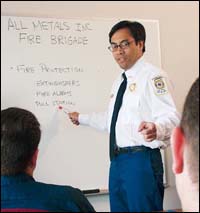 Figure 1. Fire response training by fire department personnel.
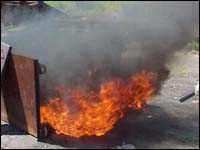 Figure 2. Training fire being extinguished by handheld fire extinguisher.
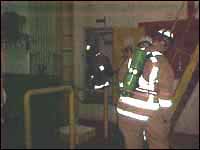 Figure 3. Fireman training in low light conditions in an enclosed space on vessel.
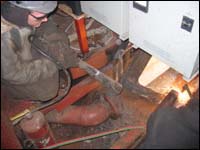 Figure 4. Fire watches in spaces with fire extinguisher.
Potential Hazards:
- No training program in place.
- Infrequency of training.
- Training is not effective or retained.
- Inadequate training.
- Unqualified trainers.
- Insufficient training of subcontractors, temporary workers and non-English speaking workers.
Requirements and Example Solutions:
General Fire Protection Training
- All workers must be trained on the applicable fire protection requirements (Figure 1). [1915.508(a)]
- All workers must be trained on: [1915.508(b)]
- Emergency alarm signals, including system discharge alarms and employee evacuation alarms. [1915.508(b)(1)]
- Primary and secondary evacuation routes to be used in the event of a fire in the workplace. While all vessels and vessel sections must have a primary evacuation route, a secondary evacuation route is not required when impracticable. [1915.508(b)(2)]
Extinguishing Small (Incipient) Fires
- All workers expected to fight incipient
stage fires must be trained in: [1915.508(c)]
- General principles of using fire extinguishers or hose lines (Figure
2). [1915.508(c)(1)]
- Hazards involved with incipient firefighting. [1915.508(c)(1)]
- Procedures used to
reduce these hazards. [1915.508(c)(1)]
- Hazards associated with fixed and portable fire protection
systems that workers may use or to which they may be exposed during
discharge of those systems. [1915.508(c)(2)]
- Activation and operation of fixed and portable fire protection systems
that the employer expects workers to use in the workplace. [1915.508(c)(3)]
Fire Response
- Workers designated for fire response must:
- Receive additional training on the written fire training policy and standard operating procedures. [1915.508(d)(1) and 1915.508(d)(2)]
- Review fire response with training programs and hands-on sessions as
necessary. [1915.508(d)(3)]
- Ensure that fire response workers are capable
of carrying out their duties and responsibilities. [1915.508(d)(4)]
- Train new fire response workers. [1915.508(d)(5)]
- Provide quarterly training on the written operating procedures. [1915.508(d)(6)]
- Use qualified instructors. [1915.508(d)(7)]
- Conduct live fire response exercises (Figure 4). [1915.508(d)(8), NFPA
1403-2002]
- Conduct semi-annual drills. [1915.508(d)(9)]
- Prohibit the use of smoke-generating devices that create a dangerous
atmosphere in training exercises. [1915.508(d)(10)]
Fire Watch
- Each fire watch must be trained: [1915.508(e)]
- Before being assigned to fire watch duty. [1915.508(e)(1)(i)]
- Whenever there is a change in operations that presents a new or different
hazard. [1915.508(e)(1)(ii)]
- Whenever the employer has reason to believe that the fire watch's
knowledge, skills, or understanding of the training previously
provided is inadequate. [1915.508(e)(1)(iii)]
- Annually. [1915.508(e)(1)(iv)]
- Fire watch workers must be trained in: [1915.508(e)(2)]
- Fire watch must be trained to alert others to
exit the space whenever: [1915.508(e)(3)]
Training Records
- Records must be kept to demonstrate that workers have
been trained. [1915.508(f)]
- Ensure that records include the employee's name, the
trainer's name, the type of training and the date(s) on which the training
took place. [1915.508(f)(1)]
- Training record must be kept for one year from the time it
was made or until it is replaced. [1915.508(f)(2)]
- Make training records available for inspection and copy by
OSHA upon request. [1915.508(f)(2)]
 Back to Top Back to Top |
|
Maritime Labor/Industry Recommendations |
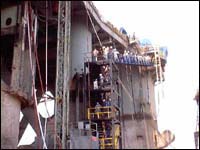 Figure 5. Workers exiting vessel during evacuation drill.
- Use an open fire training system to train fire watches to extinguish fires.
- Use multimedia techniques such as signs, videos, pictographs and bilingual trainers, if necessary.
- Test workers after training is conducted.
- Conduct annual refresher training.
- Conduct annual evacuation drills of workers (Figure 5).
- Use fire extinguishers in good working order and near expiration date when conducting live fire training.
- Sample Fire Safety Plans. Shipbuilders Council of America (2006).
Back to Top |
|