|
Hot Work (including Welding, Cutting and Heating) » Preparing Space for Hot Work |
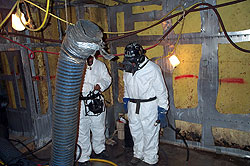
Figure 1: Ventilation and temporary lighting provided for hot work.
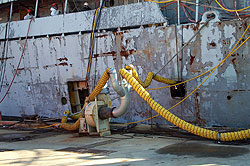
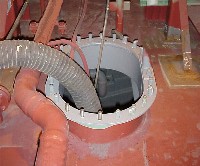
Figure 2: Ventilation provided for enclosed spaces.
The tasks and
inspections below can be conducted by shipyard
personnel (such as tank cleaners, ship superintendent, port
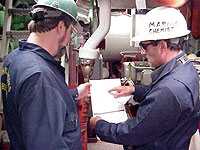
engineer, Shipyard Competent Person (SCP), Marine Chemist, etc). Either
a Shipyard Competent Person (SCP) or a Marine
Chemist must test for hot
work,
depending on the hot work location.
| Tasks to Prepare for Hot Work |
In preparation of a space for hot work,
the requirement in 29 CFR 1915 Subpart D must be followed. If a
Marine Chemist Certificate is required, the following must be
provided [NFPA 306, Chapter 2]:
-
Determine the nature and the extent of the hot work. [NFPA 306,
2-2.2(b)]
-
Determine the nature of other operations in or adjacent to the space that
may affecting hot work (such as cleaning). [NFPA 306, 2-2.2(b)]
-
Determine the cargo history, the last three cargos held in work space and adjacent
spaces. [NFPA 306, 2-2.2(a)]
-
Secure pipelines and other equipment (heating coils,
pumps, etc.) in the work space to prevent flammable or toxic materials
from being discharged into the space. [NFPA 306, 2-2.2(e)]
-
Make space "Safe
for Workers," including installing appropriate
illumination, access, staging, and so forth. [29 CFR 1915.71,
29 CFR 1915.72,
29 CFR 1915.73,
29 CFR 1915.74,
29 CFR 1915.77,
29 CFR 1915.91,
29 CFR 1915.92]
-
Post warning signs as appropriate. [29 CFR 1915.14(b)(2),
29 CFR 1915.16(b)]
[NFPA 306, 2-3]
-
Install appropriate hot work ventilation.
[29 CFR 1915.51]
- Before use, ensure that welding and burning equipment is
properly grounded, inspected, and installed. [29 CFR 1915.55 and 29 CFR 1915.56]
-
Ensure that adequate
fire protection is available. [29 CFR 1915 Subpart P].
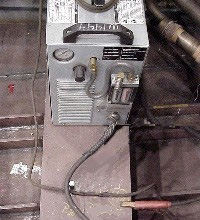
Figure 7: Grounded/bonded welding
machine.
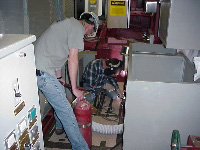
Figure 8: Fire watch.
|
| Inspections for Hot Work |
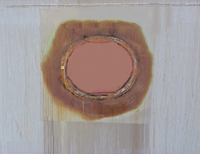
Figure 9: Paint removed 4" all around
both sides.
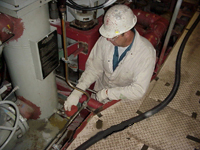
Figure 10: Removal of flammable or
combustible material.
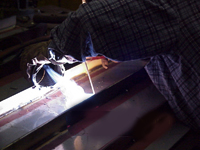
Figure 11: Adequate ventilation.
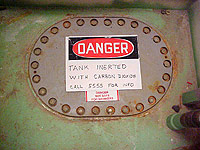
Figure 12: Adjacent space has been
inerted.
Preparation for hot work also includes:
-
Ensuring that flammable, combustible, or toxic
coatings (preservative coatings or insulation) have been removed from hot work
surfaces.
-
A shipyard competent
person must perform testing on any surface of which the
flammability is not known. [29 CFR 1915.53(b)]
-
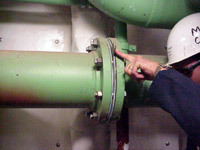
Toxic preservative coatings must be stripped back at least
4 inches, otherwise airline respirators must be used. [29 CFR 1915.53(d)(1)]
- Ensuring that flammable and combustible materials (such as trash, rags, open containers of solvents, etc.) have been removed from the area.
[29 CFR 1915.91 and 29 CFR 1915 Subpart P]
-
Ensuring that flammable or combustible materials have been removed or are adequately covered. [29 CFR 1915 Subpart P]
-
Ensuring that all movable fire hazards in the vicinity have been removed
from the hot work area. [29 CFR 1915 Subpart P]
- Ensuring ventilation is adequate to
maintain a safe atmosphere during hot work. [29 CFR 1915.51(b)]
- Ensuring that adjacent spaces have been inspected and
meet requirements for hot work.
-
In lieu of cleaning, adjacent spaces can be inerted.
Additional Resources
- See also, NFPA Fire Protection Handbook for "Hot Work Oxygen
Chart" (Inerting).
 Back to Top Back to Top |
|
|
|