Before you perform cold work, prepare spaces for entry and work by:
A Shipyard Competent Person (SCP) must then conduct atmospheric testing and
a visual inspection of the space. [See Confined
or Enclosed Spaces and Other Dangerous Atmospheres]
Following the pre-entry inspection, shipyard personnel must:
Preparation for cleaning and cold work also includes coordinating the
necessary personnel, equipment, and materials required for Cleaning
and Cold Work Operations.
| Remove Liquid Residues |
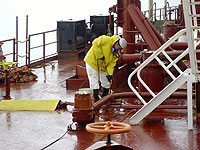
Figure 2: Worker removing liquid residues from space using bucket.
The vessel's crew off-loads the cargo, washes the
spaces through the butterworth openings, and pumps out the space, where appropriate. However, residues
often remain in the space when the vessel reaches the shipyard.
Potential Hazards:
- Residues may be toxic (e.g., styrene, urea), corrosive (e.g., caustic
soda, pencil pitch), or flammable/combustible (e.g., crude oil,
gasoline). These residues can cause illness, fire,
or explosion.
Requirements and Example Solutions:
- Liquid residues of hazardous materials must be removed from
work spaces as thoroughly as possible before employees begin cleaning operations. [29 CFR 1915.13(b)(1)]
 Back to Top Back to Top |
| Secure Piping and Pumping Systems |
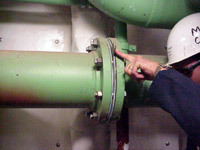
Figure 3: Marine Chemist verifying that piping into space to be cleaned is properly blanked off.
Potential Hazards:
Pipes and pumping systems that enter the space may contain residual
liquid, flammable or combustible gases or vapor and toxic, corrosive, or irritant
materials. These materials may be released or inadvertently pumped
into the space, exposing workers to safety and health hazards.
Requirements and Example Solutions:
- Pipes and pumping systems entering the work space must be
disconnected, blanked off, and/or secured by a positive method, if they
are possibly carrying hazardous materials. [29 CFR 1915.15(a)]
- Pumps within the system must be secured (e.g., disabled). [29 CFR 1915.15(a)]
Back to Top
|
| Determine Ventilation Needs |
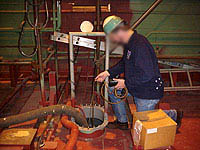
Figure 4: Shipyard Competent Person testing space to determine how much ventilation will be needed
Potential Hazards:
- Workers entering a space containing flammable, combustible,
toxic, corrosive or irritant vapors, mists, or gases are at risk
of fire and explosion, as well as health hazards.
- Cleaning operations may also generate concentrations of flammable, combustible,
toxic, corrosive or irritant vapors, mists, or gases through interaction of cleaning agents, or
reactions of cleaning agents with residues.
Requirements and Example Solutions:
- Testing must be conducted by a Shipyard Competent Person (SCP) to determine
the concentration of flammable, combustible, toxic, corrosive,
or irritant vapors within the space.[29 CFR 1915.13(b)(2)]
- Continuous ventilation must be provided at volumes and flow
rates sufficient to ensure that the concentrations of:
- When ship repair operations result in flammable/combustible
atmospheres:
- All air-moving equipment and its component parts, including
duct work capable of generating a static electric discharge of
sufficient energy to create a source of ignition; must be
electrically bonded to the structure of a vessel or vessel section,
or
in the case of landside spaces, grounded to prevent an electric
discharge in the space. [29 CFR 1915.13(b)(11)]
- Fans must have non-sparking blades and portable air ducts
shall be of non-sparking materials. [29 CFR 1915.13(b)(12)]
Back to Top |
| Posting of Warning Signs |
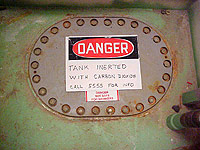
Figure 5: A space containing insufficient oxygen to enter safely is properly labeled.
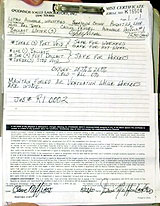
Figure 6: A certificate (prepared by SCP or MC) must be posted near the space that has been determined safe for entry while work is in
progress.
Potential Hazards:
Without warnings, workers may enter unsafe spaces and be exposed to safety
and health hazards.
Requirements and Example Solutions:
- The (warning) signs posted shall be presented in a manner that can
be perceived and understood by all employees. [29 CFR 1915.16(a)]
- If the space contains an oxygen-deficient
or -enriched atmospheres, the space must be labeled "Not
Safe for Workers" and not entered until the oxygen content is
between 19.5% and 22%. [29 CFR 1915.12(a)(2)]
- If the concentration of flammable vapors or gases in the
space is equal to or greater than 10 percent
of the lower explosive limit the space must be labeled "Not
Safe for Workers" and not entered until the
concentration of flammable vapors is maintained below 10% of
the LEL. [29 CFR 1915.12(b)(2)]
- If the space contains an air concentration of a material
which exceeds a Part 1915 Subpart Z permissible exposure
limit (PEL) or is IDLH, the space shall be labeled "Not
Safe for Workers." [29 CFR 1915.12(c)(2)]
- The shipyard competent person report and/or Marine Chemist
certificate must be posted in the immediate vicinity of the
effected operation while work is in progress. [29 CFR 1915.7(d)(2)
and
29 CFR 1915.14(a)(2)]
- Signs prohibiting sources of ignition within or near
spaces that previously contained flammable or combustible
liquids or gases must be posted at the entrance to those
spaces, in adjacent spaces, and in the open area
adjacent to those spaces. [29 CFR 1915.13(b)(10)]
- A warning sign or label may be posted at the means of
access if the entire work area has been tested. [29 CFR 1915.16(b)]
Back to Top |
| Determine Illumination Needs |
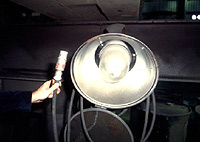
Figure 7: Explosion proof light.
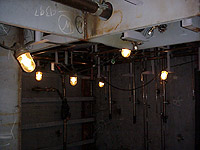
Figure 8: Temporary lighting in dark enclosed space.
Potential Hazards:
- Workers entering spaces containing flammable or
combustible vapors and gases are at risk of fire and
explosion if the space also contains improper electrical
equipment.
- Inadequate illumination in a space can lead to injuries
from slips,
trips, and falls.
- Workers entering inadequately illuminated spaces may become disoriented and fail to find the exit.
This prevents the worker from safely exiting the space.
- Inadequate illumination can prevent workers from safely
performing tasks.
Requirements and Example Solutions:
- Only explosion proof, self-contained portable lamps (e.g.
explosion-proof flashlight) or other electric
equipment approved for hazardous locations by a National Recognized Testing Laboratory
(NRTL), shall be used until the space is deemed "Safe
for Workers". [29 CFR 1915.13(b)(9)]
- All means of access and walkways leading to work areas as
well as working areas themselves must be adequately
illuminated. [29 CFR 1915.92(a)]
- Temporary lights must meet the requirements of
29 CFR 1915.92(b)
and
(c).
- Where temporary lighting from sources outside the vessel
is the only means of illumination, portable emergency
lighting equipment must be available to provide
illumination for safe movement of employees. [29 CFR 1915.92(d)]
- Employees must not be permitted to enter dark spaces
without a suitable portable light. [29 CFR 1915.92(e)]
- The use of matches and open flame lights is prohibited.[29 CFR 1915.92(e)]
- In non-gas free spaces, portable lights must meet the
requirements of
29 CFR 1915.13.
[29 CFR 1915.92(e)]
- All illumination equipment must meet the requirements of
29 CFR 1915.92.
Back to Top |
| Select PPE for Workers |
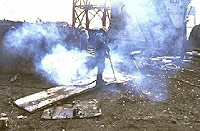
Figure 9: Workers at risk from fumes, heat and flying debris.
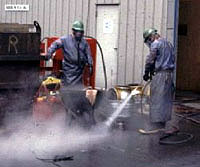
Figure 10: A good PPE hazard assessment results in proper PPE selection for these workers.
Potential Hazards:
- Toxic, corrosive, irritant, or high pressure/temperature cleaning agents
and their
application equipment, may put the safety and health of workers
at risk.
Requirements and Example Solutions:
- A hazard assessment must be made to determine the appropriate
PPE. [29 CFR 1915.152(b)]
- Also see the PPE requirements for specific cleaning
operation hazards that may be encountered:
Additional Resources:
- See the Ship Repair: PPE
module for information on general PPE requirements and example specific cleaning operation PPE.
Back to Top |
|
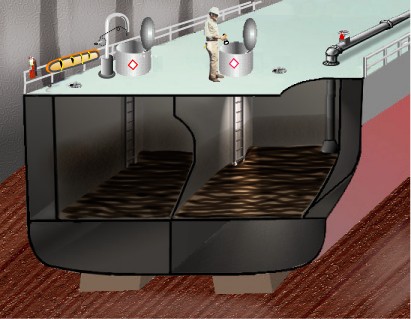 Figure 1: Ship cleaning preparation: