|
Hot Work (including Welding, Cutting and Heating) » Hot Work in Other Locations
|
Hot work is occasionally conducted in locations other than enclosed and confined spaces. Such locations may
include the
exterior of the ship's hull and deck, hollow structures, as well as locations in the
shipyard such
as shops, dry docks, and tank farms.
The Confined or Enclosed
Spaces and Other Dangerous Atmospheres module should be reviewed
before continuing with this section. Also, this module, outlining the requirements for
Hot Work in Enclosed Spaces, should be reviewed before reviewing the
modules regarding hot work requirements for Confined
Spaces, or these requirements for Other Locations.
| Hot Work in Other Locations |
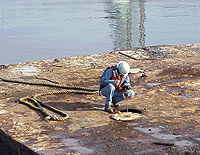 Figure 2: Shipyard Competent Person, with
PFD, tests tanks on a barge before authorizing entry. Note:
Fall protection must be installed after testing for initial entry.
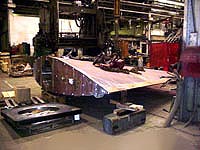 Figure 3: Hot work on rudder
Potential Hazards:
Hot work performed outside confined/enclosed spaces also presents potential fire and
explosion hazards if adjacent spaces are not properly prepared.
- Welding on hollow
structures or containers also presents a hazard.
Requirements and Example Solutions:
-
The shipyard competent person must inspect and test hollow structures and
containers such as drums, skegs, rudders, and voids before any hot work
is performed. [29 CFR 1915.54]
-
Warning: Do not
use oxygen for ventilation or cleaning.
[29 CFR 1915.51(b)(1)(vi)]
-
Ventilate and clean hollow structures as necessary before hot work is
performed. [29 CFR 1915.54]
-
For additional requirements, see the
Fire Protection
chapter.
Note:
When hot work is being performed, it is the employers'
responsibility to ensure that precautions are taken in
adjacent spaces. [29 CFR 1915.503(a)(2)]
 Back to Top Back to Top |
| Fall Hazards |
Potential Hazards:
Fall hazards are a leading cause of shipyard fatalities.
Shipyard employees are often required to work in dangerous
environments that may include fall hazards. Accidents involving
elevation equipment such as ladders, scaffolds, and aerial lifts are often serious,
even fatal. Workers also risk falls from open deck edges.
Requirements and Example Solutions:
Guarding of Deck Openings and Edges
- Openings and deck edges must be guarded. [29 CFR1915.73]
- Flush manholes and other small openings must be guarded after opening. [29 CFR 1915.73(b)]
- During the installation of guards on large openings and deck
edges, fall protection (harness with lanyard) must be used. [29 CFR 1915.73(d)]
- When floor plates or gratings (e.g. bilges, engine rooms,
pump rooms, machinery spaces) are removed, the openings must
be guarded or planked. [29 CFR 1915.73(f)]
Fall Protection for Scaffold Work
- Guardrails or other appropriate fall protection must be
used when working on scaffolds 5 feet above surfaces. [29 CFR 1915.71(j)]
- During the installation of guards on scaffolds, fall
protection must be used. [29 CFR 1915.73(d)]
- SHAC recommends that personal fall protection including
lanyards and harnesses be used and secured during installation
of guardrails and erection and dismantling of scaffolds.
Back to Top |
| PPE Requirements |
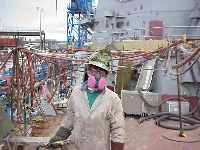
Figure 4: Respiratory protection.
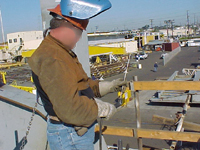
Figure 5: Welding PPE.
In most cases, respiratory protection requirements are less
restrictive in locations other than confined/enclosed spaces,
due to the natural ventilation available. However, numerous
workers may be performing other work nearby and may be at risk
of exposure to:
- Toxic metal fumes, vapors, and gases from welding
- Ultraviolet radiation from arc welding
- "Spatter" from hot metal
- Fire and explosion from nearby operations using flammable
or combustible materials
Requirements and Example Solutions:
- Provide UV shielding for welding when practical. If not
practical, UV filter lenses must be worn by employee at
risk. [29 CFR 1915.56(e)
and 29 CFR 1915.51(e)(1)(ii)]
- Do not allow use of chlorinated solvents within 200
feet of the exposed arc of welder. [29 CFR 1915.51(e)(1)(i)]
- Use appropriate PPE for welders and helpers.
- Use airline respirators when welding on beryllium
containing base or filler metals. [29 CFR 1915.51(d)(3)]
For more specific information, see PPE Selection: Hot Work.
Back to Top |
|
|
|
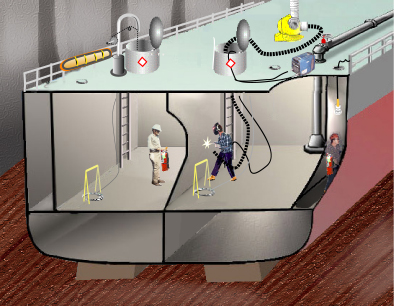 Figure 1: Hot Work in Enclosed Spaces. Also see: