Key Components: Considerations
Component 3. Strut Connections
General Considerations
Stability in a marine hanging staging
platform is achieved in part by the number of adjacent
platform systems. The tendency of any cable-suspended
staging to sway, whether during installation, disassembly,
or use, must be considered by the Qualified
Person when a particular installation is being
designed.
 |
In
general, the more tiers and sections of marine
hanging staging that are tied together, the more
stable the staging.
Conversely, a failure of
one component or section of marine hanging staging may damage
other portions of the staging. |
|
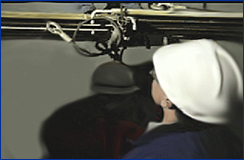
Check all strut connections.
Photo courtesy of OSHA.
|
Also, operations such as the hoisting
and lowering of materials near the marine hanging staging
could cause it to move and widen the gap between an
unguarded working side of the stage and the adjacent
solid structure.
|
Tie-ins should
be installed to stabilize the marine hanging staging whenever
lateral movement could compromise fall protection
systems or the integrity of the scaffold or its
component parts. |
Struts: Critical Connections
Properly securing platforms to struts
and connecting struts to suspension cable assemblies
are critical aspects of safe marine hanging staging.
Struts form the bearing for the staging planks. The
sequence of their installation and the manner in which
they are connected to the suspension cables is critical
to the safe installation and use of the staging.
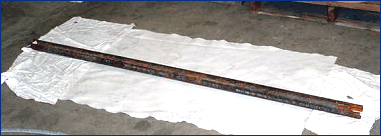
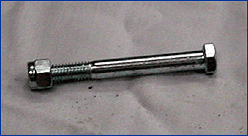
Definitions:
 |
 |
Strut. |
Basic strut pin. |
Photos courtesy of VSRA. |
More information:
 |
 |
 |
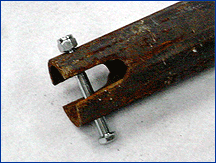
Strut
and strut pin.
|
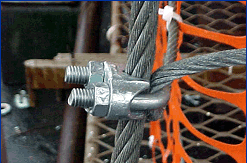
Cable
clip and backing rod.
Photos courtesy of VSRA.
|
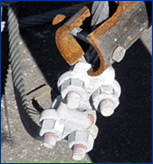
Strut secured to cable.
|
Important Strut-Related Stability Considerations
(based on sound engineering principles) |
- Cable clips and backing
rods to support the struts must
be installed at predetermined intervals
along the length of the suspension
cables before being hoisted by the rope walker to overhead attachment points.
- The struts that support the lowest
level of platforms should be
attached to the suspension cable assemblies
first, and an entire tier of platforms
should be put in place and secured
to the struts before erecting the next
level. This ensures the degree of angulated
cable necessary when overhead
attachments such as S-hooks and pork chops are used to hang suspension
cable assemblies. It also minimizes
horizontal sway in the staging
generally.
- Rough edges on the struts should be
smoothed by grinding, machining,
or other methods so that the struts do
not abrade the suspension cables.
- Cable clamps and backing rods that
support the struts should be installed in pairs, close together, and
tightened to not less than 90 foot-pounds and not more than specified by the manufacturer.
- Wire cable used for backing rod assemblies
must be of the same size as the suspension
cable, and wire cable clips must
be sized appropriately to the suspension
cable.
-
U-bolt cable clamps are used to support
the struts at intervals along the
suspension cables. In marine hanging staging,
the clamps must be the same size as the
suspension cables and spaced close to each
other and applied with the saddle on the
live end of the cable (in this case, the
suspension cable itself), not the backing
rod [29 CFR Part 1915.112(b)(3)].
- When U-bolt clamps are used to attach a cable assembly to an S-hook, the minimum spacing requirements for wire rope clips as presented in Table G-6 (referenced in this section of the standard) apply.
-
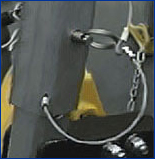
Strut pin.
Photo courtesy of OSHA.
|
The strut pins, though not designed
or intended as primary, load-carrying
elements of the scaffold, must be
capable of withstanding the forces during
installation, disassembly, and use (e.g.,
the minor angle of suspension cable when
attached to an overhead with S-hooks or
pork chops, and the potential for side-loading
from material handling operations where
a suspended load may hang up on a portion
of the staging system).
- The strut pins must provide a positive
closure, such as a bolt with a locking
nut, that will not disengage the
struts from the suspension cables.
|
|
 
|
