Key Components: Considerations
Component 4. Planking
Specifications
for Planking or “Bedsprings”
The standing surfaces typically used
in marine hanging staging are of a specialized design
and are constructed for hard use. Referred to in the
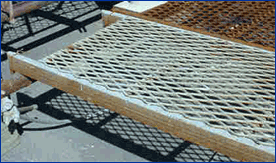
industry as "bedsprings" by
virtue of their appearance and material make-up, they
vary in length between 2 and 10 feet, depending on
desired platform length.
Bedsprings consist of two rails constructed
of 1-inch solid steel stock (ASTM 105), 2-inch (OD)
40-gauge steel tubing (ASTM 105) or equivalent, joined
by cross members of equivalent strength, spaced between
12 and 27 inches apart, depending on length.
Expanded metal mesh, the standing
surface of the bedspring, is welded to the rails and
cross members at intervals that prevent no more than
1 inch of downward deflection. The ends of the bedspring
rails are equipped with hangers that secure the rails
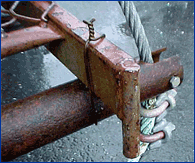
to the staging struts. Bedsprings are wire-tied to
the struts at both ends to prevent displacement.
 |
 |
Planking. |
Tie
wire. |
Photos courtesy of VSRA.
|
 |
Through
design criteria established by engineering analyses
and failure mode analysis of marine hanging staging
components, a duty rating of 500 pounds has been
assigned to this type of planking. Thus, no more
than two persons and their tools can occupy a
single platform at any given time [29 CFR Part 1915.71(b)(1)].
(Note: Relevant
engineering analyses were performed or commissioned
by the Virginia Ship Repair Association, Inc.,
or VSRA, and provided to OSHA in association
with the preparation of this section of the Ship Repair module of the Shipyard Employment eTool.) |
|
Important
Considerations for Planking
(based on sound engineering principles) |
-
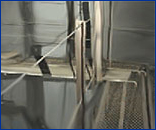
Planking.
Photo courtesy of OSHA.
|
Except during installation, disassembly,
alteration, or modification of
the marine hanging staging system, struts
must be fully planked with bedsprings
or standing surfaces of equivalent
strength and safety characteristics.
- Platforms must be secured to the
struts at each end with tie wire
to prevent uplift and horizontal movement
across the struts [29
CFR Part 1915.71(i)(3)].
- When installing, modifying, or removing
platforms, workers who are erecting
staging must be protected by personal
fall protection equipment when
they are exposed to falls of more than
5 feet [29
CFR Part 1915.71(j)(3)].
- Platforms, when ready for scaffold
users, should be level to within
an inch for every foot of length. For
example, a completed platform supported
by two struts spaced 7 feet apart
should have one end no more than 7 inches
higher than the other. The Qualified Person shall ensure that tripping
hazards are not created for workers
moving from one platform to another
[29 CFR Part 1915.91(a)].
|
|
 
|
