Slides 1-10
Slides 11-20
Slide 21
Slide 22
Slide 23
Slide 24
Slide 25
Slide 26
Slide 27
Slide 28
Slide 29
Slide 30
Slides 31-40
Slides 41-46
-
TEXT VERSION OF SLIDE:
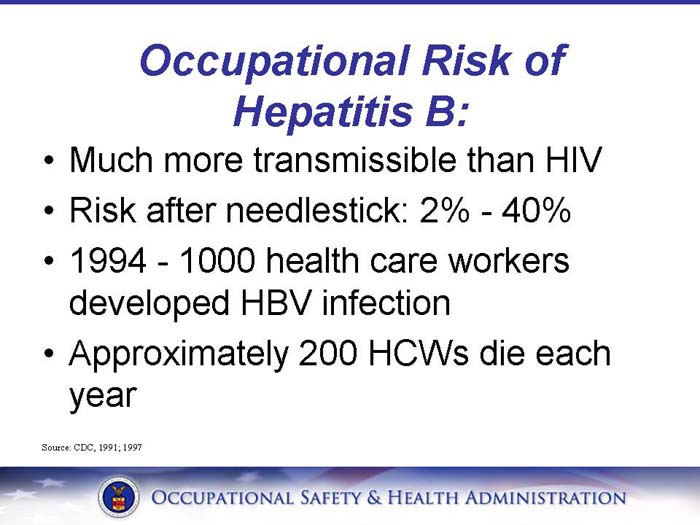
- Much more transmissible than HIV
- Risk after needlestick: 2%-40%
- 1994 - 1000 health care workers developed HBV infection
- Approximately 200 HCWs die each year
Title: Occupational Risk of Hepatitis B:
Type: Text Slide
Content:
Speaker Notes:
What occupational risk does Hepatitis B pose to the health care worker?
For more than 50 years, HBV infection, a well-documented and recognized occupational risk for health care workers, has been and continues to be one of the most dangerous bloodborne pathogens to health care and laboratory personnel (Moyer & Hodgson, 1996).
Hepatitis B is much more transmissible than HIV. Health care workers at greatest risk work in areas such as emergency rooms, clinical laboratories, operating rooms, and hemodialysis units, where they are directly exposed to blood (CDC, 1991).
The chances of infection from a single contaminated needlestick is 2% to 40% (American Liver Foundation, 1995).
In 1994, 1000 health care workers developed HBV infection, and each year approximately 200 health care workers die from this disease (CDC, 1997).