TEXT VERSION OF SLIDE:
Title: 1904.10 – Hearing Loss
Type: Text Slide
Content:
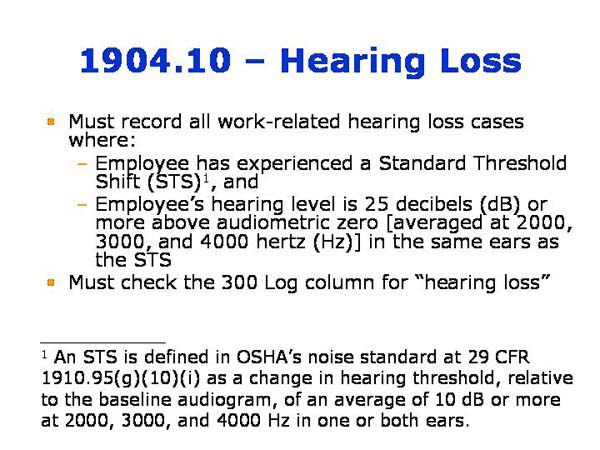
- Must record all work-related hearing loss cases where:
- Employee has experienced a Standard Threshold Shift (STS)1, and
- Employee’s hearing level is 25 decibels (dB) or more above audiometric zero [averaged at 2000,
3000, and 4000 hertz (Hz)] in the same ears as the STS
- Must check the 300 Log column for "hearing loss"
____________
1An STS is defined in OSHA’s noise standard at 29 CFR 1910.95(g)(10)(i) as a change in
hearing threshold, relative to the baseline audiogram, of an average of 10 dB or more at 2000,
3000, and 4000 Hz in one or both ears.
Speaker Notes:
Employers must record work-related hearing loss cases when an employee’s hearing test shows a
marked decrease in overall hearing.
If an event or exposure in the work environment caused or contributed to the hearing loss, or
significantly aggravated a pre-existing hearing loss, the case is work related. If a physician or
other licensed health care professional determines that the hearing loss is not work related or has
not been significantly aggravated by occupational noise exposure, employers are not required to
record the case.
If an employee’s hearing test (audiogram) reveals that the employee has experienced a work related
Standard Threshold Shift (STS) in hearing in one or both ears, and the employee’s hearing level is
25 decibels (dB) or more above audiometric zero [averaged at 2000, 3000, and 4000 Hertz (Hz)] in
the same ear(s) as the STS, you must record the case on the OSHA 300 Log.
A Standard Threshold Shift, or STS, is defined in OSHA’s general industry noise standard at 29 CFR
1910.95(g)(10)(i) as a change in hearing threshold, relative to the baseline audiogram for that
employee, of an average of 10 dB or more at 2000, 3000, and 4000 Hz in one or both ears.
|
 Printing Instructions | Text Version