TEXT VERSION OF SLIDE:
Title: 1904.10 – Hearing Loss (cont’d)
Type: Text Slide
Content:
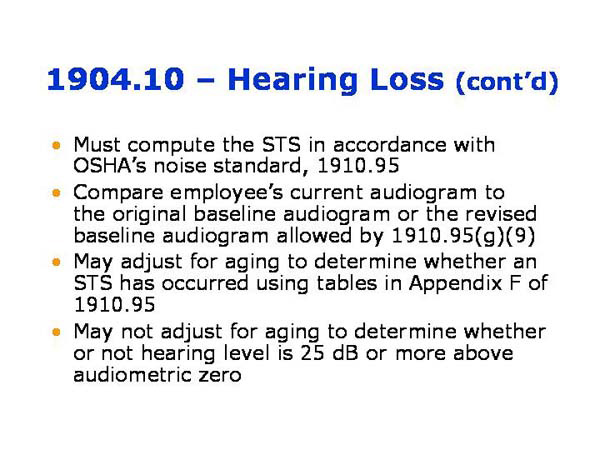
- Must compute the STS in accordance with OSHA’s noise standard, 1910.95
- Compare employee’s current audiogram to the original baseline audiogram or the revised
baseline audiogram allowed by 1910.95(g)(9)
- May adjust for aging to determine whether an STS has occurred using tables in Appendix F of
1910.95
- May not adjust for aging to determine whether or not hearing level is 25 dB or more above
audiometric zero
Speaker Notes:
Paragraph 1910.95(g)(9) of OSHA’s noise standard states:
(9) Revised baseline. An annual audiogram may be substituted for the baseline audiogram when, in
the judgment of the audiologist, otolaryngologist, or physician who is evaluating the audiogram:
(i) The standard threshold shift revealed by the audiogram is persistent, or
(ii) The hearing threshold shown in the annual audiogram indicates significant improvement over the
baseline audiogram.
When you are determining whether an STS has occurred, you may age adjust the employee’s current
audiogram results by using Tables F-1 or F-2, as appropriate, in Appendix F of 29 CFR 1910.95. You
may not use an age adjustment when determining whether the employee’s hearing level is 25 dB or
more above audiometric zero.
In short, a recordable hearing loss case occurs when an employee experiences an STS (as defined in
1910.95), the STS is work-related, and the employee’s aggregate hearing loss exceeds 25 dB from
audiometric zero.
|
 Printing Instructions | Text Version