TEXT VERSION OF SLIDE:
Title: What Are the Health Effects of Crystalline Silica?
Content:
- Silicosis (pulmonary fibrosis)
- Chronic, accelerated, acute
- A continuing problem
- Lung cancer
- Tuberculosis
- Chronic obstructive pulmonary disorder
- Other
- Immunologic disorders and autoimmune diseases
- Renal disease
- Stomach and other cancers
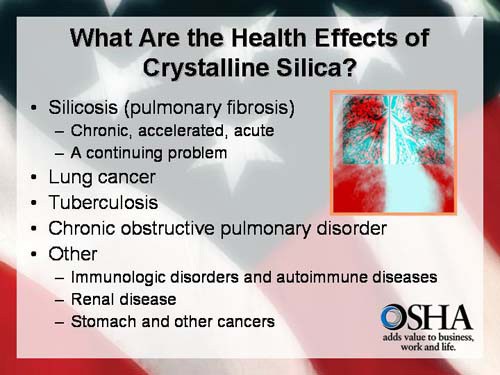
[Includes image of a diseased lung and the OSHA logo]
Speaker Notes:
Silicosis is one of the oldest known occupational diseases, identified as far back as ancient
Greece. Silicosis is a disabling, nonreversible and sometimes fatal lung disease caused by
breathing in a large amount of crystalline silica.
Chronic or “classical” silicosis is the most common type. It typically appears 20-40 years after
exposure and progresses even if exposure ceases.
Accelerated silicosis may occur 5-15 years after exposure that is more intense. It progresses more
rapidly than classic chronic silicosis. It is considered a variant of chronic silicosis.
Acute silicosis results form an overwhelming exposure to crystalline silica and may occur within
weeks of the exposure. An immune mechanism may be involved.
The development of silicosis is dependent on the size of the crystalline silica dust particles
(with respirable particles smaller than 5 micrometers being the most hazardous), the percentage of
crystalline silica in the dust in the air, the dust concentration that is breathed, and the
duration of the exposure.
Silicosis exposure and resultant disease are a continuing problem.
--Silicosis was associated with more than 14,000 U.S. fatalities since 1968. Still about 200
silicosis deaths in U.S. every year
--Silicosis was the underlying cause of death of 868 men and 46 women in non-mining occupations
from 1985-1992
|
 Printing Instructions | Text Version