
- U.S. Department of Labor
- Occupational Safety and Health Administration
- Directorate of Technical Support and Emergency Management
- Office of Science and Technology Assessment
Hazards of Operating Unguarded Stone Cutters and Splitters in Landscaping and Other Worksites
Safety and Health Information Bulletin
SHIB 01-25-2013
This Safety and Health Information Bulletin is not a standard or a regulation, and it creates no new legal obligations. It contains recommendations as well as descriptions of mandatory safety and health standards. The recommendations are advisory in nature, informational in content, and are intended to assist employers in providing a safe and healthful workplace. The Occupational Safety and Health Act requires employers to comply with safety and health standards and regulations promulgated by OSHA or by a state with an OSHA-approved state plan. In addition, the Act's General Duty Clause, Section 5(a)(1), requires employers to provide their employees with a workplace free from recognized hazards likely to cause death or serious physical harm.
Purpose
The purpose of this Safety and Health Information Bulletin (SHIB) is to:
- Warn employers and workers of the hazards involved in using stone-cutting machines; and
- Explain methods to eliminate or reduce the risk of injury when operating stone-cutting machines.
This SHIB describes prevention methods such as:
- Using machine-guarding methods that eliminate worker access to the cutting blades on stone-cutting machines, called the "point of operation;"
- Ensuring that machine-guarding components are properly installed and inspected daily, prior to use; and
- Providing information, instruction, training and supervision to workers on safe work practices when using stone-cutting machines.
Background
Stone-cutting machines, also called stone masons, stone cutters, stone splitters, and rock cutters, have hydraulically operated rams to split and cut various types of stone products used mainly for decorative purposes in the landscaping industry. The machines are produced in both stationary and mobile models. Their high-pressure hydraulic systems may be driven by combustion engine (gasoline/diesel) or electric motor.
Point of operation is the area on a machine where work is performed on the material being processed - that is, the actual mechanical action such as cutting.
Stone-cutting machines with unguarded cutting blades can cause amputations and other serious injuries. According to the Bureau of Labor Statistics, in 2010 (the most recent detailed data), 180 injuries occurred while using shears, which operate similar to stone cutters. Of these injuries, 100 were amputations and 50 were described as cuts, lacerations and punctures. Amputations can occur when shears or stone cutters are not guarded properly and a worker's hands or other body part is placed in the point of operation during operation.
Hazard Description
OSHA's Englewood, Colorado, Area Office investigated a landscaping products company that used a stone splitter to cut decorative rocks. Each rock was lifted by a forklift to a rolling conveyor table where the operator placed the rock under the cutting blades or the "point of operation" by hand. The operator then operated the hand controls with one hand and held the back of the stone with the other hand. This method of operation puts the operator's hand within inches of the unguarded point of operation and could result in severe injury, including amputation. In addition, the rock-splitting process often results in flying rock chips, which presents a hazard to the operator's eyes and face.
The Englewood office's investigation found that many of the stone cutters available for purchase pose amputation hazards because, typically, these machines are not designed with adequate machine guarding to prevent the operator from reaching into the point of operation.
OSHA worked with the stone splitter manufacturer and the landscaping company to retrofit the machine with two-handed controls, which prevented worker access to the point of operation. A cycle-initiation method was installed that requires constant, simultaneous pressure from each hand on two separate controls to move the cutting blades. If the operator removes either hand from either of the controls, the blades will stop immediately. This type of machine-guarding configuration is known as a "two-hand control."
The modification was easily engineered, relatively inexpensive, and readily accepted by the operators.
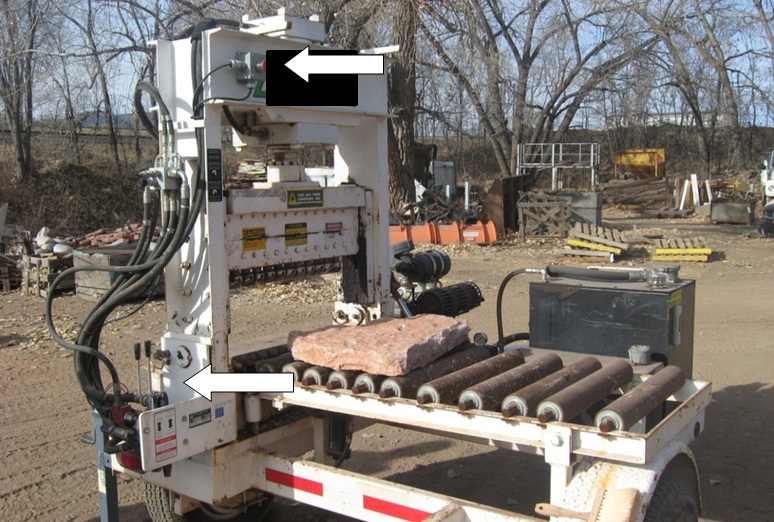
Retrofitted stone cutter with arrows showing top control button (added in the retrofit) and bottom controls (existing hand controls). The operator must press both the button and one of the hand controls to lower the blade.
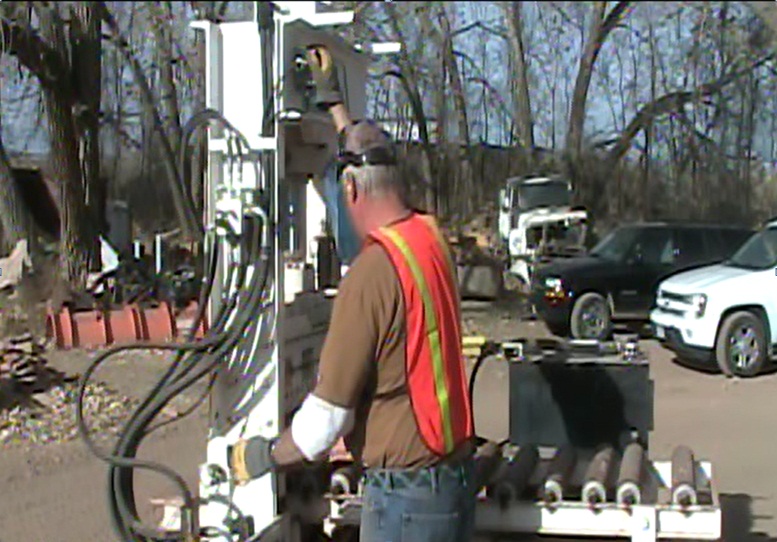
Operator using the retrofitted stone cutter while wearing appropriate protective clothing (hearing protection, gloves, and faceshield).
Requirements and Recommendations
Under the Occupational Safety and Health Act of 1970 (OSH Act), employers are responsible for providing safe and healthful workplaces for their workers.
The following measures will prevent or greatly reduce the chance that a worker using a stone cutter or splitter will suffer an amputation or other serious injury:
- Identify the hazards of powered stone cutters and splitters prior to being used, asking questions such as:
- Does the equipment have machine guarding at the point of operation?
- Can the guarding be easily removed or bypassed?
- Does the guarding keep the operator's hands, fingers, and body out of the danger area?
- Is there evidence that the machine guarding has been tampered with or removed?
- Could changes be made on the machine to eliminate the point of operation hazard entirely?
- Are the machine manufacturer's recommended safety procedures available to the operator and being followed?
29 CFR 1910.212(a)(3)(ii) and 29 CFR 1926.300(b)(4)(ii) require employers to guard the point of operation of machinery to prevent workers from having any part of their body in the danger zone during operating cycles.
- Ensure stone cutters are equipped with machine guarding to prevent worker access to the point of operation, as required by 29 CFR 1910.212(a)(3)(ii) and 29 CFR 1926.300(b)(4)(ii). A good system eliminates the possibility of the operator or another worker placing parts of their bodies where they could be injured by hazardous moving parts. Examples of machine-guarding methods include two-handed starting devices, barrier guards, remote-operator controls, and electronic safety devices. This also includes the two-handed control retrofit described above.
- Conduct regular inspections and keep machinery clean and properly maintained. Good inspection, maintenance and repair procedures contribute significantly to the safety of the machine operator. Routinely inspect and maintain machinery according to the manufacturer's recommendations and good engineering practice.
- Identify other possible machine-related hazards that may pose a risk of injury and necessitate the use of personal protective equipment (PPE), as required by 29 CFR 1910.132(d) and 29 CFR 1926.95(a).
- Provide workers with PPE that adequately protects them from recognized hazards and ensure that it is used properly, as required by 29 CFR 1910.132(d)(1) and 29 CFR 1926.95(a). For example, provide safety glasses with side shields or face shields for workers exposed to eye hazards, face shields to protect workers' faces from flying rock chips, or gloves to protect workers' hands from cuts and abrasions from handling rock or stone.
- Train workers on the following topics:
- All hazards in the work area, including machine-specific hazards;
- Machine-operating procedures;
- The purpose and proper use of machine-guarding, including instruction in the safe use and care of the machines;
- Procedures for addressing unsafe conditions, such as, immediately reporting problems with machine guards; and
- Safe use of PPE, as required by 29 CFR 1910.132(f).
- Provide adequate supervision and reinforce safe practices by ensuring that:
- Only trained workers operate machinery;
- Machine operators do not wear loose-fitting clothing, jewelry, or other items that could become entangled in the machinery; and
- All other workers are prohibited from being near the machine during cutting operations.
Conclusion
Amputations from point-of-operation hazards, and eye and face injuries from flying rock chips, may result when workers use stone-cutters and splitters. Amputation hazards can be prevented by equipping stone cutters and splitters with two-hand controls or other devices that will prevent worker access to the point of operation, as well as providing adequate training in the safe operation of stone splitters. Eye and face injuries can be prevented by providing and enforcing the use of adequate eye and face protection.
References
The resources listed below provide more detailed information on machine guarding, controlling amputation hazards, and PPE use.
- 29 CFR 1910.212: General requirements for all machines for general industry.
- 29 CFR 1910.132: General requirements for personal protective equipment for general industry.
- 29 CFR 1926.300: General requirements for hand and power tools for the construction industry.
- 29 CFR 1926.95: Criteria for personal protective equipment for the construction industry.
- Machine Guarding eTool: OSHA eTool.
- Amputations: OSHA QuickCard Publication No. 3204.
- Machine Guarding: OSHA Safety and Health Topics Page.
- Amputations: OSHA Fact Sheet.
- Occupational Noise Exposure: OSHA Safety and Health Topics Page.
- Hazards Associated with the "Unintended (Double) Cycling" of Mechanical Power Presses: OSHA Safety and Health Information Bulletin SHIB No. 02-02-2010.
- U.S. Department of Labor. Occupational Safety and Health Administration. OSHA Training Institute. Machinery and Machine Guarding Standards Course Objectives.
- Safeguarding Equipment and Protecting Employees from Amputations (PDF): OSHA Publication 3170-02R (2007).
What Workers Need to Know
Machines with unguarded cutting blades (at the point of operation) can cause amputations and other serious injuries.
Tell your employer if the stone-cutting machine you are using does not appear to be safe.
Is there a hazard?
- Has the safety of the machinery at your worksite been evaluated?
- Can any part of a worker's body, such as an arm or hand, be near the cutting blades when the machine is on?
- Are there other potential hazards during machine use such as flying rock chips?
What employers need to do to prevent injuries:
- Make sure that some type of guarding method is in place to prevent worker access to cutting blades when the machine is in use. These methods may include retrofitting stone cutting machines with two-handed controls or starting mechanisms.
- Conduct regular inspections of, and maintenance, on the machines.
- Provide, and ensure that workers use, appropriate personal protective equipment, such as safety glasses or protective gloves, if other machine-related hazards are identified.
- Provide information, training and supervision to workers on safe work practices when using stone-cutting machines. Inform workers about the:
- Hazards associated with particular machine operations;
- Purpose and proper application of machine guarding methods;
- Proper use of personal protective equipment;
- Hazards related to wearing loose-fitting clothing, jewelry, or other items that could become entangled in the machines;
- Importance of not allowing workers other than the machine operator near the machine when it is in use; and
- The need to contact a supervisor if a machine guard is not working as it should.
How OSHA Can Help
OSHA has compliance assistance specialists located in most OSHA offices throughout the nation who can provide information to employers and workers about OSHA standards, short educational programs on specific hazards or OSHA rights and responsibilities, and information on additional compliance assistance resources. Contact your local OSHA office for more information.
OSHA's On-site Consultation Program offers free and confidential advice to small and medium-sized businesses in all states across the country, with priority given to high-hazard worksites. On-site Consultation services are separate from enforcement and do not result in penalties or citations. Consultants from state agencies or universities work with employers to identify workplace hazards, provide advice on compliance with OSHA standards, and assist in establishing safety and health management systems. To locate the OSHA On-site Consultation Program nearest you, call 1-800-321-6742 (OSHA) or visit OSHA's Small Business page.
Workers have the right to:
- Working conditions that do not pose a risk of serious harm.
- Receive information and training (in a language and vocabulary they understand) about workplace hazards, methods to prevent them, and the OSHA standards that apply to their workplace.
- Review records of work-related injuries and illnesses.
- Receive copies of results from tests and monitoring done to find and measure hazards in their workplace.
- File a confidential complaint with OSHA to have their workplace inspected if they believe there is a serious hazard or that their employer is not following OSHA's rules.
- File a complaint with OSHA if they have been retaliated or discriminated against by their employer as the result of requesting an inspection or using any of their other rights under the OSH Act.
Contact OSHA
- For questions or to get information or advice, or to report an emergency, report a fatality or catastrophe, order publications, sign up for OSHA's e-newsletter, or to file a confidential complaint, contact your nearest OSHA office, visit www.osha.gov or call OSHA at 1-800-321-OSHA (6742), TTY 1-877-889-5627.
- Many states operate their own occupational safety and health programs approved by OSHA. States enforce similar standards that may have different or additional requirements. A list of state plans is available at OSHA's State Occupational Safety and Health Plans.