
- U.S. Department of Labor
- Occupational Safety and Health Administration
- Directorate of Technical Support and Emergency Management
- (formerly Directorate of Science, Technology and Medicine)
- Office of Science and Technology Assessment
Suspension Trauma/Orthostatic Intolerance
Safety and Health Information Bulletin
SHIB 03-24-2004, updated 2011
Purpose
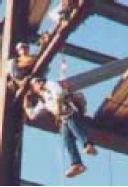
This Safety and Health Information Bulletin provides employees and employers with important information about the hazards of orthostatic intolerance and suspension trauma when using fall arrest systems. This bulletin:
- describes the signs and symptoms of orthostatic intolerance;
- discusses how orthostatic intolerance can occur while workers are suspended following a fall; and
- outlines recommendations for preventing orthostatic intolerance, as well as recommendations for worker training and rescue.
Background
Orthostatic intolerance may be defined as "the development of symptoms such as light-headedness, palpitations, tremulousness, poor concentration, fatigue, nausea, dizziness, headache, sweating, weakness and occasionally fainting during upright standing" [1,2]. While in a sedentary position, blood can accumulate in the veins, which is commonly called "venous pooling," and cause orthostatic intolerance [3]. Orthostatic intolerance also can occur when an individual moves suddenly after being sedentary for a long time. For example, a person may experience orthostatic intolerance when they stand up quickly after sitting still for a long time.
A well-known example of orthostatic intolerance is that of a soldier who faints while standing at attention for long period of time. The moment the soldier loses consciousness, he or she collapses into a horizontal position. With the legs, heart, and brain on the same level, blood is returned to the heart. Assuming no injuries are caused during the collapse, the individual will quickly regain consciousness and recovery is likely to be rapid.
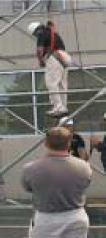
Venous pooling typically occurs in the legs due to the force of gravity and a lack of movement. Some venous pooling occurs naturally when a person is standing. In the veins, blood normally is moved back to the heart through one-way valves using the normal muscular action associated with limb movement. If the legs are immobile, then these "muscle pumps" do not operate effectively, and blood can accumulate. Since veins can expand, a large volume of blood may accumulate in the veins.
An accumulation of blood in the legs reduces the amount of blood in circulation. The body reacts to this reduction by speeding up the heart rate and in an attempt to maintain sufficient blood flow to the brain. If the blood supply is significantly reduced, this reaction will not be effective. The body will abruptly slow the heart rate and blood pressure will diminish in the arteries. During severe venous pooling, the reduction in quantity and/or quality (oxygen content) of blood flowing to the brain causes fainting. This reduction also can have an effect on other vital organs, such as the kidneys [3]. The kidneys are very sensitive to blood oxygen, and renal failure can occur with excessive venous pooling. If these conditions continue, they potentially may be fatal [3].
Description of Hazard
Orthostatic intolerance may be experienced by workers using fall arrest systems. Following a fall, a worker may remain suspended in a harness. The sustained immobility may lead to a state of unconsciousness. Depending on the length of time the suspended worker is unconscious/immobile and the level of venous pooling, the resulting orthostatic intolerance may lead to death. While not common, such fatalities often are referred to as "harnessinduced pathology" or "suspension trauma."
| Signs & symptoms that may be observed in an individual who is approaching orthostatic intolerance: | |
|---|---|
| Faintness | Nausea |
| Breathlessness | Dizziness |
| Sweating | Unusually Low Heart Rate |
| Paleness | Unusually Low Blood Pressure |
| Hot Flashes | "Greying" or Loss of Vision |
| Increased Heart Rate | |
References: Seddon, Paul. Harness Suspension: review and evaluation of existing information. Health and Safety Executive. Research Report 451/2002. 104 pp. Sheehan, Alan. Suspension Trauma. Training handout. |
|
| Factors that can affect the degree of risk of suspension trauma: | |
|---|---|
| Inability to move legs | Hypothermia |
| Pain | Shock |
| Injuries during fall | Cardiovascular disease |
| Fatigue | Respiratory disease |
| Dehydration | Blood loss |
References: Seddon, Paul. Harness Suspension: review and evaluation of existing information. Health and Safety Executive. Research Report 451/2002. 104 pp. Sheehan, Alan. Suspension Trauma. Training handout. |
|
Unconscious/immobile workers suspended in their harness will not be able to move their legs and will not fall into a horizontal position, as they would if they fainted while standing. During the static upright position, venous pooling is likely to occur and cause orthostatic intolerance, especially if the suspended worker is left in place for some time. Venous pooling and orthostatic intolerance can be exacerbated by other circumstances related to the fall. For example, shock or the experience of the event that caused the fall, other injuries, the fit/positioning of the harness, the environmental conditions, and the worker's psychological state all may increase the onset and severity of the pooling and orthostatic intolerance [3,5]. Unless the worker is rescued promptly using established safe procedures, venous pooling and orthostatic intolerance could result in serious or fatal injury, as the brain, kidneys, and other organs are deprived of oxygen [3]. Recommended rescue procedures are outlined below in the Conclusions and Recommendations section.
Conclusions and Recommendations
Prolonged suspension from fall arrest systems can cause orthostatic intolerance, which, in turn, can result in serious physical injury, or potentially, death. Research indicates that suspension in a fall arrest device can result in unconsciousness, followed by death, in less than 30 minutes [4]. To reduce the risk associated with prolonged suspension in fall arrest systems, employers should implement plans to prevent prolonged suspension in fall protection devices. The plan should include procedures for: preventing prolonged suspension, identifying orthostatic intolerance signs and symptoms, and performing rescue and treatment as quickly as possible.
OSHA recommends the following general practices/considerations:
- Rescue suspended workers as quickly as possible.
- Be aware that suspended workers are at risk of orthostatic intolerance and suspension trauma.
- Be aware of signs and symptoms of orthostatic intolerance.
- Be aware that orthostatic intolerance is potentially life threatening. Suspended workers with head injuries or who are unconscious are particularly at risk.
- Be aware of factors that can increase the risk of suspension trauma.
Training
OSHA requires employers to train workers to use fall arrest systems and other personal protective equipment correctly while performing their jobs, in accordance with standards 29 CFR 1910.132 (Personal Protective Equipment) 29 CFR 1915.159 (Personal Fall Arrest Systems) and 29 CFR 1926.503 (Training Requirements for Fall Protection).
Workers who wear fall arrest devices while working, and those who may perform rescue activities, should also be trained in:
- How to ascertain whether their personal protective equipment is properly fitted and worn, so that it performs as intended;
- How orthostatic intolerance/suspension trauma may occur;
- The factors that may increase a worker's risk;
- How to recognize the signs and symptoms identified in this bulletin; and
- The appropriate rescue procedures and methods to diminish risk while suspended.
Rescue Procedures
Under 29 CFR 1926.502 (d) (Fall Protection Systems Criteria and Practices), OSHA requires that employers provide for "prompt rescue of employees in the event of a fall or shall assure that employees are able to rescue themselves." This should include identifying rescue procedures that address the potential for orthostatic intolerance and suspension trauma. Rescue procedures also should address how the rescued worker will be handled to avoid any post-rescue injuries.
Rescue procedures should include the following contingency based actions:
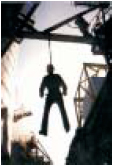
- If self-rescue is impossible, or if rescue cannot be performed promptly, the worker should be trained to "pump" his/her legs frequently to activate the muscles and reduce the risk of venous pooling. Footholds can be used to alleviate pressure, delay symptoms, and provide support for "muscle pumping."
- Continous monitoring of the suspended worker for signs and symptoms of orthostatic intolerance and suspension trauma.
- Ensuring that a worker receives standard trauma resuscitation1 once rescued.
- If the worker is unconscious, keeping the worker's air passages open and obtain first aid.
- Monitoring the worker after rescue, and ensuring that the worker is evaluated by a health-care professional. The worker should be hospitalized when appropriate. Possible delayed effects, such as kidney failure, which is not unusual in these cases, are difficult to assess on the scene.
References
- Robertson, David. Orthostatic Intolerance. Vanderbilt University, Nashville, Tennessee.
- New York Medical College. Orthostatic Intolerance. Vahalla, New York.
- Seddon, Paul. Harness Suspension: Review and evaluation of existing information. Health and Safety Executive. Research Report 451/2002. 104 pp.
- Sheehan, Alan. Suspension Trauma. Training handout.
- Weems, Bill and Bishop, Phil. Will Your Safety Harness Kill You? Occupational Health & Safety. 72(3): 86-88, 90, March, 2003.
1National Association of Emergency Medical Technicians (NAEMT). Provider Textbook section in: PHTLS Basic and Advanced Prehospital Trauma Life Support Fifth Edition St. Louis, MO: Mosby; 2003: Section 1. Summary available at: http://phtls.org/datafiles/PHTLS%205ed%20Compendium.pdf