
- U.S. Department of Labor
- Occupational Safety and Health Administration
- Directorate of Technical Support and Emergency Management
- (formerly Directorate of Science, Technology & Medicine)
- Office of Science and Technology Assessment
Hazards of Wood Chippers
Safety and Health Information Bulletin
SHIB 04-16-2008
Preface
Operating wood chippers can be dangerous for operators and others working nearby. When employees feed tree limbs and branches into chippers they are at risk of getting caught in the machine and being pulled into the fast-turning chipper knives.
This Safety and Health Information Bulletin (SHIB) discusses ways to reduce or eliminate "caught-in" and "struck-by" chipper-related accidents. It discusses training and proper work practices and identifies controls that manufacturers have installed to reduce the risk of serious injury. Although the hazards associated with chipper use are generally known, awareness of these hazards and the associated safeguards needs to be highlighted and reinforced.
Additionally, a recent fatality involving a chipper equipped with a winch line assembly revealed that these chippers can pose unique "struck-by" hazards. Special considerations for the safe operation of these chippers are also highlighted and discussed below.
Purpose
The purpose of this SHIB is to:
- Alert employers, employees and manufacturers to the hazards involved during the use of chippers, and the unique hazards associated with operating a chipper equipped with a winch line assembly,
- Inform employers and employees about safe work practices,
- Stress the importance of following the manufacturer's instructions for operating, inspecting and maintaining chippers, and
- Inform employers and employees about chipper safety devices, including recently developed devices.
Background
According to the OSHA Integrated Management Information System (IMIS), 39 employees were killed in chipper accidents from 1996-2005.1 Of those fatalities, the vast majority (78 percent) resulted from being caught in the chipper, and most of the remainder resulted from "struck-by" accidents.
Equipment
Chippers are used to dispose of tree trimmings and other wood debris. Chippers generally consist of a powered feed mechanism, knives mounted on a rotating disc or drum, and an internal combustion engine. Typically, employees feed branches into the infeed chute by hand. Feed rollers at the end of the infeed chute grab the branches and force them into the chipper knives. The chipper knives generally rotate from 1,000 to 2,000 revolutions per minute. The drum and its knives chip the branches and force the chips through a discharge chute. The housing that contains the point-of-operation chipper disc is sectioned and includes a removable hood to allow access to the components for maintenance and repair.
Many chippers are equipped with a mechanical feed control bar that activates the feed rollers when it is pulled. The bar is mounted across the top and along the sides of the infeed chute for quick and easy access. The American National Standards Institute (ANSI) ANSI Z133.1-2006 standard, "Safety Requirements for Arboricultural Operations," requires that chippers equipped with a mechanical feed control bar must have quick-stop and reverse feed devices for emergencies.2 The chipper involved in the accident described below met this ANSI requirement.
Accident Discussion
The Denver, Colorado OSHA Area Office investigated a fatal accident in which a chipper operator was killed when he was pulled into the chipper.
At the time of the accident, the operator was feeding branches into the chipper. The operator usually stood to the side of the chipper feed table in order to have easy access to the feed control bar. However, the investigation indicated that, in this incident, the operator was standing directly in front of the infeed chute. Further, the leather gloves that the operator was wearing to protect his hands from cuts and scrapes had cuffs. While the operator stood in front of the infeed chute, it is possible that a tree branch snagged the cuff of his glove and pulled him into the chipper. He was killed instantly upon contact with the rotating chipper knives.
Engineering Controls
Employees must be protected from contacting operating chipper components such as knives, feed rollers and chip discharge spouts. OSHA's general industry machine guarding standard requires that all machines be equipped with one or more methods of guarding to protect the operator and other employees in the work area from hazards such as those created by rotating parts and flying chips (29 CFR 1910.212(a)(1)).3 In addition, the point of operation of such machines must be guarded appropriately (29 CFR 1910.212(a)(3)). Moreover, OSHA's Logging Operations standard, to the extent that it applies to a particular chipping operation, requires that infeed and outfeed chutes be guarded to prevent contact with the disc, knives, or blades (29 CFR 1910.266(h)(4)).4
Chipper safety devices are available to reduce the risk of "caught-in" or "struck-by" accidents. Some manufacturers have equipped chippers with one or more of these devices, including:
Feed Control Bar - Many chippers in use today have mechanical feed control bars that meet the ANSI Z133.1 requirement to include emergency stop devices. Pushing the feed control bar to the center (neutral position) stops the feed rollers, and pushing it toward the discharge spout reverses the feed rollers.
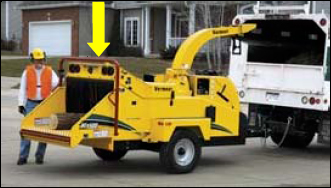
Feed control bar (in red) on top and sides with handles.
Bottom Feed Stop Bar - To address the hazard of being pulled into the chipper, one manufacturer has developed and installed a "bottom feed stop bar" (patent pending) on all its new models. It is a pressure sensitive device that cuts off all power completely when 34 pounds of force are applied to the lower edge of the feed table.
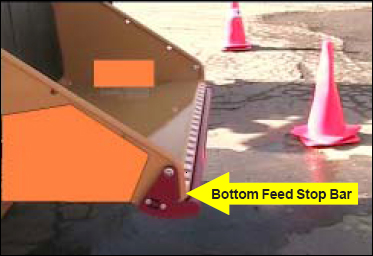
According to the manufacturer, the device cannot be retrofitted onto older models due to its electronic and mechanical requirements.
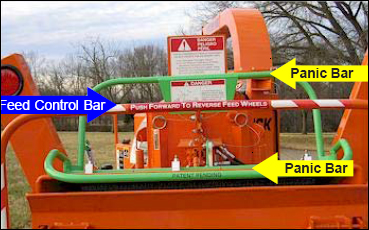
Panic Bar - Another manufacturer has equipped its chippers with a "panic bar" (patent pending) to stop the feed system in an emergency. When the operator grabs the "panic bar" it instantly stops the hydraulic system that operates the feed rollers. The "panic bar" is not attached to the feed control bar and operates independently. It has two grab bars, one in front and one behind the feed control bar, for quick access from almost any location around the feed area.
Emergency Pull Ropes - Emergency pull ropes or cables are another emergency shut-off device installed by some manufacturers. Pulling the ropes immediately reverses the action of the feed rollers. The two ropes are located on both sides of the throat of the infeed chute for quick access. However, if the ropes become entangled in branches, they may be difficult to locate and pull in an emergency. These ropes can be retrofitted onto existing machines.
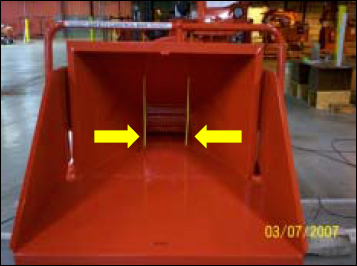
Emergency Pull Ropes
Feed Tray Extensions - Many chippers have longer feed trays (i.e., tray extensions or fold down trays) to reduce the potential for employees getting pulled into the chipper. These trays can increase the length of the infeed area by as much as four feet, thus making it more difficult for employees to reach into the feed rollers. Many chippers have these trays and retrofit kits are also available. Using extended trays is effective in creating a physical barrier between the operator and the point of operation.
Wooden Push Tools - Push tools are used to push branches, particularly shorter ones, and other debris into the infeed chute. Using push tools prevents employees from using their hands and feet to push material into the feed rollers.
Flexible Rubber Curtain/Flaps - Rubber curtains installed at the front of the infeed chute may reduce both "caught-in" and "struck-by" accidents. The curtains serve as physical warnings to operators to keep their hands away from the infeed chute. They also prevent objects from kicking back and striking employees standing nearby.
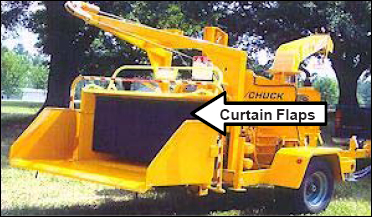
Flexible Rubber Curtain/Flaps
Discharge Spout Deflector/Guard - This device reduces the risk of being struck by flying debris. It redirects the discharge of wood chips into a chipper truck or in a safe direction away from employees.
Chipper Hood Safety Latch - This device serves as an interlock by preventing the operator from starting the chipper before the chipper hood is locked and by preventing the operator from opening the hood before the disc/drum has stopped running. This device reduces "struck-by" and "caught-in" injuries.
Training and Work Practices
The following recommended training and work practices will help to ensure safe operation of chippers:
Training - Employers and employees should be trained to understand the hazards associated with chippers. Training should cover the following:
- Correct operation of the chipper and its safety controls,
- Manufacturer's instructions on operation, inspection and maintenance of the chipper,
- Proper procedures for machine start-up and shutdown, and
- Correct use and maintenance of personal protective equipment.
Training should be provided in an effective manner and should make provision for those employees who speak or read little or no English.
Employers should closely supervise newly-hired employees to ensure that they are safely operating the chipper and should reinforce training through regular safety talks and unannounced site visits. When an employee engages in unsafe work practices, or disables existing safety devices, immediate corrective action, including refresher instruction and/or disciplinary measures, should be taken.
When chipping is being done as part of a logging operation, training is required by the Logging Operations standard (29 CFR 1910.266(i)). The logging standard establishes specific training requirements for all employees, including provisions on training content, frequency and portability.
Work practices - Proper work practices are essential for safe operation of chippers. Employers should reinforce proper work practices on a regular basis, such as during "toolbox talks".
The following are recommended safe chipper work practices to reduce "caught-in" and "struck-by" hazards:
- Designate one or more employees as a safety watch to be stationed near emergency shut-off devices while other employees feed material into the chipper.
- Stand to the side of the infeed chute when feeding material into the chipper. This reduces the "caught-in" hazard and allows quick access to emergency stop devices.
- Keep hands and feet out of the immediate infeed chute area while the chipper is running.
- Push material into feed rollers with a wooden tool or a long branch.
- Feed branches into the chipper butt-end first.
- Place shorter branches on top of longer branches being fed into the chipper.
- Place small debris into trash cans instead of feeding it into the chipper.
- Never stand, sit or climb onto any part of the chipper while it is running.
- Shut down the chipper and remove the ignition key when it is unattended.
- Before starting a chipper, ensure that the chipper's disc hood is completely closed and latched, and that there are no foreign objects in the infeed area.
- Ensure that the discharge chute is positioned to prevent chips from hitting employees.
- Do not stand in front of the feed table when the chipper is running.
- Check material to be fed to ensure that it is free of metal and other foreign objects.
- Use proper locking pins to immobilize the disc cutting wheel when attempting to clear a clogged chipper chute or changing chipper blades.
When chipping is being done as part of a logging operation, the Logging Operations standard requires:
- Employers hold safety and health meetings as necessary and at least monthly (29 CFR 1910.266(i)(11)),
- Chipper access covers or doors must not be opened until the drum or disc comes to a complete stop (29 CFR 1910.266(h)(4)),
- Employees be trained in the recognition of safety and health hazards associated with specific work tasks, including work practices to prevent or control those hazards (29 CFR 1910.266(i)(3)(iii)).
Personal protective equipment and clothing - Employers must "assess the workplace to determine if hazards are present, or likely to be present, which necessitate the use of personal protective equipment" (29 CFR 1910.132(d)(1)).5
Employees must take the following precautions:
- Use appropriate hand protection ... relative to the task(s) to be performed, conditions present ... and the hazards and potential hazards identified (29 CFR 1910.138(a) and (b)).6
- Use appropriate eye and face protection (29 CFR 1910.133).7 Devices purchased after July 5, 1994 must comply with ANSI Z87.1-1989 (.133(b)).
- Wear a protective helmet (29 CFR 1910.135). Helmets purchased after July 5, 1994 must comply with ANSI Z89.1-1986 (.135(b)).8
The following are industry and ANSI recommended clothing and apparel to prevent entanglement hazards:
- Wear gloves with no cuffs (non-gauntlet) (ANSI Z133.1-2006-3.4 4, 8.6.3).
- Wear close-fitting and tucked-in clothing with no stray straps or strings. Jewelry should not be worn while operating chippers (ANSI Z133.1-2006-8.6.3).
Inspection and maintenance - Employers need to inspect and maintain chippers in accordance with the manufacturer's specifications. Employers should inspect and test the chipper at the start of each workshift to ensure that all parts and safety devices are functioning properly. This should include looking for broken parts, cracks, worn hinges, and missing parts and pins.
Before beginning any servicing operation, lockout/ tagout procedures must be utilized to control hazardous energy related to start-up of the chipper (29 CFR 1910.147).9
When chipping is being done as part of a logging operation, the Logging Operations standard requires that employers ensure that machines, including chippers, are maintained in serviceable condition (29 CFR 1910.266(f)). To that end, the logging standard requires that each machine be inspected before every workshift and that damage or defects be repaired before the machine is used.
Chippers Equipped with a Winch Line
Equipment and Procedures
Generally, a chipper with a winch assembly mounted on top has the same standard and safety features as one without a winch line. The winch assembly is used to secure and pull large diameter, heavy branches or trunks to the chipper. The winch is located directly above and in front of the chipper infeed chute. The winch in the fatal accident described below, had the capacity for handling logs/trees up to 2,000 pounds and 19-inches in diameter. Although winch lines can be wire rope or braided synthetic rope depending on the application, the winch line in this incident was a double-braided nylon rope approximately 150 feet long and 7/16-inch in diameter. Additionally, a 5-foot, 1/4-inch diameter metal chain with hook was attached to the end of the winch rope. This "chain and hook" assembly at the working end of the winch line is referred to as a "choker." The choker is used to attach the butt end of the tree limb to the winch line. When activated, the winch pulls the heavy limb toward the chipper and into the feed chute.
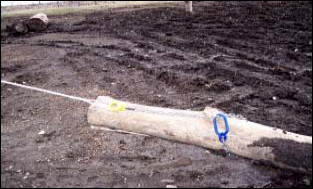
Chain chocker installed on limb and winch line attached to chocker
Accident Discussion
OSHA's Boise, Idaho Area Office investigated a fatality involving a chipper equipped with a winch line. The chipper operator stood to the side of the chipper to operate the controls while the winch line handler pulled the line out from the winch. As the handler pulled the line out, a section of the line that was slackened became entangled in the tree limb that was being fed into the chipper. The tree limb pulled the slackened line into the chippers's cutter drum causing the winch line and choker to snap and recoil with such force and speed that the chipper operator suffered fatal head injuries despite wearing ANSI-approved head protection.
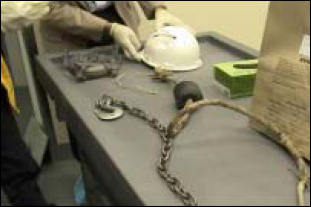
Chain that fatally struck employee
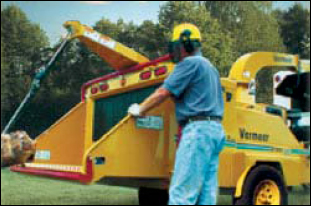
The investigation revealed that the location of the winch boom directly above and in front of the feed rollers, coupled with the simultaneous operation of the feed rollers, created this fatal "struck-by" hazard.
Engineering Controls and Work Practice Strategies for Chippers with a Winch Assembly
In response to this accident, the manufacturer of the chipper involved in this incident is now providing the following additional safety measures for its chipper models equipped with a winch option:
For existing chipper:
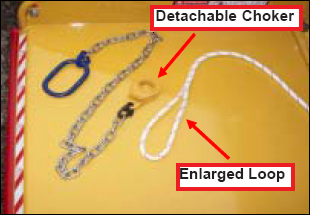
- Supplying a detachable choker. A detachable choker that can be removed from the end of the winch line during line handling operations reduces the weight of the line.
- Increasing the size of the loop on the winch line from 5 to 10 inches. The enlarged loop reduces the chance of the loop snagging or pinching the operator's hand and pulling the operator with great force towards the chipper.
- Providing a lighter weight winch line. In addition to the removable choker chain, this will help to reduce the recoil hazard if the winch line is accidentally pulled into the feed rollers and chipper knives.
- Providing a winch line transport/storage hook so that the line can be stored away from the branches being fed into the chipper.
- Providing a new chipper and winch operation safety video to address the potential hazards.
- Providing safety signs on the chipper to warn employees of the potential hazard of a winch line getting caught in the feed rollers and chipper knives.
- Revising the instructions in the chipper operating manual to reflect the new parts, safety signs and the proper operating sequence.
For new models
Safety Interlock
New chipper models from this manufacturer will include a safety interlock system. This system will require that the winch line be safely stored before the feed rollers can be operated. The interlock system will also prevent the winch line from accidentally being pulled into the chipper.
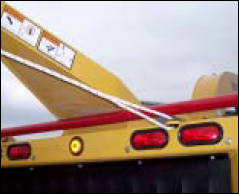
Winch line Safety Interlock and Storage Hook
Recommendations for Use of Chippers with a Winch Assembly
- Employers should ensure that employees follow all safe work practices for the operation of the winch.
- Employers who own chippers with winch lines should contact their equipment supplier to investigate the application of strategies to minimize the "struck-by" hazard posed by the winch line assembly.
- Employers should otherwise ensure that all employees are trained on the safe operation of chippers equipped with a winch line and should also train their employees to recognize and avoid possible "pinch point" hazards where the winch line enters the winch boom and where the choker connects to the log.
Conclusion
Chipper operations can be dangerous and result in severe injury or death when proper precautions and work practices are not followed. Implementing the actions described in this SHIB will help protect employees from serious or fatal injuries during chipper operations.
For additional information on the tree care industry as well as other information on applicable OSHA standards, compliance directives, letters of interpretation, alliances, and compliance assistance materials, please refer to the Tree Care Industry Safety and Health Topics Page.
References
- IMIS. OSHA Integrated Management Information System, 1996-2005.
- ANSI. American National Standard for Arboricultural Operations-Safety Requirements. Z133.1-2006. International Society of Arboriculture, P.O. Box 3129, Champaign, IL 61826-312929.
- 29 CFR 1910.212, General Requirements for all Machines.
- 29 CFR 1910.266, Logging Operations.
- Subpart I - Personal Protective Equipment. 29 CFR 1910.132, General Requirements.
- 29 CFR 1910.138, Hand Protection.
- 29 CFR 1910.133, Eye and Face Protection.
- 29 CFR 1910.135, Head Protection.
- 29 CFR 1910.147, The Control of Hazardous Energy.
- Edwin G. Foulke, Jr.
- Assistant Secretary
- Occupational Safety and Health Administration