
- U.S. Department of Labor
- Occupational Safety and Health Administration
- Directorate of Technical Support and Emergency Management
- (formerly Directorate of Science, Technology and Medicine)
- Office of Science and Technology Assessment
Hazards of Auger Drilling
Safety and Health Information Bulletin
SHIB 04-16-2008
Preface
Powered augers are used predominantly in the agriculture, landscaping, construction and utility industries. They are commonly used to drill holes for pilings, utility poles, light poles and fence posts. The auger may be mounted on a variety of equipment or vehicles that may be ridden on or walked behind.
The drilling operation that prompted this Safety and Health Information Bulletin (SHIB) involved the use of a truck-mounted auger to install the final post of a security fence on a landscaped area covered by landscape fabric and a layer of mulch. The operator standing on the mulch was pulled into the rotating auger by the hidden fabric. His legs were amputated as they were pulled into the auger and he died as a result of the severe injuries.
This SHIB addresses some potential hazards employees may be exposed to when an auger strikes materials beneath or above the surface. In addition to contact with hidden landscape fabric, contact with underground utility installations such as gas, fuel, or electric lines (29 CFR 1926.651(b)(1)) or overhead power lines such as electrical distribution and transmission lines (29 CFR 1926.550(a)(15)) also could result in a fatal accident.
Purpose
The purpose of this SHIB is to:
- Alert and inform employers, employees, and manufacturers about some of the potential hazards associated with auger drilling, including hazards posed by hidden or exposed fabrics, overhead or underground utilities, modified equipment, and disabled safety controls,
- Explain the importance of inspecting the area for hidden or exposed fabric, and underground or overhead utilities (29 CFR 1926.651(b)(1), 29 CFR 1926.550(a)(15)),
- Remind employers that frequent and regular inspections of the job site, materials, and equipment must be performed by competent persons designated by the employer (29 CFR 1926.20(b)(2)),
- Remind employers of the training requirements to instruct employees in the recognition and avoidance of unsafe work conditions (29 CFR 1926.21(b)(2)) and to permit only employees qualified by training or experience to operate equipment and machinery (29 CFR 1926.20(b)(4)), and
- Remind employers of the importance of reviewing relevant precautions and following the manufacturer's operating manual.
Background
OSHA's Wilkes-Barre, Pennsylvania Area Office investigated a fatality at the site of a newly-constructed administration building. A subcontractor had been hired to install a security fence. On the day of the incident, one post hole was left to be dug. All of the previous post holes had been dug on disturbed construction soil, but the last hole was in a landscaped area covered with mulch. The investigation revealed that the operator did not inspect the area where this last hole was to be dug before drilling and, therefore, was not aware of the landscape fabric beneath the mulch. Consequently, the landscape fabric was not cut to accommodate the 16-inch auger before drilling. Additionally, although the 1961 truck-mounted auger was originally equipped with a platform, it had been removed years before this incident, forcing the operator to stand on the mulch while operating the auger. The accompanying operator's instruction manual did not mention the existence of the platform as a standard piece of equipment for the auger, nor did it refer to it as a safety feature. Newer truck-mounted augers are equipped with a seated operator's control work station mounted on the vehicle. This is a standard configuration for products of this type. Additionally, the accompanying manufacturer's operating manual reflects safe practices for operating the auger from the operator's control station. Although the operator's station removes the operator from the ground, its use does not eliminate the hazard to nearby helpers working on the ground.
In this accident, as the rotating auger penetrated the mulch, it entangled the landscape fabric under the mulch and drew it into itself. The operator lost his footing and was drawn into the point of operation where the auger entered the soil. The operator sustained severe injuries including the amputation of both legs and he later died as a result of these injuries.
Hazard Information
Synthetic fabrics are used in outdoor settings for different purposes, such as landscape fabric for weed control, erosion control, or civil engineering applications. The strength of these fabrics varies depending on their uses and the duration of exposure to ultraviolet light. Polypropylene ground cover is most commonly used for landscaping. It can weigh as much as 27 ounces per square yard with a grab tensile strength as high as 105 pounds per square inch.1
If an auger contacts fabric as it is drilling, the material may be rapidly drawn into the point of operation, possibly causing any person standing on the fabric to be drawn in at the same time. As in this incident, entanglements can happen so quickly that there is no time for the operator to react.
The accident that prompted this bulletin was the first known recorded fatality that has occurred as a result of an auger penetrating landscape fabric hidden beneath ground cover. However, there have been a number of other fatal accidents involving augers. According to OSHA's Integrated Management Information System (IMIS), since 1987 at least thirteen fatalities have resulted from entanglement or crushing hazards involving augers. The IMIS data also indicate that a number of fatal accidents have occurred from contact with underground and overhead electrical equipment and utility lines.
OSHA's Construction Standard Requirements
Training:
- 29 CFR 1926.21(b)(2) requires employers to instruct each employee in the recognition, avoidance and prevention of unsafe conditions.
- Employers should train operators, helpers and other employees to recognize the hazards that may be encountered in the drilling process; for example, hazards posed by hidden or exposed fabric, overhead or underground utilities, modified equipment, or disabled safety controls.
Inspections:
- 29 CFR 1926.20(b)(2) requires frequent and regular inspections of the job site, materials and equipment to be made by competent persons2 designated by the employer. For example, a competent person should inspect to determine if the operator's platform has been removed, the condition of the ground (including the existence of any hidden fabric), and for the presence of overhead or underground utilities.
Located overhead power lines:
- 29 CFR 1926.600(a)(6) requires compliance with 29 CFR 1926.550(a)(15). Except where electrical distribution and transmission lines have been de-energized and visibly grounded at the point of work or where insulating barriers, not a part of or an attachment to the equipment or machines, have been erected to prevent physical contact with the lines, equipment or machines shall be operated proximate to power lines only in accordance with the following:
- For lines rated 50 kV. or below, minimum clearance between the lines and any part of the crane or load shall be 10 feet;
- For lines rated over 50 kV., minimum clearance between the lines and any part of the crane or load shall be 10 feet plus 0.4 inch for each 1 kV., over 50 kV., or twice the length of the line insulator, but never less than 10 feet;
- In transit with no load and boom lowered, the equipment clearance shall be a minimum of 4 feet for voltages less than 50 kV., and 10 feet for voltages over 50 kV., up to and including 345kV., and 16 feet for voltages up to and including 750 kV.
Determine underground installations:
- 29 CFR 1926.651(b)(1) requires that "the estimated location of utility installations, such as sewer, telephone, fuel, electric, water lines or any other underground installations that reasonably may be expected to be encountered during excavation work, shall be determined prior to opening an excavation."
Contact utility companies or owners:
- 29 CFR 1926.651(b)(2) requires that utility companies or owners shall be contacted within established or customary local response times, advised of the proposed work, and asked to establish the location of the utility underground installations prior to the start of actual excavation. When utility companies or owners cannot respond to a request to locate underground utility installations within 24 hours (unless a longer period is required by state or local law), or cannot establish the exact locationof these installations, the employer may proceed, provided that the employer does so with caution, and provided that detection equipment or other acceptable means to locate utility installations are used.
Personal protective equipment:
- 29 CFR 1926.28 states that "the employer is responsible for requiring the wearing of appropriate personal protective equipment..." and 29 CFR 1926.95(a) further requires that protective equipment include protective clothing where necessary.
Recommended Safety Measures
- Follow the instructions in the manufacturer's operating and preventive maintenance manual.
- Conduct daily pre-task meetings to ensure that all employees are aware of the correct procedures to prevent an unwanted incident and any hazards associated with the job task.
- Look for obstacles that may need to be removed. Hand digging may verify the presence or absence of underground material, including utilities.
- Prior to drilling, cut a hole in the landscape fabric sufficiently larger than the diameter of the auger to prevent contact or entanglement with the fabric.
- Except for the operator, employees should not be near the auger when it is operating.
- Employees using hand tools should not move or remove spoil-pile while the auger is operating.
- The operator should sit or stand at the operator's station while operating the auger.
- Do not modify the operator's station or disable safety controls beyond manufacturer's recommendations (for example: hold-to-run or seat switch controls).
- Remain a safe distance (a minimum of 10 feet) from the auger when helping the operator.
Conclusion
Landscaping fabric of sufficient strength can trap employees' limbs when entangled in a powered auger. Hazards resulting from contact with underground or overhead utilities and from modifying equipment or disabling safety controls can also lead to severe injuries or fatalities. Implementing the actions described in this SHIB will reduce the potential for additional fatalities or serious injuries relating to operating powered augers.
- Edwin G. Foulke, Jr.
- Assistant Secretary
- Occupational Safety and Health Administration
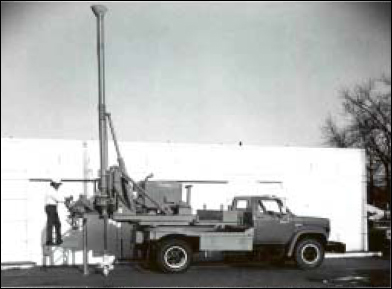
STERLING MODEL, "B-7" Earth Boring Machine with Standard Pole Setter, Hydraulic Winch,
240° Turntable Fore & Aft Platform, Stiffleg. GMC Chassis with Hydraulically Driven Front End Winch.
Figure #1. This is not the truck-mounted auger that was used in this operation, but it
is an example of this type of equipment. Notice the operator platform at the rear.
1 Grab tensile strengths are from specification sheets for Dupont SF 65 Style geotextile and Dupont Seed Bed Covers. ASTM D4632-91-1966 Standard Test Method for Grab Breaking Load and Elongation of Geotextiles. (http://www.greenvista.dupont.com/pdf/DuPont_Seed_Bed_Cover.pdf, http://www.typargeo.com/pdf/kintex_dupont_sf_styles.pdf)
Competent person means one who is capable of identifying existing and predictable hazards in the surroundings or working conditions which are unsanitary, hazardous, or dangerous to employees and who has authorization to take prompt corrective measures to eliminate them.