
- U.S. Department of Labor
- Occupational Safety and Health Administration
- Directorate of Technical Support and Emergency Management
- (formerly Directorate of Science, Technology & Medicine)
- Office of Science and Technology Assessment
Preventing the Uncontrolled Release of Anhydrous Ammonia at Loading Stations
Safety and Health Information Bulletin
SHIB 12-05-05
Preface
Recent fatalities during releases at anhydrous ammonia loading stations illustrate the potential hazards associated with transfer operations if the transfer system is not adequately protected from hose severance or an inadvertent pull-away during transfer. Anhydrous ammonia storage facilities and nurse tank loading stations are considered anhydrous ammonia systems and are covered by a variety of Federal, State, and consensus standards. The most recent American National Standards Institute (ANSI) standard for storage and handling of anhydrous ammonia (K61.1 - 1999) and several State regulations include provisions that specifically address hose severance and pull-away protection. This Safety and Health Information Bulletin highlights these provisions and illustrates their use in complying with existing Federal Occupational Safety and Health Administration (OSHA) standards that cover anhydrous ammonia systems. These standards include 29 CFR 1910.111, Storage and handling of anhydrous ammonia [1] and 29 CFR 1910.119, Process Safety Management (PSM) standard. [2]
Purpose
The purpose of this Safety and Health Information Bulletin (SHIB) is to increase awareness about:
- the potential for an uncontrolled anhydrous ammonia release during transfer operations at loading stations and other anhydrous ammonia systems/processes without certain safety mechanisms, and
- examples of devices, work practices, and training that employers and employees can use to eliminate or reduce the likelihood of these incidents.
Background
OSHA's Bismarck, North Dakota Area Office recently investigated an anhydrous ammonia release at a loading station in a grain handling facility. The release occurred when an employee pulled a nurse tank away from a fixed storage installation with transfer hoses still attached. Because the loading risers were not equipped with excess flow valves to limit the uncontrolled release of anhydrous ammonia, approximately four (4) tons of anhydrous ammonia were released. As a result of the release, a grain facility employee driving the truck and a customer were hospitalized. The customer died while in the hospital.
Applicable OSHA Standards
The loading station involved in the investigation and other systems where anhydrous ammonia is used or stored are covered by OSHA's Storage and handling of anhydrous ammonia standard (29 CFR 1910.111) provided they are not ammonia manufacturing plants or refrigeration plants where ammonia is used solely as a refrigerant. If the system contains more than 10,000 pounds (lbs.) of anhydrous ammonia it would be covered by OSHA's Process Safety Management (PSM) standard (29 CFR 1910.119). Although the loading station investigated was not part of a larger system or process and it did not involve sufficient anhydrous ammonia to be covered by PSM, many similar facilities may be covered by 29 CFR 1910.119 depending on the amount of anhydrous ammonia contained in the process.
OSHA's Storage and handling of anhydrous ammonia standard generally requires that all transfer systems include certain types of protective devices. Paragraph (b)(12)(vii) states:
"Loading and unloading systems shall be protected by suitable devices to prevent the emptying of the storage containers in the event of severance of the hose. Backflow check valves or properly sized excess flow valves shall be installed where necessary to provide such protection. In the event that such valves are not practical, remotely operated shutoff valves may be installed." [1]
As a performance standard, 29 CFR 1910.111(b)(12)(vii) does not state where the devices must be installed, only that once installed the devices will prevent the emptying of a container if hose severance should occur.
OSHA's Process Safety Management standard includes several general requirements that pertain to transfer system equipment. Paragraphs (d)(3)(ii) and (iii) state:
"The employer shall document that equipment complies with recognized and generally accepted good engineering practices.
For existing equipment designed and constructed in accordance with codes, standards, or practices that are no longer in general use, the employer shall determine and document that the equipment is designed, maintained, inspected, tested, and operating in a safe manner." [2]
The employer must first identify the "recognized and generally accepted good engineering practices" and then ensure that his/her equipment is compliant. "Recognized and generally accepted good engineering practices" can include Federal, State or local government requirements, national consensus codes and standards such as ANSI K61.1, recommended practices from trade associations such as the American Petroleum Institute (API), Center for Chemical Process Safety (CCSP) guidelines, corporate/facility standards/policies, insurance company reports, and others. If the system was built under an older code, then the employer must determine the best way to document that it still operates safely. Even if the transfer system is not a PSM-covered "process," the requirements in the PSM standard and the recommendations in this SHIB can assist the employer in effectively managing and implementing measures that will protect employees during transfer operations at all anhydrous ammonia systems, including loading stations.
Other Standards
North Dakota and many other States have adopted ANSI K61.1 (1989 or 1999). The most recent version of ANSI K61.1 (1999) and the North Dakota regulations (as amended in 2004) include language that may be useful to employers in understanding and complying with 29 CFR 1910.111. These standards may also need to be evaluated by employers as "recognized and generally accepted good engineering practices" for compliance with 29 CFR 1910.119. ANSI K61.1 (1999) includes general provisions for the protection of all covered systems in Section 5.10 Basic Rules, Transfer of Liquids. The provisions in 5.10.8 include:
- Suitable back-flow check valves in loading lines for non-refrigerated containers.
- Suitable in-line excess flow valve in unloading lines for non-refrigerated containers.
- Pipe sizing that does not restrict flow rates.
- Emergency shutoff or backflow check valves in liquid and vapor fixed piping of transfer system within 5 ft. or a reasonable distance from where hose/swivel piping is attached to fixed piping (stationary storage systems > 4000 gal.). Installed so that a break due to pull-away will occur on hose or swivel type piping side (not fixed piping side). This may be accomplished by using a bulkhead or equivalent anchorage, or by using breakaway/ shear fittings.
- Emergency shutoff valve with manually activated shutoff from a remote location and at the installed location. [3]
These provisions address hose severance and provide protection for other system/process components during pull-away incidents.
In response to the incident in Bismark, the North Dakota Department of Agriculture modified the State regulation so that it would include clear provisions for protective systems to prevent releases from severance of hoses and other system components during pull- away incidents. The North Dakota regulation now includes the following provisions in section 7-12-01-05.3:
- Approved bulkheads or breakaways, or both at nurse tank fill stations. Emergency shutoff valves must be in place in liquid and vapor piping before the bulkhead or breakaway, or both. Approved cables must be connected to the emergency shutoff valves and these cables can be activated both at the valves and at a remote location. Breakaway action will close the valves.
- Approved bulkheads and breakaways at truck unloading stations. Emergency shutoff valve on the vapor piping on system side of the bulkhead and a back-check valve installed on the liquid piping on the system side of the bulkhead. Approved cables must be connected to the emergency shutoff valve and these cables must be activated both at the valve and at a remote location.
- Excess flow protection for nurse tank filling station risers:
- For facilities using bulkheads with emergency shutoff valves below the bulkhead - install the required excess flow valves integral with the riser shutoff valves or as in-line excess flow valves.
An approved installed location cable must be used between the emergency shutoff valve actuator and the riser shutoff valve. - For facilities using breakaway devices with positive closure - install excess flow valve integral with the riser shutoff valve or as approved in-line excess flow valve installed prior to the positive closure device.
- Installer must verify operation of any excess valve covered. [4]
- For facilities using bulkheads with emergency shutoff valves below the bulkhead - install the required excess flow valves integral with the riser shutoff valves or as in-line excess flow valves.
Other States that identify similar types of protection include Illinois and Minnesota. [6, 7]
Figure 1 shows a transfer system with the protection devices identified in the North Dakota regulation and recommended in the ANSI standard:
- excess flow valves are located in the "riser" integral with shutoff.
- risers are anchored through a bulkhead and have emergency shutoff valves below the bulkhead.
- a location cable runs between the emergency shutoff valve actuator and the riser shutoff valve.
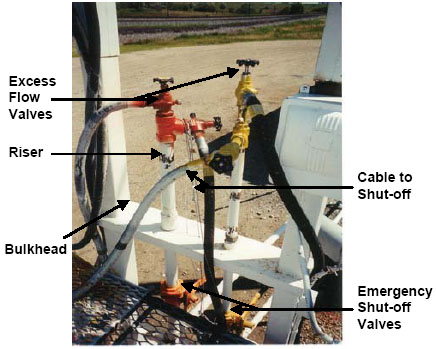
Figure 1
The excess flow valve protects against the emptying of the storage tank if the hose is severed. During a severance, the pressure differential would result in a release from the tank through the piping. If the flow in the pipe exceeds a predetermined level, the valve is triggered and will automatically close. The piping around the excess flow valve must be large enough to ensure that the valve will close when needed. A smaller diameter pipe will provide more resistance to the flow, potentially reducing the flow rate below the actuation rate of the valve. The diameter of the pipe and the excess flow valve must be matched accordingly. The bulkhead provides protection to the risers during a pull-away, and the cable ensures that the emergency shutoff is triggered if the top portion of the riser is dislodged or severed during a pull-away.
Figure 2 shows an example of a loading platform from bulk storage. Nurse tanks can be loaded from both sides of the platform simultaneously.
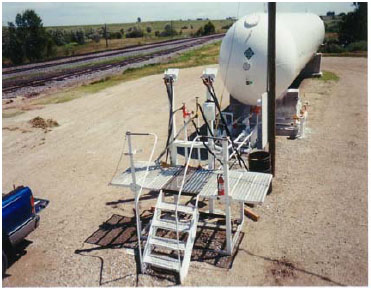
Figure 2
Figure 3 shows a breakaway device that may be used in place of the protection offered by the bulkhead and location cable. It is a quick release device that uncouples during a pull-way to protect the hoses and risers. The breakaway device includes double backflow check valves to minimize the release of anhydrous ammonia when it breaks away. It is not sensitive to the direction of the pull-way and is similar to the device used on pumps at gas stations.
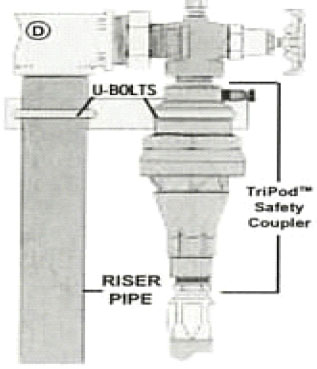
Figure 3
In addition to provisions that specifically address protective devices, OSHA and ANSI standards, and the North Dakota regulation identify work practices and protective equipment for use during transfer operations, equipment for use on vehicles transporting anhydrous ammonia, and training that can provide additional protection for workers conducting transfer operations at loading stations and other anhydrous ammonia systems/processes.
Recommendations
- Determine if the loading station or other anhydrous ammonia system is covered by the PSM standard. If it is, then many of the following recommendations are also required under the PSM standard. [2] If not, implementing the following recommendations will provide additional protection to workers during anhydrous ammonia transfer operations.
Protective Devices
- Identify appropriate "recognized and generally accepted good engineering practices" that address protection for hose severance and vehicle pull- away. Several alternatives are described in the Other Standards section of this SHIB, above. [2]
- Based on selected and documented "recognized and generally accepted good engineering practices," evaluate, select, and install a combination of protective devices that protect the entire system, including the risers, during pull-away incidents. Several alternatives are described in the Other Standards section of this SHIB, above.
Work Practices and Equipment Design
- Document the applicable codes and standards used for equipment in the process, including the transfer station equipment. This is one of the first steps in managing the equipment integrity of the process. [2]
- Document that the equipment in the loading station and other areas of the process comply with applicable "recognized and generally accepted good engineering practices." [2]
- Conduct a process hazard analysis and identify, evaluate, and control the hazards associated with the entire system/process. [2]
- Develop written operating procedures that include step-by-step procedures for transfer and a checklist that must be completed for each transfer. These should be used during training to establish competency (see, training requirement, below). [2, 9]
- Inspect, test, and maintain all system/process equipment, including the protective devices installed to prevent releases during hose severance and pull-away incidents. Include this information in the written standard operating procedures. [2]
- Ensure that an attendant is physically present throughout the entire transfer operation. Assure that a qualified operator, experienced in the procedures, is present from the time the connections are first made until they are finally disconnected. [1, 3, 4, 9]
- Chock/block all vehicles involved in transfer operations; make removing the chock/block the last step when shutting down operations and getting ready to allow a vehicle to pull away.
[1,3,4] - Require that the attendant conduct a walk-around inspection once transfer is completed. Attendant should walk around tanks and storage containers and ensure that hosing has been uncoupled and secured and that all steps of the transfer operation are complete. [4]
- Manage any changes in the system/process to ensure that any new hazards introduced by the changes are identified, evaluated and controlled. Also, any subsequent changes to the process will then have documentation showing the history of the equipment which evaluators can use to determine the technical basis for subsequent changes and the safety and health impacts of those changes. [2]
- Develop and implement an emergency action plan for the facility and include procedures for handling small releases. The requirements of this type of plan are detailed in OSHA's Emergency Action Plans standard 29 CFR 1910.38 and Hazardous Waste Operations and Emergency Response (HAZWOPER) standard 29 CFR 1910.120. [2]
- Perform a pre-start-up safety review for new and modified facilities to assure that the design and construction is in accord with the design specifications. Note: The design specifications should comply with "recognized and generally accepted good engineering practices." [2]
- Check and inspect to assure that the equipment in the process, including the transfer station, are installed properly and consistent with design specifications and the manufacturer's recommendations. [2]
- The PSM standard includes other elements related to mechanical integrity, incident investigation, and compliance audits that should be reviewed and implemented as necessary. These elements are mandatory for systems that are covered by the PSM standard. [2]
Personal Protective and Other Equipment
- Select and provide personal protective equipment that will adequately protect employees during routine transfer operations and anticipated emergencies. At a minimum, the following should be easily accessible during an emergency: gloves, protective slicker or protective pants and jacket (impervious to ammonia); goggles and/or face shield; and full-face respiratory protection with appropriate cartridges. A Self-Contained Breathing Apparatus (SCBA) may be required if there is potential for entry into an atmosphere that contains ammonia concentrations in excess of the immediately dangerous to life or health (IDLH) value. [1, 3, 4]
- Install, inspect, and maintain easily accessible emergency shower and plumbed eyewash or at least 150 gal. of clean water in an open top container. [1, 3]
Training
- Provide initial training to any person required to handle, transfer, transport, or otherwise work with ammonia in the system/process. Training should enable the employees to understand the hazards of the process, properties of ammonia and the system/process, become competent in safe operating practices, and to take appropriate actions during an incident. [2, 3, 4, 9]
- Conduct refresher training annually. [3, 4]
Conclusion
As illustrated by the investigation in Bismark, even though OSHA requires that employers provide suitable protection from anhydrous ammonia releases due to hose severance, the Agency still continues to investigate serious accidents involving these types of releases. In addition to the requirements identified by OSHA in 29 CFR 1910.111 and 29 CFR 1910.119, the ANSI K61.1 standard and the recently revised North Dakota Anhydrous Ammonia regulation identify additional steps that employers can take to provide protection during hose severance and vehicle pull- away. Employers are encouraged to review these and other applicable standards, install the protective devices recommended, develop and implement appropriate work practices, and provide the training identified to ensure that employees are protected during transfer operations.
References/Resources
- Occupational Safety and Health Administration. 29 CFR 1910.111, Storage and Handling of Anhydrous Ammonia.
- Occupational Safety and Health Administration. 29 CFR 1910.119, Process Safety Management (PSM).
- American National Standards Institute. ANSI K61.1 "American National Standard Safety Requirements for the Storage and Handling of Anhydrous Ammonia." Arlington, VA: Compressed Gas Association. 1999.
-
North Dakota Department of Agriculture. "Anhydrous Ammonia Regulation, Chapter 7-12-01, Anhydrous Ammonia Standard . http://www.agdepartment.com/PDFFiles/AARULES-REGS-Amended10-2004.pdf."
- Occupational Safety and Health Administration. "Recommendation for Issuance of a National Hazard Alert on Anhydrous Ammonia (NH3) Operations." Memorandum. September 5, 1980.
- Illinois Department of Agriculture, "Anhydrous Ammonia, Equipment, Containers, and Storage Facilities" (Part 215).
-
Minnesota Department of Agriculture, Application for Permit to Install Anhydrous Ammonia Storage. http://www.mda.state.mn.us/appd/nh3/instructions.htm
- OSHA's online Ammonia Refrigeration e-Tool: Plant Safety - Self Inspection Checklist. Though refrigeration plants where ammonia is used solely as a refrigerant are not covered under 29 CFR 1910.111, this checklist is a useful summary of the types of emergency equipment and placarding that should be present for anhydrous ammonia systems.
- Department of Transportation (DOT) HM-225A: Transportation and Unloading of Liquefied Compressed Gases. http://hazmat.dot.gov/regs/rules/final/97_2718_4.htm
-
Environmental Protection Agency. 40 CFR Part 68, Accidental Release Prevention Requirements: Risk Management Programs Under the Clean Air Act, Section 112(r)(7). http://yosemite.epa.gov/oswer/ceppoweb.nsf/content/caa112r.htm#Regulation
-
Environmental Protection Agency. General Guidance for Risk Management Programs (40 CFR Part 68). http://yosemite.epa.gov/oswer/ceppoweb.nsf/content/EPAguidance.htm
-
Environmental Protection Agency. Guidance for Implementation of the General Duty Clause: Clean Air Act Section 112(r). http://yosemite.epa.gov/oswer/ceppoweb.nsf/vwResourcesByFilename/gdcregionalguidance.pdf/$File/gdcregionalguidance.pdf.