|
Hot Work (including Welding, Cutting and Heating) » Hot Work in Confined Spaces
|
In addition to the requirements and recommendations for working in enclosed spaces and due to the unique hazards associated with hot work in confined spaces, the following controls are required:
Note: During shipbuilding operations, the need for testing by a SCP and CMC will depend on the progress of the vessel construction. Until there is a potential for a hazard, such as after the introduction of flammable liquids, testing may not be required.
Also, the module outlining the requirements for Hot Work in Enclosed Spaces should be reviewed before reviewing this module.
Note: Confined space entry is one of the leading hazards associated with barge cleaning. Review the Shipbuilding: Confined or Enclosed Spaces and Other Dangerous Atmospheres chapter for information on how to protect workers from this hazard.
| Hot Work Operations in Confined Spaces |
Potential Hazards:
Due to the isolation and difficulty of egress, hot work
operations in confined spaces present additional hazards. These
include:
- Impeded egress from the space under emergency conditions.
- Delayed treatment of injured workers..
Requirements and Example Solutions:
- Provide, if possible, more than one means of access to
the space. [29 CFR 1915.76(b)]
- Keep access to the space clear. [29 CFR 1915.51(c)]
- Make frequent checks to ensure the safety of employees
working alone in a confined space. [29 CFR 1915.94]
 Back to Top Back to Top |
| Fall Hazards |
Potential Hazards:
Fall hazards are a leading cause of shipyard fatalities.
Shipyard employees are often required to work in dangerous
environments that may include fall hazards. Accidents involving
elevation equipment such as ladders, scaffolds, and aerial lifts are often serious,
even fatal. Workers also risk falls from opening in decks and unguarded edges.
Requirements and Example Solutions:
Guarding of Deck Openings and Edges
- Openings and deck edges must be guarded. [29 CFR1915.73]
- Flush manholes and other small openings must be guarded after opening. [29 CFR 1915.73(b)]
- During the installation of guards on large openings and deck
edges, fall protection (harness with lanyard) must be used. [29 CFR 1915.73(d)]
- When floor plates or gratings (e.g. bilges, engine rooms,
pump rooms, machinery spaces) are removed, the openings must
be guarded or planked. [29 CFR 1915.73(f)]
Fall Protection for Scaffold Work
- Guardrails or other appropriate fall protection must be
used when working on scaffolds 5 feet above surfaces. [29 CFR 1915.71(j)]
- During the installation of guards on scaffolds, fall
protection must be used. [29 CFR 1915.73(d)]
- Maritime Labor/Industry recommends that personal fall protection including
lanyards and harnesses be used and secured during installation
of guardrails.
Back to Top |
| Fire Prevention Requirements |
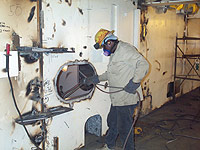
Figure 3: Removal of torches and hoses.
Because confined spaces have little natural ventilation,
flammable gases may accumulate to hazardous levels, even when
unoccupied, exposing workers to risk of fire or explosion upon
re-entry.
Requirements and Example Solutions:
Work in confined spaces requires certain restrictions
regarding what equipment can be taken inside and what
equipment can be left inside when unoccupied.
- Torches and hoses must be removed from confined spaces
when not in use (lunch breaks, shift changes, etc.). [29 CFR 1915 Subpart P]
- Oxygen and fuel gas cylinders must not be taken into
confined spaces. [29 CFR 1915.55(b)(4)]
- For additional requirements, see the
Fire Protection
chapter.
Back to Top |
| PPE Requirements |
Potential Hazards:
Due to the difficulty of providing
adequate ventilation to protect workers, personal protective equipment
requirements, especially
respiratory protection, are extremely restrictive when performing
hot work in confined spaces.
Requirements and Example Solutions:
The
following are specific requirements for PPE during hot work
operations in confined spaces.
- Use airline respirators when access to the space is
blocked. [29 CFR 1915.51(c)(3)]
- Use airline respirators when welding on beryllium-containing base or filler metals. [29 CFR 1915.51(d)(2)(iv)]
- Use PPE in accordance with requirement for hot work in
enclosed spaces if not superseded by the above
requirements. [29 CFR 1915.51(d)]
For more specific information, see PPE Selection: Hot Work.
Back to Top |
|
|
|
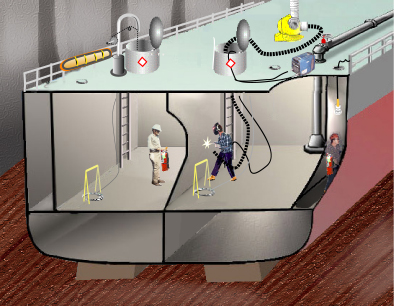 Figure 1: Hot Work in Enclosed Spaces. Also see: