|
Hot Work (including Welding, Cutting and Heating) » Hot Work in Enclosed Spaces
|
| Hot Work Operations |
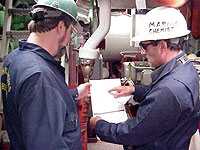
Figure 2: Reviewing of Marine Chemist
Certificate.
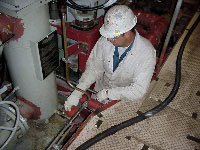
Figure 3: Removing of flammable and
combustible material.
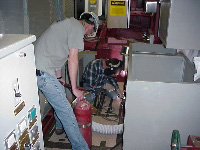
Figure 4: Fire watch.
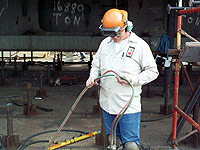
Figure 5: Inspecting welding
equipment.
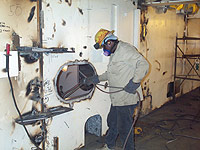
Figure 6: Leak test.
Potential Hazards:
Workers performing hot work or working in spaces adjacent to
hot work are exposed to the following risks:
- Fire and explosions caused by flammable or combustible
materials or airborne gases, vapors, and particulates
- Toxic gases and metal fumes produced from the hot
operations (such as nitrogen oxides, and lead fumes)
- Ultraviolet radiation from electric arcs
Requirements and Example Solutions:
Before beginning hot work, the following tasks must be
performed:
Remember:
When hot work is being performed, it is the employers'
responsibility to ensure that precautions are taken in
adjacent spaces. [29 CFR 1915
Subpart P]
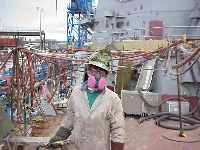
Figure 7: Burner wearing
respirator, tinted face shield and leather gloves.
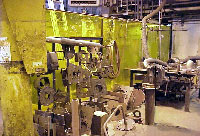
Figure 8: Welding UV screens.
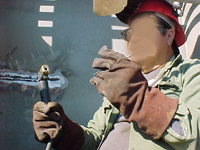
Figure 9: Welding torch.
|
| Inspection and Tests to Maintain Safe Conditions |
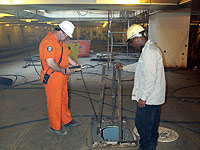
Figure 10: Inspection to maintain safe
conditions.
Potential Hazards:
When the work space is initially inspected by a Certified Marine
Chemist (CMC) or a Shipyard Competent Person (SCP), conditions may change during
work. The Shipyard Competent Person must inspect the hot work area as often as
necessary. If the Shipyard Competent Person discovers a change that could adversely alter
safe conditions (such as a missing fire watch,
ventilation failure, piping system leak, or hazardous materials spill),
work must be stopped. Work may not be resumed until the affected space is
visually inspected and re-evaluated (by a Marine Chemist, if a marine
chemist certificate was issued) to meet requirements. [29 CFR 1915.15(f)]
Requirements and Example Solutions:
Examples of items that can change conditions
include:
-
Temperature changes: increased or decreased temperatures affect flammable and toxic vapor levels.
-
Type of work in tank: leaking torches, use of cleaning solvents, and
removal of tank residue ("mucking out") may alter
atmosphere.
-
Unattended tanks or spaces: if a period of time has elapsed, it is recommended that spaces be retested before re-entry and continuation of work.
[29 CFR 1915 Subpart A and Subpart B]
-
Ballasting or trimming: changing the
position of the vessel could release hazardous materials into a space or
compartment.
-
Ventilation changes: ventilation duct damage or fans not in use.
- Maritime Labor/Industry recommends that tests before re-entry and continuation of
work in unattended tanks and spaces should be conducted at the
beginning of the shift and then at least every 24 hours.
 Back to Top Back to Top |
| Fall Hazards |
Potential Hazards:
Fall hazards are a leading cause of shipyard fatalities.
Shipyard employees are often required to work in dangerous
environments that may include fall hazards. Accidents involving
elevation equipment such as ladders, scaffolds, and aerial lifts are often serious,
even fatal. Workers also risk falls from open deck edges.
Requirements and Example Solutions:
Guarding of Deck Openings and Edges
- Openings and deck edges must be guarded. [29 CFR1915.73]
- Flush manholes and other small openings must be guarded after opening. [29 CFR 1915.73(b)]
- During the installation of guards on large openings and deck
edges, fall protection (harness with lanyard) must be used. [29 CFR 1915.73(d)]
- When floor plates or gratings (e.g. bilges, engine rooms,
pump rooms, machinery spaces) are removed, the openings must
be guarded or planked. [29 CFR 1915.73(f)]
Fall Protection for Scaffold Work
- Guardrails or other appropriate fall protection must be
used when working on scaffolds 5 feet above surfaces. [29 CFR 1915.71(j)]
- During the installation of guards on scaffolds, fall
protection must be used. [29 CFR 1915.73(d)]
- Maritime Labor/Industry recommends that personal fall protection including
lanyards and harnesses be used and secured during installation
of guardrails and erection and dismantling of scaffolds.
Back to Top |
| Ventilation Requirements |
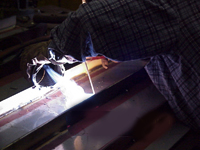
Figure 11: Local exhaust ventilation being
properly used.
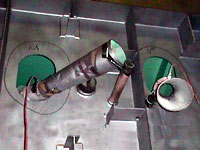
Figure 12: Air movers provide general
ventilation to confined spaces.
Potential Hazards:
Workers performing hot work operations are exposed to toxic gases and metal
fumes (such as nitrogen oxides, zinc, or iron oxide fumes) that may cause
occupational illnesses.
Requirements and Example Solutions:
Ventilation removes or dilutes metal fumes and gases generated by hot work.
The following ventilation requirements must be met:
Back to Top |
| Fire Prevention Requirements |
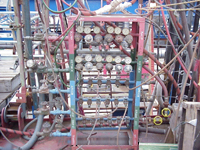
Figure 13: Typical gas manifold.
Figure 14: Fire watch.
Potential Hazards:
Workers performing hot work in enclosed spaces are exposed to the risk of
fires from ignition of flammable or combustible materials in the space and
from leaks of flammable gas into the space from hot work equipment.
Requirements and Example Solutions:
Fires caused by hot work in enclosed spaces can be prevented with the following
precautions:
Note:
When hot work is being performed, it is the employers'
responsibility to ensure that precautions are taken in
adjacent spaces. [29 CFR 1915
Subpart P]
Back to Top |
| PPE Requirements |
Figure 15: Respiratory protection.
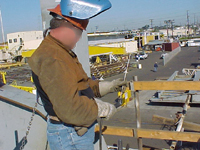
Figure 16: Welding PPE.
Injury and illness may be caused by hot work (such as welding fumes, UV
light, sparks, noise, skin injury, etc.).
Example Solutions:
Personal protective equipment is used during hot work to protect workers. A PPE program consists of the following:
For more specific information, see PPE Selection: Hot Work.
Back to Top |
|
|
|
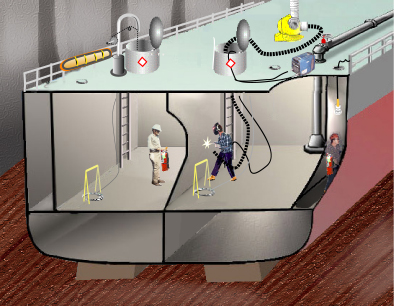 Figure 1: Hot Work in Enclosed Spaces. Also see: