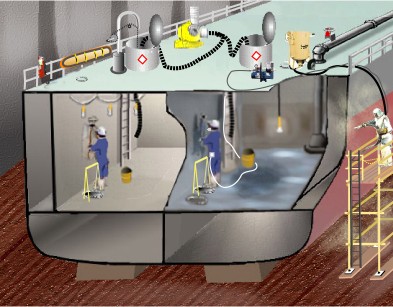
Figure 1: Illustrates the variety of painting
and coating operations during shipbuilding. |
Paints and other preservative coatings may contain toxic and flammable materials such as hydrocarbon solvents (e.g., Toluene and Methyl Ethyl Ketone [MEK]), epoxy resins, and anti-fouling paints. Surface coating applications may release large quantities of these materials into the air, causing possible fire and explosion hazards as well as toxic inhalation and skin absorption hazards.
Note: Confined space entry is one of the leading
hazards associated with barge cleaning. Review the Shipbuilding: Confined/Enclosed Spaces and Other Dangerous Atmospheres and Hot Work Operations chapters for information on how to protect workers from this hazard.
Coating applications may expose workers to the following hazards:
Note: Confined space entry is one of the leading
hazards associated with barge cleaning. Review the Ship Repair: Confined/Enclosed Spaces and Other Dangerous Atmospheres chapter for information on how to protect workers from this hazard.
|
Fire and Explosion Hazards |
Potential Hazards:
Fire and explosion hazards associated with paint and coating
applications depend upon the flashpoint and volatility of the substance. Lower
flashpoint liquids (less than 80º F) present greater hazards and
require additional controls.
Requirements and Example Solutions:
The following control requirements and hazard solutions have been
separated into two categories:
- Liquids/substances with flashpoints above 80º F.
- Liquids/substances with flashpoints below 80º F.
Liquids/substances with flashpoints 80º F and above
- Hot
work must not be performed in the space or adjacent
spaces during painting operations. [29 CFR 1915.36(a)(1) and 29 CFR 1915 Subpart P]
- Rags soaked with solvents must be kept in covered metal
containers. [29 CFR 1915.36(a)(3)
and 29 CFR 1915.81(a)(5)]
- Paints, thinners, and solvents must be kept in
fire-resistant covered containers when not in use. [29 CFR 1915.81(a)(5)]
- Smoking and open flames must be prohibited in the area. [29 CFR 1915.36(a)(1)]
- Arcing and sparking equipment and tools must not be used.
[29 CFR 1915.36(a)(1)]
- Equipment that may generate static electricity (e.g., ventilation systems) must be grounded/bonded. [29 CFR 1915.35(a)(4)]
- Only explosion-proof lights must be used. [29 CFR 1915.36(a)(4)]
- Adequate ventilation must be maintained in storage,
mixing, and transfer areas. [29 CFR 1915.36(a)(2)]
- Frequent tests by a Shipboard Competent Person (SCP) must be required during painting
operations to determine if air concentrations are below 10
percent of
the lower exposure limit (LEL). [29 CFR 1915.36(a)(2)]
- Suitable fire fighting equipment must be immediately
available. [29 CFR 1915.36(a)(6)]
- 30-gallon drums and containers of flammable or toxic
liquids must be placed in an area where they will not be
subject to physical damage. [29 CFR 1915.173(d)]
- 55-gallon drums containing flammable or toxic liquids must
be surrounded by dikes or pans. [29 CFR 1915.173(e)]
- Power and lighting cables must be inspected by a person
competent to evaluate electrical hazards and ensure there are no
connections within 50 feet of the painting operations (not necessarily the
Shipyard Competent Person). [29 CFR 1915.36(a)(5)]
- Spills of solvents should be cleaned up immediately.
Liquids/substances with flashpoints below 80º F
When paints and tank coatings are dissolved in highly
volatile, flammable solvents with flash points below 80º F,
the following additional precautions must be taken:
-
Sufficient exhaust ventilation must be provided
to keep the concentration of solvent vapors below 10 percent of the LEL. Frequent tests must be made by
a shipyard competent person (SCP) to determine concentrations. [29 CFR 1915.35(b)(1)]
-
If the concentration exceeds 10 percent of
the LEL, work must be stopped until the concentration falls below 10
percent of the LEL. [29 CFR 1915.35(b)(2)]
-
Ventilation must be continued after painting is
complete until the space or compartment is "gas-free." [29 CFR 1915.35(b)(3)]
-
Exhaust ducts must discharge clear of working
areas and away from sources of possible ignition. [29 CFR 1915.35(b)(4)]
-
Periodic tests must be conducted by the Shipyard
Competent Person to ensure the exhausted vapors are not
accumulating in other areas within or around the vessel or dry dock.
[29 CFR 1915.35(b)(4)]
-
Explosion-proof motors, fan blades, and portable air ducts
must be non-ferrous. [29 CFR 1915.35(b)(5)]
-
All footwear worn during painting operations must be
non-sparking. [29 CFR 1915.35(b)(9)]
-
PPE must not produce static electrical sparks. [29 CFR 1915.35(b)(9)]
-
No matches, lighted cigarettes, cigars, pipes, cigarette lighters, or
other ferrous articles are allowed into
the work area. [29 CFR 1915.35(b)(10)]
-
All solvent drums taken into the compartment where
painting operations are being performed must be placed on
nonferrous surfaces and grounded to the vessel. [29 CFR 1915.35(b)(11)]
-
All metallic parts of paint spraying equipment
must be electrically grounded and the assembly grounded to the vessel. [29 CFR 1915.35(b)(12)]
|
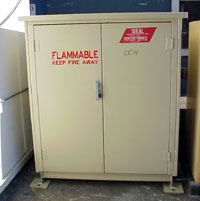
Figure 1: Storage locker for proper storage of flammable paints and thinners.
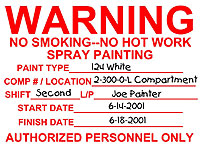
Figure 2: Warning sign - No Smoking, No Hot Work.
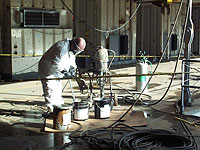
Figure 3: Paint mixing in an outside well ventilated area.
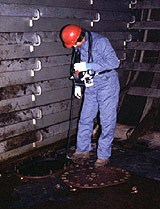
Figure 4: Shipyard Competent Person testing for flammability.
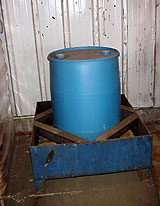
Figure 5: 55-gallon drum of flammable liquid in a leak-protected pan.
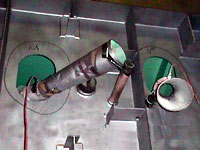
Figure 6: Air movers for ventilating paint area.
Figure 7: Shipyard Competent Person testing other area for flammability.
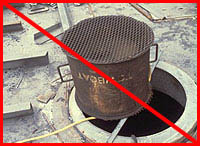
Figure 8: Improper practice: ventilation equipment for flammable painting. |
 Back
to Top Back
to Top |
|
|
|
Respiratory Hazards |
Potential Hazards:
Toxic vapors and mists from paints and paint solvents may present significant health hazards
due to inhalation during painting operations. These vapors may
accumulate in low-lying areas as well as enclosed spaces where they displace the air and lower the oxygen
content.
Requirements and Example Solutions:
- A hazard assessment must be conducted to determine the
proper selection of respirators. [29 CFR 1915.152(b)]
- The components of epoxy, isocyanate, anti-fouling, and coal tar pitch
paints may be particularly dangerous to workers'
health and call for special
precautions.
- Many of these paints cause respiratory and skin
sensitization and allergic reactions, which may be life
threatening.
- Respirators must be used in accordance with the PPE
section 29 CFR 1915.154. [29 CFR 1910.134]
When paints are mixed with toxic vehicles or when solvents are
sprayed the following respiratory protection
procedures are required:
- Continual Air Monitoring
- The Shipyard
Competent Person (SCP), Certified Marine Chemist
(CMC), or
Certified Industrial Hygienist (CIH) may require continual monitoring to
determine that vapor/mist air concentrations are within the permissible exposure limit (PELs) and below immediately dangerous to life or health (IDLH)
levels while workers are in the area.
- If the concentrations are above appropriate levels, additional
administrative controls (e.g., exposure time limits),
engineering controls (e.g., ventilation), or PPE (e.g.,
respirators) are required.
- Use of Airline Respirators
- Airline respirators are required in confined spaces to
protect employees who
are continuously exposed to toxic materials during coating
operations. [29 CFR 1915.35(a)(1)(i)]
- Airline respirators are required in enclosed spaces to
protect workers when
mechanical ventilation is not provided, [29 CFR 1915.35(a)(1)(ii)]
or when the flash point of the paint or solvent is less than 80º F. [29 CFR 1915.35(b)(13)]
- Use of Air Purifying Respirators (Filter Respirators)
- In tanks and compartments where mechanical ventilation is
provided, employees continuously exposed must be protected by
filter respirators, at a minimum; in accordance with Subpart I (29 CFR 1915.154). [29 CFR 1915.35(a)(1)(ii)]
- In large and well-ventilated areas, employees exposed to spray
painting must be protected by filter respirators in accordance
with Subpart I (29 CFR 1915.154). [29 CFR 1915.35(a)(1)(iii)]
- All employees doing exterior spray painting with material containing solvents with flash points below 80º F
must be
protected by suitable filter cartridge-type respirators, at a
minimum; in accordance with Subpart I (29 CFR 1915.154). [29 CFR 1915.35(b)(14)]
- Employees entering compartments where
spray painting is being done with paints containing solvents
with a flash point below 80º F, for a limited time, must be protected with filter
cartridge type respirators, at a minimum; in accordance with
Subpart I (29 CFR 1915.154). [29 CFR 1915.35(b)(13)]
When coatings are applied by non-spray methods, the
following respiratory protection procedures are required:
- Air Purifying Respirators (Filter Respirators).
- when brush application of paints containing toxic solvents is done in
confined spaces or in other areas where lack of ventilation creates
a hazard, filter respirators at a minimum in accordance with Subpart I (29 CFR 1915.154). [29 CFR 1915.35(a)(2)]
Additional Resources:
|
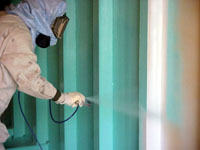
Figure 9: Worker protected from toxic paint vapors by air-line respirator.
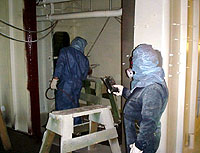
Figure 10: SCP doing air monitoring during spray painting.
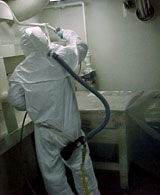
Figure 11: Worker using full body suit with airline respirator in enclosed space.
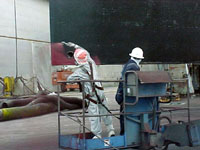
Figure 12: Worker protected by filter respirator during spray painting hull. |
|
Back
to Top |
|
|
|
Contact with Paint and Paint Solvents |
Potential Hazards:
Employees working with paint or paint solvents containing
toxic or corrosive materials are
at risk if skin or eye contact occurs. Precautions must
be taken to prevent such contact in order to avoid:
- Organ damage through chemical absorption through the skin or eyes;
- Chemical burns, irritation, sensitization, and allergic
reaction to skin or eyes; and
- Ingestion of food contaminated with toxic materials due to
poor hygiene.
Requirements and Example Solutions:
- A hazard assessment for each job and condition must be
conducted to determine proper
selection of PPE. [29 CFR 1915.152(b)]
This assessment should include:
- The nature of the hazardous materials involved;
- Anticipated concentrations of the materials;
- How the materials will be used;
- Performance of the PPE; and
- Actions workers will perform.
- All body parts, including face, eyes, head,
and hands must be protected from highly volatile paints. [29 CFR 1915.35(b)(9)]
- Spills or other releases of painting materials should be cleaned up as
soon as possible.
- Washing facilities (such as facilities for quick-drenching of the eyes and body) must be available in case employees
have skin contact with paint and paint solvents that may be
absorbed through the skin. [29 CFR 1915.88(e) and 29 CFR 1915.151(c)]
- Workers must be trained about potential hazards involved with the
materials they work with, as well as precautions; in
accordance with Hazard
Communication Standard. [29 CFR 1915.1200]
Additional Information
|
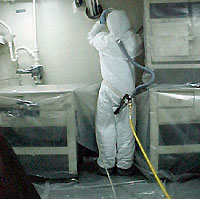
Figure 13: Worker using proper PPE for spray painting.
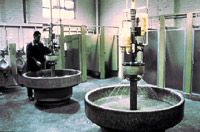
Figure 14: Washing facilities for clean up.
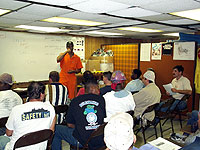
Figure 15: Workers receiving training on potential hazards and solutions. |
|
|
Maritime
Labor/Industry Recommendations |
- Fixed or portable eye wash stations/safety showers should
meet ANSI Z358.1-1998: Emergency Eye Wash and Shower
Equipment.
|
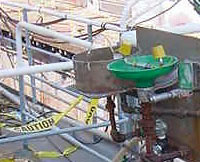
Figure 16: Eye wash station. |
|
Back
to Top |
|
|
|
|
Slips and Trips |
Potential Hazards:
Workers performing painting operations are exposed to slippery conditions
and tripping hazards. Workers are at risk of:
- Slipping off oily and greasy ladders;
- Slipping and falling on oily decks;
- Tripping over equipment, hoses, and vessel structures; and
- Slipping on freshly painted surfaces.
Requirements and Example Solutions:
|
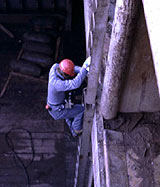
Figure 17: Worker on vertical ladder.
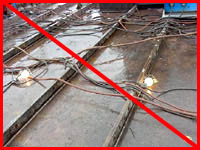 Figure 18: Improper Practice: Tripping hazards due to hoses, vessel structures and wet conditions.
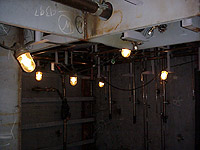
Figure 19: Enclosed space illuminated with temporary lighting. |
|
Back
to Top |
|
|
|
Fall Hazards |
Potential Hazards:
Fall hazards are a leading cause of shipyard fatalities.
Shipyard employees are often required to work in dangerous
environments that may include fall hazards. Accidents involving
elevation equipment such as ladders, scaffolds, and aerial lifts are often serious,
even fatal.
Deck Openings and Edges
- Falls from deck openings;
- Falls into open holes.
Scaffolds
- Falls from ladders;
- Falls from scaffolds;
- Falls from aerial lifts.
Requirements and Example Solutions:
Guarding of Deck Openings and Edges
- Openings and deck edges must be guarded. [29 CFR 1915.73]
- Flush manholes and other small openings must be guarded after opening. [29 CFR 1915.73(b)]
- During the installation of guards on large openings and deck edges, fall protection (harness with lanyard) must be used. [29 CFR 1915.73(d)]
- Openings must be guarded or planked when floor plates or gratings (e.g. bilges, engine rooms,
pump rooms, machinery spaces) are removed. [29 CFR 1915.73(f)]
Fall Protection for Scaffold Work
- Guardrails or other appropriate fall protection must be
used when working on scaffolds 5 feet above surfaces. [29 CFR 1915.71(j)]
- Fall protection must be used during the installation of guards on
scaffolds. [29 CFR 1915.73(d)]
- Personal fall protection (such as harness and lanyard) must be worn when working from aerial lifts.
[29 CFR 1910.67(c)(2)(v)]
- Defective ladders must not be used and must be removed immediately. [29 CFR 1915.72(a)(1)]
- Portable ladders must be secured and extend 3 feet above the landing surface. [29 CFR 1915.72(a)(3)]
- For additional information on Ladders, see the Shipyard Ladders module.
|
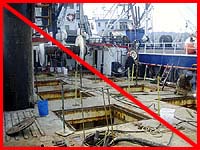
Figure 20: Improper Practice: Unguarded deck holes and openings.
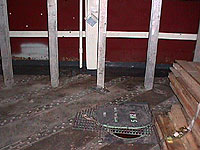
Figure 21: Open manway covered with grate and cover.
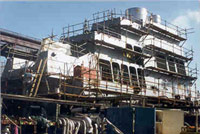
Figure 22: Scaffold edges protected by guardrails. |
|
|
Maritime
Labor/Industry Recommendations |
- Maritime Labor/Industry recommends that personal fall protection, including
lanyards and harnesses, be used and secured during installation
of guardrails, as well as scaffold erection and dismantling.
|
|
Back
to Top |
|
|
|
|
High-Pressure Hazards |
Potential Hazards:
The use of high-pressure paint equipment may expose the
operator, as well as other workers, to the following hazards:
- Contact with high-pressure painting equipment;
- Contact by uncontrolled high-pressure hoses; and
- Contact with air leaks from high-pressure equipment.
Injuries associated with these hazards include:
- Loss of body parts (e.g., fingers, hands, etc.)
- Lacerations
- Burns
- Loss of sight
Requirements and Example Solutions:
- Access to the area should be controlled.
- Avoid contact with high-pressure nozzle.
- Maintain high-pressure spray equipment according to the
manufacturer's requirements.
- Inspect hoses and connections before use.
- Use paint pots with appropriate pressure regulators/ratings.
|
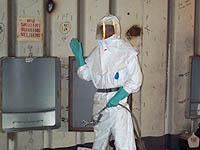
Figure 23: High pressure nozzle guarded to prevent contact with nozzle.
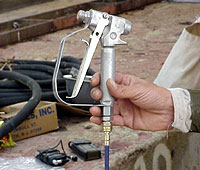
Figure 24: Inspection of high pressure spray equipment. |
|
Back
to Top |
|
|
|
Work Environment Temperature-Related Hazards |
Potential Hazards:
Environmental conditions such as temperature, humidity, and air
movement within the work area may cause hazards. A combination of PPE
use, heat-producing equipment, work activity, and environmental
conditions can cause temperature-related illnesses.
Heat-related illnesses include:
- Heat Stress
- Heat Stroke
- Heat Cramps
- Dehydration
Cold-related illnesses include:
Additional Resources:
-
OSHA Technical Manual (OTM). OSHA Directive TED 01-00-015 [TED
1-0.15A], (1999, January 20). Identifies heat stress as part of the
evaluation process in the following:
-
Heat Stress. Contains useful sections on the signs and symptoms of
heat stress, sampling methods, control suggestions, and guidelines for
investigating heat stress in the workplace.
- Occupational Heat Exposure. OSHA
Safety and Health Topics Page.
- Protecting Workers from Heat Stress [3 MB PDF, 2 pages]. OSHA QuickCard™ (Publication 3154), (2017).
|
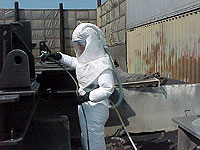 Figure 25: Full body suit can increase potential heat related illnesses for painter.
 |
|
|
Maritime
Labor/Industry Recommendations |
Example Solutions:
Maritime Labor/Industry recommends the following for heat-related
illnesses:
- Plenty of fluids
- Frequent breaks
- Ice vest
- Shaded or cooled break areas
- Ventilation
- Awareness training
Maritime Labor/Industry recommends the following for cold-related illnesses:
- Appropriate insulation (PPE)
- Warming areas for breaks
- Awareness training
|
Figure 26: Air-supplied hood reduces heat related problems when wearing full body PPE.
Figure 27: Workers being trained to recognize and avoid temperature related hazards |
|
Back
to Top |
|
|
|
|
Electrical Hazards |
Potential Hazards:
Employees who work with or around
electrical equipment have an increased risk of getting shocked or
electrocuted due to:
- Exposed energized electrical parts;
- Open lighting parts (such as broken bulbs, exposed conductors);
- Damaged insulation on power cords.
Requirements and Example Solutions:
|
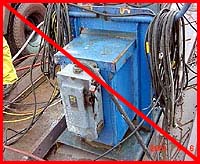
Figure 28: Faulty electrical breaker box.
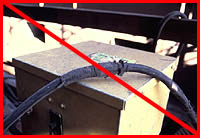
Figure 29: Damaged electrical cable.
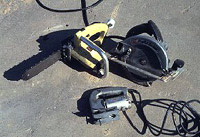 Figure 30: Portable electrical tools must be double insulated or properly grounded.
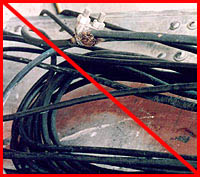
Figure 31: Improper Practice: Inspection shows uninsulated cable connection. |
|
|
Maritime
Labor/Industry Recommendations |
- All electrical tools or equipment should undergo a visual
inspection before use.
- All portable electric hand tools and temporary lighting
systems should use Ground Fault Circuit Interrupters (GFCI).
- Electrical tools and equipment should correspond with the
requirements of the job.
- Electrical equipment and tools should be used with proper
circuit protection for the voltage and amperage used.
- Only qualified electricians should attempt repair of
electrical tools and equipment.
- A Ground Assurance Program should be in place for all
electrical tools and equipment used including:
- Records of tools inspected and repaired;
- Records of electrical boxes inspected and repaired;
- Records of electrical extension cords inspected and
repaired; and
- Recall of records of the above.
- The requirements of the Ground Assurance Program should be
performed on a regular basis.
|
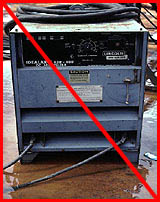
Figure 32: Inspection shows welding equipment in water. Must be corrected before use. |
|
Back
to Top |
|
|
|
|
Limited Access/Egress |
Potential Hazards:
When working in confined or enclosed spaces, workers may become
trapped and unable to exit due to:
- Improperly located equipment blocking egress.
- Ventilation ducts and hoses running through an opening blocking
egress.
Requirements and Example Solutions:
- When employees work in confined spaces with limited access, the
access must not be blocked or impeded by ventilation ducts, hoses,
or other equipment. [29 CFR 1915.76(b)(2)]
- More than one means of access must be provided where practical. [29 CFR 1915.76(b)(1)]
- Additional openings should be provided for ducts, hoses, and other
equipment.
|
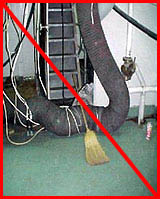
Figure 33: Improper Practice: Ventilation hose obstructing exit.
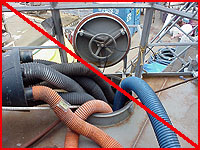 Figure 34: Improper Practice: Ventilation hoses blocking exit from opening.
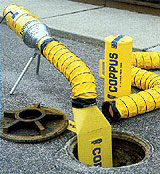
Figure 35: Special ventilation hose (flat), to avoid blocking exit.
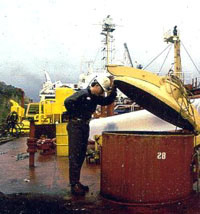
Figure 36: Two access holes for equipment or access. |
|
Back
to Top |
|
|
|